India is not only a land of
religion, superstition and blind beliefs, but also atheism, rationalism,
humanism, skepticism and agnostics. It is a land of enlightenment,
philosophical quest for truth and practical application of (rationalistic) principles
for common good…..
Dr. G. Vijayam
one will wonder whether it is really true, since we all the while see only the
degradation of humanism and glorification of irrationalism all around us. However
Johannes Quack, who is academically qualified in Religious Studies, Philosophy
and Anthropology and is currently a research fellow at McGill
University, Montréal, had
painstakingly documented various aspects of rationalism as practiced in India by traveling the length and breadth in India. During
his travel he met many contemporary rationalists and recorded their views about
rationalism. In fact he was in search of an organization which has practical
approach towards rationalism. By chance he attended a seminar of Federation of
Rationalist Associations in India
hosted by Maharashtra Andhashraddha Nirmoolan Samiti, ANS
(the author however, addresses ANS
as ANiS throughout the book) and chose ANS
as his field work for his research thesis. While interviewing the rationalists
in various part of India
and describing their views on rationalism in general, he spent more time with ANS activists to record their views in particular.
The book, Disenchanting India: Organized
Rationalism and Criticism of Religion in India, is the result of his
studies, observations and experiences. During the ethnographic fieldwork on the
aims and activities of ANS, he
accompanied teams at actual sites, and observed critically the activities like
miracle bursting, poster exhibitions, lectures and debates, street plays etc
during public performances conducted in the villages, schools and colleges.
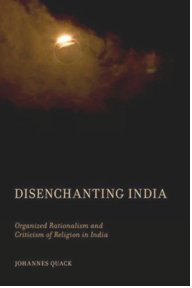 This book is not like any other
promotional material with gorgeous titles like Incredible India, Emerging
India, Fascinating India Shining India etc. The essential content of this book
is about the Indian rationalist, atheist, humanist, and freethinkers’ movement.
The prevailing rationalist movements in India are explicitly intent to
challenge belief in supernatural powers of irrational efficacy as practiced by
charismatic gurus even in this age of advanced science and technology. All
these rationalist movements have aimed to show a way out of their enchanted –
imaginative world towards a rational and this worldly way of life in spite of
most of them are preoccupied with religion, spirituality, magic and miracles.
In this connection the rationalists stress upon that there has always been
rationalism and criticism of religion through out the historical period of India. The main
advocates were Charvakas, Lokayatas, Basaveshwar, Sant Kabir, Sant Tukaram,
Raja Ram Mohan Roy, Mahatma Phule, Pandita Ramabai, Agarkar, Maharshi
Karve, Raghunath Karve, Periyar E.V.
Ramasami, M.N. Roy, Gora, Dr. Ambedkar , Abraham Kovoor etc.
is a published doctoral thesis of the author’s research work. The author calls
his research as ‘multisited’ ethnography. In classical research, researchers
generally limit their efforts to interviews, attending seminars, studying
related documents, collecting the inputs by circulating the questionnaire,
visiting the places and videotaping etc. But this researcher in addition to
these methodologies of research gets involved with the organization by
critically studying and spending as much time as possible with the activists to
get feel and insight of the organization under study. He critically assesses
the aims and goals, actions and thinking, structure and set up, profile and
agenda, interpretation of rationalism and ideas about way of life by field
activists and intellectuals of the organization to corroborate his findings.
His critical assessment of ANS can
be summed up as a ‘Social Audit’.
about the Indian Rationalists of the past era which has been based upon sparse
literature available on this topic. The author tries to explain the notion of
‘mode of disbelief’ and its relationship to the notion of ‘mode of
religiosity’. In this regard, author elaborates the concepts of ‘rationality’,
‘irrationalism’ and ‘rationalization’ as employed by various Western
philosophers and compares these concepts in Indian context. For some,
rationalism means to fight for justice and equality, to avoid violence and to
try to find the truth. For a few, rationalism is that philosophy of life which
is based upon the reasoning faculty of a person. That may be the one of the
reasons why Indian rationalists call themselves as buddhivaadi, vivekvaadi, tarkikvaadi,
yuktivaadi, etc even manavataavaadi too. This difference appears to be related
to the stand that has been taken by the individual in terms of religion,
existence/non-existence of God, etc. For example, humanists are simply atheists
who believe in living purposeful and moral lives. As such rationalists want to link humanism,
rationalism, atheism, science and technology, the scientific temper and power
of reason in order to live a contented life, emotionally and physically. While
concluding theoretical aspects of rationalism, author quotes Max Weber and
Charles Taylor extensively.
roots of organized rationalism in India by quoting Charvaka and Vedic
materialism. He also describes Bhakti movement spread by saints like
Basaveshwar, Kabir, Tukaram etc who questioned the blind traditions practiced
during that period. In fact these saints attacked the superstitions prevailing
in the society. However, rationalism in strictest sense only appeared during
colonial period where western philosophers like Ingersoll, Bradlaugh, and
Bertrand Russell etc started dominating the minds of the intellectuals who
studied English language and were exposed to western culture. Agarkar, Mahatma
Phule, Periyar E. V. Ramasamy etc were the founders of the organized
rationalism in India
in later half of 19th century. In fact, these movements can be termed as
religious reform movements to contextualize the emergence of rationalism.
various Rationalist organizations which were set up in places like Delhi, Hyderabad, Nagpur, Bombay, Vijaywada,
Bhilai, Rourkela, Madras, Coimbatore,
Kanyakumari, Madurai,
Amrutsar etc. by well educated Indian intellectuals with strong affinities to
Western education and culture. Jawaharlal Nehru, M.N. Roy etc contributed for
the growth of rationalism in India.
Atheist Centre, founded in 1940 by Gora appears to be the milestone in
practical rationalism. R.D. Karve and his colleagues wrote extensively on
various aspects of rationalism in their ‘Reason’ magazine in spite of
opposition from the society and rulers. These organizations started challenging
Gurus and ‘Godmen’ like Sathya Saibaba.
Dr. H. Narasimhaiah and Abraham Kovoor tried their best to convince the society
the fraudulent activities of Saibaba and were exposing his supernatural powers.
However most of the rationalists confined their activities by writing the
articles in the newspapers and magazine and participating in the public
debates. Abraham Kovoor gave momentum to the existing organizations by his
miracle-exposure campaigns. Kovoor was quite famous for his rhetoric and was
able to entertain and fascinate large groups of people by giving lecture-cum-
demonstrations and exposing the tricks of the ‘Godmen’. Shri B. Premanand of
Kerala took over the task of exposure of Godmen and he toured extensively to
spread the message. There was tremendous response to his lectures from the
public and he inspired many youths of post independent India.
covers various aspects of ANS
which was chosen as field work for author’s research. Author had given
ethnographical account of ANS in
detail. He had described in detail the ANS
activities like spreading scientific temper, campaign against superstitions,
exposure of Godmen, efforts to enact the anti-superstition bill, magazines and
literature published by ANS, etc. While
accompanying the group of ANS
activists for a tour around Maharashtra,
author was very curious about ANS and wanted to see it for himself. He wanted
to know how do people react when ANS
activists enter remote villages; how does ANS
attempt to convince the people that some of the beliefs and events so central
to their everyday lives are harmful, pathological, based on illusions or made
up by people who fool and exploit them in the name of religion, traditions or
rituals; do people oppose the statements, or do they ignore them or are they converted. He observes that ANS activists always try to relate to the
perspectives of villagers, children and college students and try to involve
them in their programs through games, tricks, songs and other interactive elements.
The programs chosen are very simple in nature and lively to participate. He
concludes that the didactical methods applied are of a rather higher level.
never shied away from challenging and provoking the gods, deities and spirits,
ridiculing the people capable of controlling black magic and deliberately doing
the most inauspicious things. In fact the programs which are of interactive in
nature coerce the listeners to participate and change the attitude. Through
theses participations, activists try to invoke the spirit of inquiry within
them. Author had gone in detail to bring out the strengths and weaknesses of ANS which appears to be quite truthful and
unbiased. Author raises a question
whether or not rationalism is to be understood as directly opposing religion,
since ANS has taken a moderate and
rather unspecific position in this regard. ANS
related harmful religious practices with that of superstitions and advocates
scientific temper as the remedy for these age-old ills.
interpretations and applications of rationalism in day-to-day life, author
approached many activists to extract the information. He tried to find how the
rationalistic attitude is applicable in family relations, marriages, festivals,
births, and deaths etc. Surprisingly he found varied opinions in these matters.
In fact, ANS activists believe
that the fight against irrationality and the fight against injustice are one
and the same. However author has praised non-religious marriage ceremonies and
non religious ways of dealing with death as advocated by ANS.
is of the opinion that Indian rationalisms are in the process of trying to
disenchant Indian public – that everything in the world is, in principle,
explicable (by science) without any reference to supernatural entities (like
religion, spirituality and miracles). He takes an overview of the world
rationalistic movements and tries analysis of them in Indian context. In fact
rationalism has come very long way in various descriptions like Agnostics,
Atheists, Brights, Clandestine, Freethinkers, (Secular) Humanists, Infidels,
Secularists, liberals, etc. He concludes
that Indian Rationalist Movement can be seen as a part of a longer transnational
movement.
book by Prof. Frederick Smith of University Iowa,
Johannes Quack has ventured into new territory in his close study of the Indian
Rationalist Movement particularly its manifestations in early twenty-first
century Maharashtra. He has combined
ethnographic analysis, social theory, and a deep knowledge of Indian history
with reflections on secularism, religious belief, rationality enhancement, and
disenchantment, the result is a vivid depiction of India
in the throes of modernity, in which class, gender, nationalism, and
ideological and discursive strategy are contesting for the very future of India. This
excellent volume must be examined by anyone interested in modern and
contemporary India
because it addresses in a most illuminating way a desperately understudied
topic.
Press, 2012, pp 362
editor of Thought and Action, a journal published by Maharashtra Andhashraddha
Nirmoolan Samiti (ANS)
Leave a Reply