Ramkrishna Bhattacharya
“Why do you study ancient philosophy?”
800×600
Normal
0
false
false
false
EN-IN
X-NONE
ML
MicrosoftInternetExplorer4
/* Style Definitions */
table.MsoNormalTable
{mso-style-name:”Table Normal”;
mso-tstyle-rowband-size:0;
mso-tstyle-colband-size:0;
mso-style-noshow:yes;
mso-style-priority:99;
mso-style-parent:””;
mso-padding-alt:0cm 5.4pt 0cm 5.4pt;
mso-para-margin:0cm;
mso-para-margin-bottom:.0001pt;
mso-pagination:widow-orphan;
font-size:10.0pt;
font-family:”Calibri”,”sans-serif”;}
1 Such an answer, however, will not satisfy everybody.Yet the answer is perfectly valid. ’The first
philosophers’ (as George Thomson called the Presocratics) succeeded in making
the final break with mythology; by turning themselves into physiologoi, observers of nature ‘as it is
without alien addition’ (Engels 198) they laid the basis of the scientific
method. Benjamin Farrington noted that they were more than mere observers of
nature: ‘The novelty of their modes of thought is only negatively explained by
the rejection of mystical or supernatural intervention. It is its positive
content that is decisive.’ (41)
800×600
Normal
0
false
false
false
EN-IN
X-NONE
ML
MicrosoftInternetExplorer4
/* Style Definitions */
table.MsoNormalTable
{mso-style-name:”Table Normal”;
mso-tstyle-rowband-size:0;
mso-tstyle-colband-size:0;
mso-style-noshow:yes;
mso-style-priority:99;
mso-style-parent:””;
mso-padding-alt:0cm 5.4pt 0cm 5.4pt;
mso-para-margin:0cm;
mso-para-margin-bottom:.0001pt;
mso-pagination:widow-orphan;
font-size:10.0pt;
font-family:”Calibri”,”sans-serif”;}
Indian materialists. They too rejected any preternatural creator and asserted
that consciousness arises out of matter, not the other way round.
are of importance even now:
‘Greek thought, for historical reasons,
underlies that of later ages, and particularly the theories of modern science,
social as well as natural. We cannot think rationally except along the lines
the first philosophers laid down for us; most often we think in the very words
they first invented.’ (22)
philosophy is particularly important for the Marxists:
To a Marxist these are by no means just far
away and long ago events to be studied for their intrinsic interest alone. They
are part of the struggle of today and tomorrow. Marx himself wrote his doctoral
thesis on the atomic philosophy of Democritus and Epicurus; Engels, notably in
The Origin of the Family, discusses the social origins of the Greeks. Just
because reaction is still able to use ideological weapons forged in defence of
privilege in Ancient Greece, there is all the more reason to examine how and
why this was done and to show the contrasting ideology which is arising in the
making of a classless society. (22)
 |
| JD Bernal |
Defenders of the existing forms of class
society indeed often refer back to the glorious past of India and highlight
only a part of it. They tacitly deny the existence of classes in ancient
civilizations and speak of the idealist systems of philosophy as the greatest
achievement of human speculation. Greece produced Plato, India produced
Sankaracarya: they are projected as infallible guides for all times. Many
people fall prey to such propaganda. Generations of scholars too have joined in
reasserting this claim. If a challenge is to be thrown to them, one must learn
what the other side of the shield was like, and explain why the other side had
not been brought to light.
philosophy cultivated in India through the ages? Was there no dissident voice
at any point of time? It is not enough to conjecture that there must have been
anti-idealists and anti-fideists in India. Concrete evidence would have to be
produced to establish any counter claim. One can always assert that any view
about the world is bound to produce its opposite: as early materialism was
followed by idealism, latter-day idealism begot materialism anew. Such an
assertion, however logical and convincing it may sound, needs empirical
evidence to support it. All the evidence may not be available on the surface;
they have to be unearthed.
It may lead to another sort of glorification of the past. Farrington cautioned
long ago:
There is great danger, in discussing these
old thinkers, that one may read into them the meaning of a later age. It must
always be remembered that they were ignorant of all the accumulated knowledge
of modern science and all the refinement of ideas that centuries of
philosophical discussion had produced. In the world of thought, as in the world
of nature, everything flows.2 The very words with which we translate the
sayings of Heraclitus are charged with meanings unknown to him. It takes an
effort of historical research and of historical imagination to put oneself back
into the frame of mind of this great thinker when he supposed himself to have solved
the riddle of the universe by saying that there was a tension in things, ‘like
the bow and the lyre’. (41)
Kanada, the founder of Vaiseshika atomism, and even of the Carvakas who were
the last school of materialists in India. Hence a balanced view regarding the
ancients, giving praise where it is due and keeping in mind the shortcomings
that inevitably accompanied their achievements, is to be studiously maintained.
The same approach would apply to the moderns as well. Notwithstanding the
inroads they have made and are making, posterity will also judge them in the
same way, acknowledging their credits but, at the same time, noting what they missed.
how Frederick Engels assessed the value of ancient philosophers. After dealing
with the new strides made in the fields of geology, physics, chemistry and
biology, Engels concluded:
Thus we have once again returned to the
mode of outlook of the great founders of Greek philosophy, the view that the
whole of nature, from the smallest element to the greatest, from grains of sand
to suns, from Protista to man, has its existence in eternal coming into being
and passing away, in ceaseless flux, in unresting motion and change. (30-31)
Only with the essential difference that
what in the case of the Greeks was a brilliant intuition, is in our case the
result of strictly scientific research in accordance with experience, and hence
also it emerges in a much more definite and clear form. (31. Italics mine.)
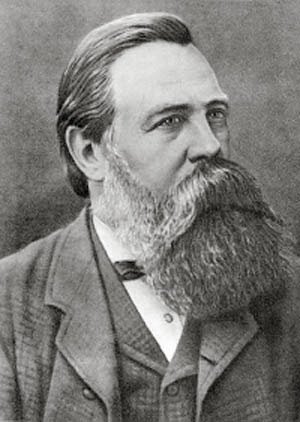 |
| Frederick Engels |
Does it mean that the nineteenth-century
scientists had solved the whole mystery of nature and left nothing for their
successors to explore? Engels was modest enough to admit that ‘empirical proof
of this cyclical course’ is still not
free from gaps,’ but said in defence that ‘these are insignificant in
comparison with what has already been firmly established, and with each year
they become more and more filled up.’ (31)
that the most important branches of science ‘have a scientific existence of
barely a century, and the comparative method in physiology, one of barely fifty
years, and that the basic form of almost all organic development, the cell, is
a discovery not yet forty years old’ (31).
raised at the beginning of this essay. Engels provides an answer that concerns
empirical natural science vis-à-vis philosophy:
Empirical natural science has accumulated
such a tremendous mass of positive material for knowledge that the necessity of
classifying it in each separate field of investigation systematically and in
accordance with its inner inter-connection has become absolutely imperative. It
is becoming equally imperative to bring the individual spheres of knowledge
into the correct connection with one another. In doing so, however, natural
science enters the field of theory and here the methods of empiricism will not
work, here only theoretical thinking can be of assistance. (42. Italics mine.)
with Marxism, such a statement may appear to be somewhat unexpected. But Engels
did emphasize the importance of ‘theory’ without any reservation. What he says
next may appear equally startling to some:
But theoretical thinking is an innate
quality only as regards natural capacity. This natural capacity must be
developed, improved, and for its improvement there is as yet no other means
than the study of previous philosophy. (42-43. Italics mine.)
in the study of modern science? Engels the dialectician explains the matter
lucidly:
In every epoch, and therefore also in ours,
theoretical thought is a historical product, which at different times assumes
very different forms and, therewith, very different contents. The science of
thought is therefore, like every other, a historical science, the science of
the historical development of human thought. And this is of importance for the
practical application of thought in empirical fields. … Formal logic itself has
been the arena of violent controversy from the time of Aristotle to the present
day. And dialectics has so far been fairly closely investigated by only two
thinkers, Aristotle and Hegel. (43. Italics mine.)
present-day world? Engels puts his finger on what has come to be known as the
philosophy of science:
But it is precisely dialectics that
constitute the most important form of thinking for present-day natural science,
for it alone offers the analogue for, and thereby the methods of, explaining
the evolutionary processes occurring in nature, inter-connection in general,
and transitions from one field of investigation to another. (43)
acquaintance of modern natural scientists with the history of philosophy. It
has caused great harm to the advancement of knowledge. Moreover, what is now
claimed to be something new may, historically speaking, not be true: in very
many cases old wisdom has reappeared in a new garb. But modern scientists were
not aware of it. Engels mentions a specific case:
Since physics and chemistry once more
operate almost exclusively with molecules and atoms, the atomic philosophy of
ancient Greece has of necessity come to the fore again. But how superficially
it is treated even by the best of natural scientists! Thus Kekulé tells us …
that Democritus, instead of Leucippus, originated it, and he maintains that
Dalton was the first to assume the existence of qualitatively different
elementary atoms, and was the first to ascribe to them different weights
characteristic of different elements. Yet anyone can read in Diogenes Laertius
… that already Epicurus had ascribed to atoms differences not only of magnitude
and form, but also of weight, that is, he was already acquainted in his own way
with atomic weight and atomic volume. (44. Italics in the original.)
of the Greeks in considerable detail (302-14). But he makes an important
reservation regarding the ‘atomist cosmology’:
The resemblance of the atomic theory of
Demokritos and Epicurus to the atomic theory of modern physics is superficially
so striking that we are tempted to regard the work of those philosophers as
scientific. This is a mistake. Ancient atomism is not science but ideology. It
is, no less than Parmenidean monism and Platonic idealism, an exercise of pure
reason ‘reflecting the structure of the society in which it was generated. (312.
Italics mine.)
scientist, however, looks at the matter in a different way. He concurs with
Thomson’s formulation that ‘the truth of the matter is, not that these ancient
Greeks anticipated the results of modern science, but that modern scientists
have succeeded in reaffirming certain fundamental but forgotten truths and
establishing them securely on the basis of experimental proof’ (Thomson 162).
Nevertheless Bernal insists:
But this is only part of the story. Those
truths would never have been reaffirmed, never indeed examined but for the form
in which their first statement was made, a form clear enough to be grasped,
tested, rejected, and improved upon. The Greeks were supreme as model builders.
Even if the models came from clan organization they are the linear ancestors of
our modern scientific concepts. The atom of today is not a rediscovery, it is
the original Democritan atom, hard, massy, impenetrable, that was recovered by
Gassendi and passed through Newton to Rutherford. (31. Italics mine.)
Engels’s emphasis on the importance of theoretical thought, which is no less
important than empirical research. Why is it so? The following observation made
by Engels is therefore worth pondering:
The fact that our subjective thought and
the objective world are subject to the same laws, and hence, too, that in the
final analysis they cannot contradict each other in their results, but must
coincide, governs absolutely our whole theoretical thought. It is the
unconscious and unconditional premise for theoretical thought. (266)
teach us even today, for much of it was grounded in sound theoretical thought.
Notes
reply to the question, ‘Why did you want to climb Mount Everest?’ Reported in
an article published in the New York Times, 18.3.1923.
rhei), it is now more or less certain, is not one of Heraclitus’ sayings nor
has it survived as a quotation from his works (all lost). Simplicius
(c.496-560), a neoplatonist, first refers to it. Plato (Cratylus 401d and
402a), however, uses a different verb: ‘Everything moves’ (panta chorei).
and it is tempting to compare it with the Buddhist doctrine of impermanence
(kshanabhanga).
at the end of the passage quoted above, however, is an authentic Heraclitean
saying (Fragment 51 (Diels)). See Barnes, 65-66 and Freeman, 28.
Works Cited
London and New York: Routledge & Kegan Paul, 1986.
Mainstream (USA), 10:6, 1957, 22-31. (A review of the US edition of George
Thomson’s The First Philosophers published by International Publishers, New
York).
Moscow: Progress Publishers, 1982 (Strictly speaking, not a ‘book’, but the
edited version of four folders consisting of unfinished drafts. Published
posthumously from the USSR in 1925).
Meaning for Us. Harmondsworth: Penguin Books, 1966.
Pre-Socratic Philosophers. Oxford: Basil Blackwell, 1962.
(Studies in Ancient Greek Society, vol. 2). London: Lawrence & Wishart,
1955.
Sunish Kumar Deb
Normal
0
false
false
false
EN-IN
X-NONE
ML
/* Style Definitions */
table.MsoNormalTable
{mso-style-name:”Table Normal”;
mso-tstyle-rowband-size:0;
mso-tstyle-colband-size:0;
mso-style-noshow:yes;
mso-style-priority:99;
mso-style-parent:””;
mso-padding-alt:0cm 5.4pt 0cm 5.4pt;
mso-para-margin-top:0cm;
mso-para-margin-right:0cm;
mso-para-margin-bottom:10.0pt;
mso-para-margin-left:0cm;
line-height:115%;
mso-pagination:widow-orphan;
font-size:11.0pt;
font-family:”Calibri”,”sans-serif”;
mso-ascii-font-family:Calibri;
mso-ascii-theme-font:minor-latin;
mso-hansi-font-family:Calibri;
mso-hansi-theme-font:minor-latin;
mso-fareast-language:EN-US;
mso-bidi-language:AR-SA;}
essay first appeared in Psyche and Society, Volume 11, No.1, May 2013. The original title of the essay was ‘Why
Do You Study Ancient Philosophy?’
Leave a Reply