 The whole fiasco of Salman Rushdie not coming to Jaipur Literary Festival, JLF, (Jan 2012) has been a great shame on Indian democracy. With the news that Salman Rushdie will be coming to JLF, Deoband seminary issued a protest against Rushdie’s coming to India to attend the same. This was due to the underlying understanding about the derogatory references to Prophet Mohammad by Rushdie’s in his novel Satanic Verses. As such Rushdie being an India born person has the right to come to the country without any VISA, and has been coming to India off and on. This time around it became a major issue in the public sphere and the conservative Muslim groups took up the issue in a strong way. There were many an associated things, Rushdie dropping his trip on the ground that there is an intelligence report that assassins have been dispatched to kill him. There are claims that this was a hoax deliberately planted to dissuade him from coming. Then, the few authors read non offensive extracts from Satanic Verses and were prevented from doing so by the organizers in the face of the strong protest from a group of conservative Muslims.
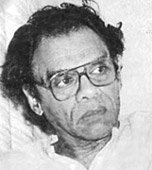 |
| AK Ramanujan |
In India, the things are much worse. In the aftermath of Partition, the seeds of communal hatred sowed by the communal organizations, Muslim League, Hindu Mahasabha-RSS, have led to the mind set which triggered communal violence, which came back strongly in post Independence India. In this communal violence, 90% victims are Muslims, while they are 13.4% in population. The series of violence going from riots to carnage, to pogrom has created an atmosphere of gross insecurity amongst the Muslims. This insecurity is the fertile ground on which the fundamentalists find the merry hunting ground. Salman Rushdie tells us that Satanic Verses is not banned in Egypt, Turkey and has been unbanned in post revolution Libya. There is a complex interplay between the global factors leading to Muslim insecurity and the local condition of Muslims, where they face the violence from majoritarian political groups operating in the name of religion. The physical insecurity amongst minorities leads to the situation where identity related issues become more important. This in turn leads to the influence of Mullahs, conservative world view and intolerance to others’ views.
 |
| Sculptures at Khajuraho |
The impact of majoritarian politics in the name of religion has a different dynamics. It creates a feeling of insecurity amongst large sections of majority by projecting the imaginary fear of minorities. In India this has been the handiwork of Hindutva politics. The politics of Hindutva, which resurfaced in the decades of 1980s, is built around the existential anxiety of upper caste/class in the face of social and political changes leading to the entry of downtrodden dalits and women in to the social space. The affluent-upper caste groups, in order to preserve their social-economic privileges hark upon identity politics, the like of Ram Janmbhumi movement-holy cow etc
The agenda of identity politics-politics in the name of religion, any religion for that matter, is to suppress the process of transformation of social equations of caste and gender. This politics of identity projects the ‘outside’ enemy in the form of minorities. The minorities are projected as the threat for majority and so the conservative mind set comes up. So in the country of Konark and Khajuraho, M.F. Husain’s old paintings of nude goddesses are ‘discovered’ and his exhibitions are rampaged. In the country where infinite versions of lord Ram story prevail, a Sahmat exhibition showing the Buddhist Jataka version is attacked, and Ramanujan’s celebrated essay, scientifically telling about diverse versions of Lord Ram story, is made to be withdrawn. This is another threat to freedom of expression, which does not come under as much criticism.
| Bharat Mata of MF Hussain |
Both, majority and minority fundamentalisms are prevailing in the country; both these fundamentalisms attack the freedom of expression and liberal thought. They are regressive; still their etiology is very different. Amongst minorities the insecurity is the expression of defensive ‘turtle’ psychology while the fundamentalism from the majoritarian groups is expression of offensive agenda and it comes from its projecting the minorities as the threat to majority. No fundamentalism is good, they have their own dangers. The one from minority groups has many times been very visible as in Shah Bano case or in the present one in Rushdie case. The other from, the majoritiarian groups sometimes aggressive; sometimes subtle has much different potential. It aims to abolish democracy and bring in a fundamentalist regime. While taking the government to the task on Rushdie fiasco, one also needs to look beyond and realize that ‘physical insecurity’ (minorities) and ‘constructed insecurity’ (majoritarian politics) are the breeding ground for the intolerance. While recapitulating the Rushdie affair one also needs to keep in mind the aggressive agendas of a politics which cannot tolerate a Ramanujan or a Husain.
Leave a Reply