⚠️
SEVERE HEALTH & CHEMICAL TOXICITY HAZARDS
This demonstration involves highly hazardous chemical agents and poses extreme biological risks. It must NEVER be performed outside a certified laboratory environment:
- Severe Mercury Toxicity: Soluble mercury salts (e.g., mercurous nitrate) and elemental amalgams are potent neurotoxins. They readily penetrate skin membranes, leading to rapid bioaccumulation, central nervous system degradation, and irreversible renal failure.
- Toxic Particulate Inhalation: The reaction residue and aluminum oxide ash remain heavily contaminated with elemental mercury vapor and fine particulate toxins. Inhaling or handling these airborne byproducts carries long-term neurological toxicity hazards.
The Ritual
Ascetics and tantriks often distribute “sacred” amulets to devotees, claiming that these charms possess miraculous powers that generate heat and spontaneously produce holy ash (vibhuti).

The Experiment
- Effect: An amulet becomes hot and produces holy ash inside a devotee’s hand.
- Materials: A copper amulet, emery paper, a solution of mercurous nitrate, a soft polishing cloth, and aluminum foil.
- Method: Clean the copper amulet thoroughly with emery paper to remove surface oxidation, then dip it into the mercurous nitrate solution. Polish the amulet with a soft cloth; the mercury reaction leaves a thin metallic coating that makes the copper resemble silver. When the prepared amulet is wrapped tightly in aluminum foil, an exothermic chemical reaction occurs. The foil rapidly oxidizes, generating noticeable heat and breaking down into a fine gray powder that resembles sacred ash.
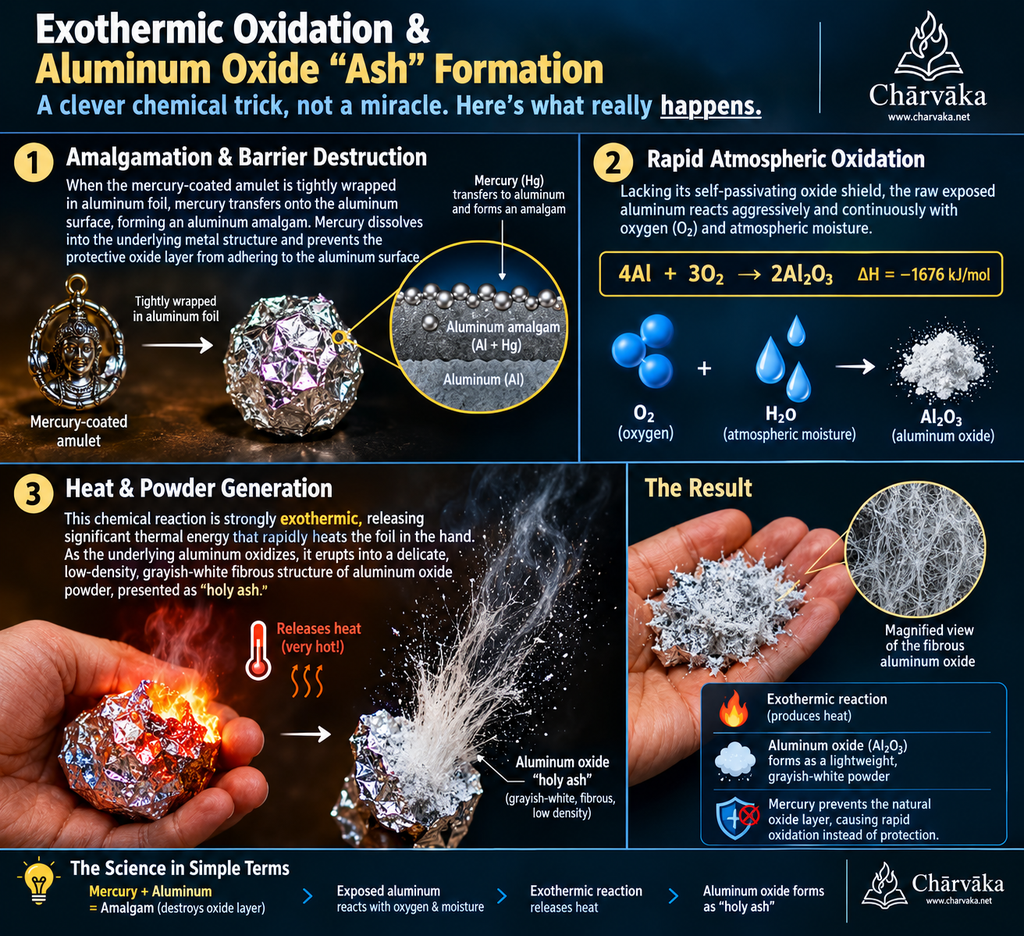
The Science Behind the Illusion
1. Redox Displacement & Amalgamation
The visual illusion and chemical transformation rely on two distinct chemical processes involving single displacement and amalgam formation:
- Chemical Silvering (Single Displacement): Copper sits higher in the activity series relative to mercury. When elemental copper is submerged in a mercurous nitrate [Hg2(NO3)2] solution, a redox reaction occurs: copper oxidizes to Cu2+ ions while mercury ions are reduced to elemental liquid mercury metal (Hg). This mercury instantly deposits onto the copper surface, creating a silver-colored copper-mercury amalgam layer.
- Passivation Layer Removal: Under ambient conditions, aluminum metal spontaneously forms a microscopic, highly stable, non-porous layer of aluminum oxide (Al2O3). This passivation film acts as a protective barrier, preventing raw aluminum from reacting rapidly with oxygen and moisture.
2. Exothermic Oxidation & Aluminum Oxide “Ash” Formation
- Amalgamation & Barrier Destruction: When the mercury-coated amulet is tightly wrapped in aluminum foil, mercury transfers onto the aluminum surface, forming an aluminum amalgam. Mercury dissolves into the underlying metal structure and prevents the protective oxide layer from adhering to the aluminum surface.
- Rapid Atmospheric Oxidation: Lacking its self-passivating oxide shield, the raw exposed aluminum reacts aggressively and continuously with oxygen (O2) and atmospheric moisture:
4Al + 3O2 → 2Al2O3 ΔH = −1676 kJ/mol
- Heat & Powder Generation: This chemical reaction is strongly exothermic, releasing significant thermal energy that rapidly heats the foil in the hand. As the underlying aluminum oxidizes, it erupts into a delicate, low-density, grayish-white fibrous structure of aluminum oxide powder, presented as “holy ash.”
3. Severe Health & Chemical Toxicity Hazards
This demonstration involves hazardous chemical agents and poses extreme safety risks:
- Severe Mercury Toxicity: Soluble mercury salts like mercurous nitrate and elemental mercury amalgams are potent neurotoxins. They readily penetrate skin membranes, causing severe accumulation in biological tissues, central nervous system damage, and renal failure.
- Toxic Particulate Inhalation: The gray aluminum oxide residue generated by this reaction remains heavily contaminated with trace elemental mercury and mercury vapor. Inhaling or handling this ash poses severe long-term toxicity hazards.
Leave a Reply