only by breaking every kind of bondage that mankind has been
subjected to in the course of the evolution of society through
different social formations. Emancipation has its philosophers even
as oppression has its agents and defenders. Marx as the most
thoroughgoing scientific analyst of society has also indicated that
the roots of religion are essentially earthly and hence the tent of
heaven cannot be pulled down by remaining in the clouds. From the
point of view of the emancipation seekers, therefore, Marx is the
most profound philosopher and guide. In the specific context of
Indian philosophy and class struggles the Bhagavad-Gita has
been the most formidable weapon for the ruling classes and
remains a significant document to be countered by Marxism whose
polaric opposite the Bhagavad-Gita is.
of the philosophy of the oppressors and the Bhagavad-Gita
abounds in such apparently invincible final truths. That
irrelevancies hardly bother the hardcore votaries of’ idealism
is amply illustrated by the method and design of the Bhagavad-Gita.
A more pernicious text in the field of Indian philosophy is almost
impossible to come by. Such is, the character of this text in the
range of Indian religion.
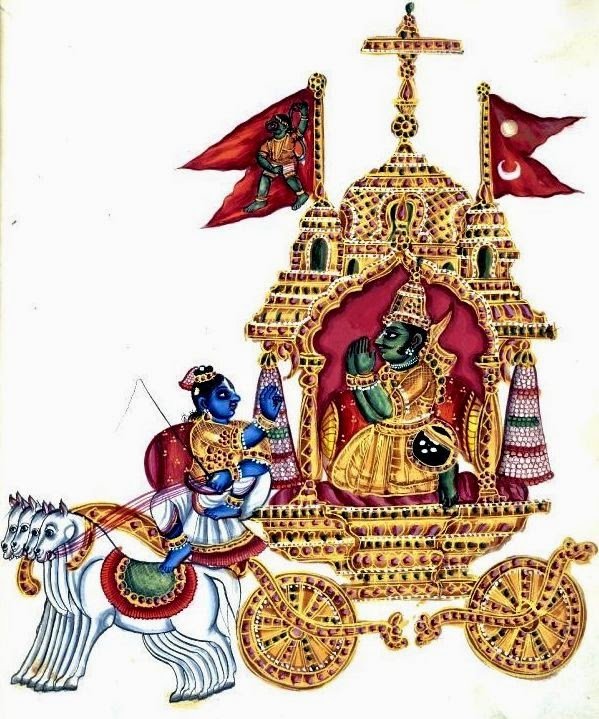 |
| Krishna and Arjuna at Kurukshetra, c. 1830 painting Courtesy: Wikimedia |

The most unalloyed idealistic merchandise is made to appear quite
glittering and glamorous by the author of the Gita who is the
most sophisticated janitor that the ruling classes have found among,
the intellectual justifiers of the horrors of oppression and crime.
Milton wrote the epic Paradise Lost to justify the ways
of god to man. The most, powerful shield that the ruling classes has
possessed in history is the mood of acceptance among the masses, for,
if an idea that grips the minds of the masses is a material force, it
does not really matter whether it is the idea of submission or revolt
that so grips the minds; each will have its own hold on the minds and
also act as the motivating force for further action or inaction, as
the case may be. The clever rationaliser, that the author of the
Gita is, induces inaction. Paradoxically enough, this message
of inaction is couched in the language of dynamic action in the Gita.
Even some scholars devoted to dialectical and historical materialism
have averred at times that the impact of the Gita is
fundamentally that the lethargic and astounded Arjuna was made a
violent resister, and so on. But all this facile deduction may be
tantalizing as a rhapsody only for those who like to excel the
falsifiers of philosophy by adding their own contribution to the act
of falsification.
various angles mainly because different shades of opinion are usually
reflected in these treatises. The Veda and Upanisads
belong to this category. The Veda and Upanisads are not
texts with a single track, and a blind tract at that. Phases of the
changing society are recognizable therein. The dialogues among the
philosophers of the Upanisads are not the despair of a
scientific socialist for the simple reason that those philosophers
consciously admit the possibility of the materialist point of view as
a basic for discussion. The Buddhist texts and texts of later
philosophical schools, especially the latter, may take pains to
discredit materialism, but they don’t dismiss it offhandedly and
abrasively. That is the extraordinary prerogative the Gita
enjoys.
in the sphere of philosophy and it is his specialty that he gives
fine finishing touches to a sordid philosophical junk. Take an
average teacher of Indian philosophy in an Indian university of
today. Chances are that he is blissfully ignorant of the dichotomy
between idealism and materialism in the stream of philosophical
disquisition through the ages even in India. He is the ‘justifier’
& ‘rationliser’ of the system for which idealism is the
typical philosophy. An enlightened observer of our society today
cannot miss what the professor of philosophy so schemingly misses.
And that is why he is the official spokesman. To put it rather
bluntly, a painstaking journalist is more relevant and useful than
such an official spokesman. In the context of the professor of
philosophy, namely the author of the Gita, it is necessary to
look for the enlightened journalist of the period to which the Gita
belongs so that the distortions and manipulations of the official
spokesman may be recognized.
author of the Gita in so far as they present their crude
formulae about social structure and social stratification without any
inhibitions. They are mercenaries straight and simple. Their spots
are thus easy to discover and guard against. But the polished tongue
of the author of the Gita conceals the venomous trick that he
is out to perform in favour of his masters. His armoury of wisecracks
provides the smokescreen for the vicious role that he has chosen to
play as the voice of the oppressing class. Howe else can we
understand the Gita’s enunciation of the caste system as
divine ordinance, but based on ‘guna’ and ‘karma’,
as opposed to the brazen-faced declaration of the Dharmasastrakaras
that it is a division entirely based on the criterion of birth?
Practice is the litmus test for ascertaining the credibility of these
differing claims of the Gita and the law-givers; that the law-givers
are nearer the truth is obvious. Still, the Gita speaks of the
ennobling criterion and gives the padding of svadharme nidhanam
sreyash, etc.
is the best part of the Gita as that is the only scientific part of
it. The forceful and inevitable questions that the supposedly
panic-stricken Arjuna raises are the questions of a responsible
sociologist. The next seventeen chapters are the answers of a windbag
in that nowhere do we find the least evidence that the author has any
sensible answers to the fundamental questions raised in the first
chapter. The questions are real and they cannot be ignored by the
philosophers of the ruling class. His answer, however, is full of
rationalizations and obscurantism. This can well be demonstrated:
concern for his fellowmen. He was frustrated with thoughts of
destruction. It was ethical consciousness which pervaded the mind of
Arjuna (1.36). There was, of course, also a sense of egoism,
presumptuousness and arrogance in him when he, together with his
preceptor, described himself as the illumined (1.39). But the main
question was: Svajanam hi katham hatva sukhinah syama madhava?
(1.37). The philosopher’s agony was that the well settled order of
hierarchy was going to be disturbed. Varnasamkara is the
menace that threatens him. But there is a mild joke there when the
author of the Gita puts the question like one of the orthodox
Brahmins might put it today. Utsadyante jatidharmah kuladharmasca
sasyatha, he says. If they are really ‘sasvatah’, then
where is the fear of their collapsing in a war crisis? The social
catastrophe, with the old order displaced, is round the corner for
the author and he must stall it. His next seventeen chapters are
there to perform this feat.
and prestige of Arjuua (BG. 2. 2-3). But Arjuna again comes up with
the doubts of his success in war. Moreover, there are pujarhah
among the opponents; they are not just tribals like Hidimba! But the
climax of it is that the author creates the ideological framework for
his class by first creating a halo round the head of the preceptor of
Arjuna (2.7).
 |
| Bhagavad Gita, a 19th-century manuscript Courtesy: Wikipedia |
Look at the concrete questions of Arjuna and the abstract answers of
his preceptor beginning with 2.11. The scientists of Los Alamos are
put to shame by Krishna who nonchalantly speaks of the stupidity of
those who grieve over the dead! Immediately thereafter we have some
inane declarations none of which are great discoveries made by
Krishna for the first time (2.13: Dehino’smin yatha dehe kaumaram
yauvanam jara, etc). But the analogy is supposed to corroborate
something said in 2.12: Na tvevaham jatu nasam na tvam neme
janadhipah; na caiva na bhavisyamah sarve vayamatah param. Arjuna
becomes gullible with these verbal gimmicks. If it is true that there
is no existence prima facie, as Krishna wants to suggest and
prove, then where is the need to fight? If there is no killer and
killed, a fight is as meaningless as reluctance to fight. And yet
Krishna is all the time proving to Arjuna that a fight is more
natural and hesitation unnatural. If there is no killer and killed,
it follows that there is no victor and vanquished. So, why indulge in
the luxury of a fight? And ultimately, when Krishna does induce
Arjuna to fight, it is not a fight against any known social evil; it
is against one’s fellow-beings. Giving some allegorical meaning to
the Gita will not help us much in this regard because the
basic question of philosophy tackled here does not vary. The attempt
of the author is to confound those who seek right answers to social
questions. Thus he starts off with a puzzling and mystifying ‘Na
jayate mriyate va kadachit …’; unfortunately, the question of
Arjuna was not that at all. Where is Krishna’s reply to the query of
Arjuna: Aho bata mahatpapam kartum vyavasita vayam;
yadrajyasukhalobhena hantum svajanamudyatah(1.45)? It is a
sociological quandary to which a mystifying high philosophy dish is
served by Krishna. The totally uncalled for jugglery of nainam
chindanti sastrani… , is the awe-inspiring chain that the
philosopher as the defender of the ruling class is presenting to the
masses. If Arjuna averred that war is evil and thereby betrayed some
sign of a civilized approach, Krishna the divine declared that it is
muck and colossal ignorance to think so. Justification? – Acchedyoyam
adahyoyam akledyoyam asas yoyam, etc. He reinforces this
philosophical obscurantism with the legend that you must be a slave
to your duty (2.31: Svadharmamapi caveksya na vikampitumarhasi;
dharmaddhi yuddacchreyo’ nyat ksatriyasya na vidyate). It is
almost like the dictum and the homily administered to the GI’s by
Nixon and Johnson during the crusade against communism in Vietnam. As
if this were not enough, he makes Arjuna feel intimate with heaven
also because ‘sukhinah ksatriyah parthalabhante yuddamidrasm’
(2.32). What a shame really that there are crazy people who decry war
as a scourge on mankind! They must take their first lessons in
morality and duty; from Sri Krishna Bhagavan!
unmistakable. Look at 2.33 to 38. Arjuna dear, if you don’t fight,
your dharma and kirti will be gone. You are a sambhavita
and that position will be lost. And dread it you must because it is
worse than death. Those who look upon you as a man of greatness and
integrity will look down upon you. They will make a scandal of it,
etc. All Goebbelsian talk. Why should Krishna want Arjna to worry
about all these things if as he had said earlier that soul of man is
acchedya, etc.?
abstract mystifying words and concepts; so much so, at the end of the
preceptor’s discourse in which there is not a word by way of a
direct answer to the questions raised by the pupil, Arjuna asks the
master to hold forth a little more about the character of the
sthitaprajna instead of simply reiterating his earlier
question by pointing out to the master that his question had not been
answered at all. Self-abnegation is made the most virtuous value
in the course of the next discourse on sthitaprajna. (It is
not without reason then that the Gandhian hypocrites have found in
this part of the Gita their gospel). Joy in status quo, helplessness,
submission; illusory happiness, aversion for fulfillment and the like
are extolled in hyperbolic language. The result is that the
enquirer’s mind is stunted in its growth, its virility is gone, and
it meekly surrenders to the ‘great and the noble’. It is needless
to say that all this is rich with the potential to check social
change and class struggle. The best fortress for the ruling class is
the inert mind of the oppressed people. The Gita has for its purpose
the transformation of a questioning mind into a dead mind. And that
is precisely the reason why the misleading importance of the Gita
needs to be exposed fully in our fight against idealism. There is no
text in the whole range of Indian Philosophy which is replete with
naked idealism and obscurantism as grievously as the Bhagavadgita. It
is no surprise, therefore, that it is extolled as the text par
excellence by all the footmen of feudalism and the staunch brokers of
capitalism.
Marx, Ma-Le Prakashana, Bangalore, 1983 (Page 29 – 35)
Dr. G Ramkrishna is the Chief Editor of Hosatu, a progressive periodical in Kannada. He was a Professor of English at National College, Bangalore and a Visiting Professor at Kannada University, Hampi. He is the author a number of books in Kannada and English including The Strange Culture of M.S. Golvalkar, The Living Marx, and Philosophy in China (in English), The features of the Anti-Fascist Movement, RSS – A Poisonous Tree, On Hindutva (Kannda)
Email ID: dgrkrishna@gmail.com
Leave a Reply