The Practice: The Weeping Idol
Reports of weeping idols are not limited to Christian statues and icons; idols of Hindu gods and goddesses were also said to shed tears. Sanskrit omen literature, including the Adbhuta Brāhmaṇa (the final section of the Ṣaḍviṃśa Brāhmaṇa) and passages attributed to the Matsya Purāṇa, lists the weeping of temple images among the portents (utpāta) that foretold misfortune for the king and his kingdom. Such events were traditionally viewed as bad omens, a sign that the deity had been offended.
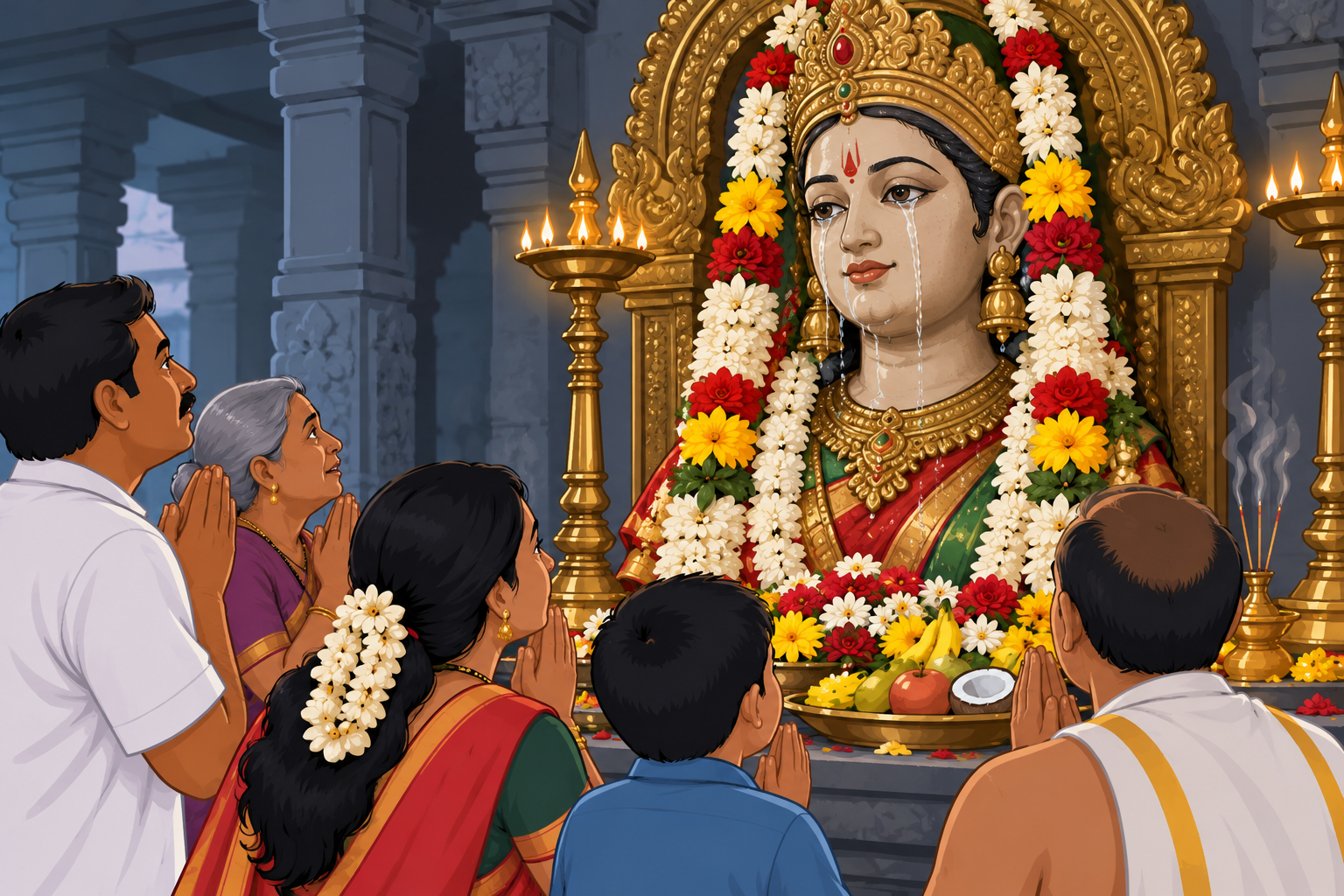
In 1926, Maharaja Krishnaraja Wadiyar IV of Mysore appointed Mirza Ismail (later Sir Mirza Ismail), a Muslim, as the Dewan of Mysore State. Some Hindu traditionalists resented a Muslim administrator leading a state ruled by a Hindu dynasty. His contemporary, the writer D. V. Gundappa, recalled that people often complained to the Maharaja about having a Muslim as Dewan, and as late as 1939, the newspaper The Hindu Outlook attacked him under the headline “Muslim Dewan over Hindu state”. Chamundeshwari, the goddess of the temple on Chamundi Hill, is the family deity of the Mysore royal family.
According to an often-repeated story, the idol of Chamundeshwari began weeping soon after the appointment. In Premanand’s account, the priests rushed to the Maharaja to tell him that the goddess was upset by the appointment and was weeping. The Dewan sent an intelligence officer to investigate, and the trick was exposed.
Yadnyeshwar Nigale, in Superstition: A Rational Discourse (translated by Suman Oak, 2012), gives a fuller version that differs in some details. The eyes of the idol suddenly began to water, and the priest brought this to the Maharaja’s notice. The Maharaja asked Mirza Ismail to investigate, and he sent an officer to the temple. The officer found that the crown on the idol’s head was hollow and connected by a tube to small hollows in the eyes, beside the nose. These had been sealed with wax, and the wax had been scratched out, so water poured into the crown oozed out of the idol’s eyes as the goddess’s “tears”. Nigale attributes the priest’s motive to opposition to a Muslim Dewan, and says that both the miracle and the priest were exposed.
Editors’ note: Neither writer cites a contemporary record of the event.
The Experiment
Effect
An idol of a deity appears to weep tears.
Materials
An idol with a crown, hollowed out from the head down to the neck, with a small inlet at the top of the crown and two small openings at the eyes. The idol must be hollow, so it would be made of metal, clay or plaster; a solid stone image cannot be used. Alternatively, as in the Mysore account, a hollow crown can hold the water and feed the eyes through a thin, concealed tube, and then the idol itself can be solid. Water and soft wax.
Method
Fill the hollow interior of the crown and head with water, and seal the openings at the eyes with wax. When the wax is secretly removed or scraped away, water trickles out through the eye holes, creating the illusion of tears. The inlet at the top of the crown is essential: it lets air in as the water drains. Without it, a partial vacuum forms inside the head and the water barely flows.
The Science Behind the Illusion
A weeping idol seems to defy common sense: water appears from stone or metal at a significant moment, and stops of its own accord. Each of these effects has an ordinary physical explanation, which also shows why the trick is convincing and how it can be exposed.
1. Why the water stays in until the right moment
Turn a full bottle with a narrow neck upside down and the water glugs out unevenly. Make the opening very small and seal the top, and almost nothing comes out at all. Two everyday forces are at work.
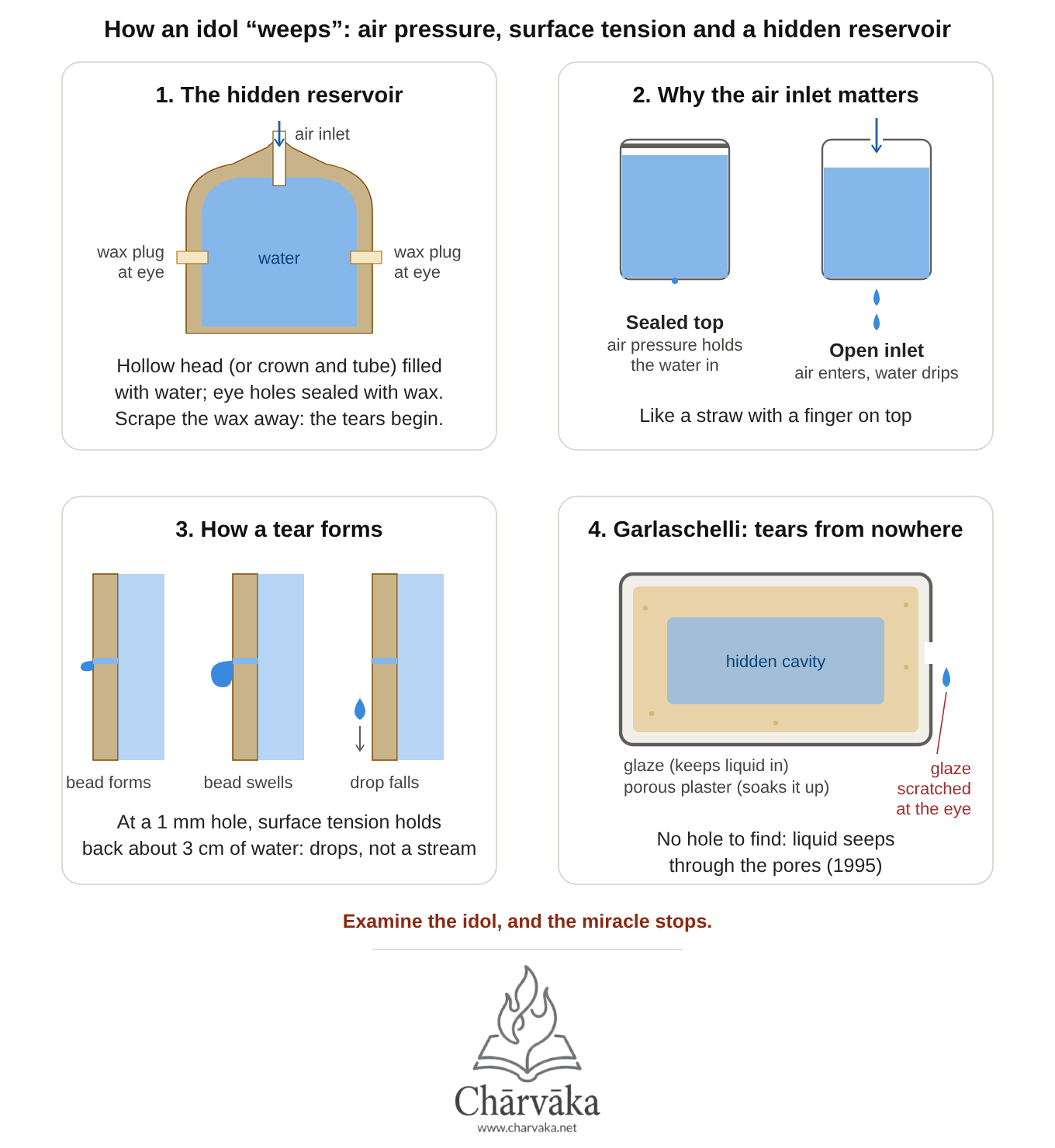
Air pressure. For water to leave a sealed container, something must take its place. If no air can get in, every drop that escapes lowers the pressure inside, and the surrounding atmosphere pushes back. Atmospheric pressure can hold up a column of water about ten metres tall, so a few centimetres of water inside an idol’s head is easily held in place. This is why the inlet at the top of the crown matters: an open inlet lets air in as water flows out. A drinking straw works the same way: cover the top with a finger and the water stays in; lift the finger and it falls.
Surface tension. Water molecules pull on each other, so the surface of water behaves like a thin, stretched skin. Across a very small hole, this skin can hold back a modest weight of water: an opening about a millimetre across can resist the pressure of roughly three centimetres of water above it. Water escaping through such a hole therefore does not pour. It gathers into a bead, swells until its weight overcomes the surface tension, then breaks free and rolls down the face. That is exactly how a tear looks. The trickster doesn’t have to imitate tears; the physics produces them.
The wax plug is simply a more reliable seal. Wax repels water and does not dissolve in it, and soft wax can be pressed into a small hole and later scraped away with a fingernail in a moment, perhaps while attention is on the lamp during worship. Once the plug is gone, the vent lets air in, surface tension shapes the drops, and gravity does the rest.
2. The crown-and-tube version
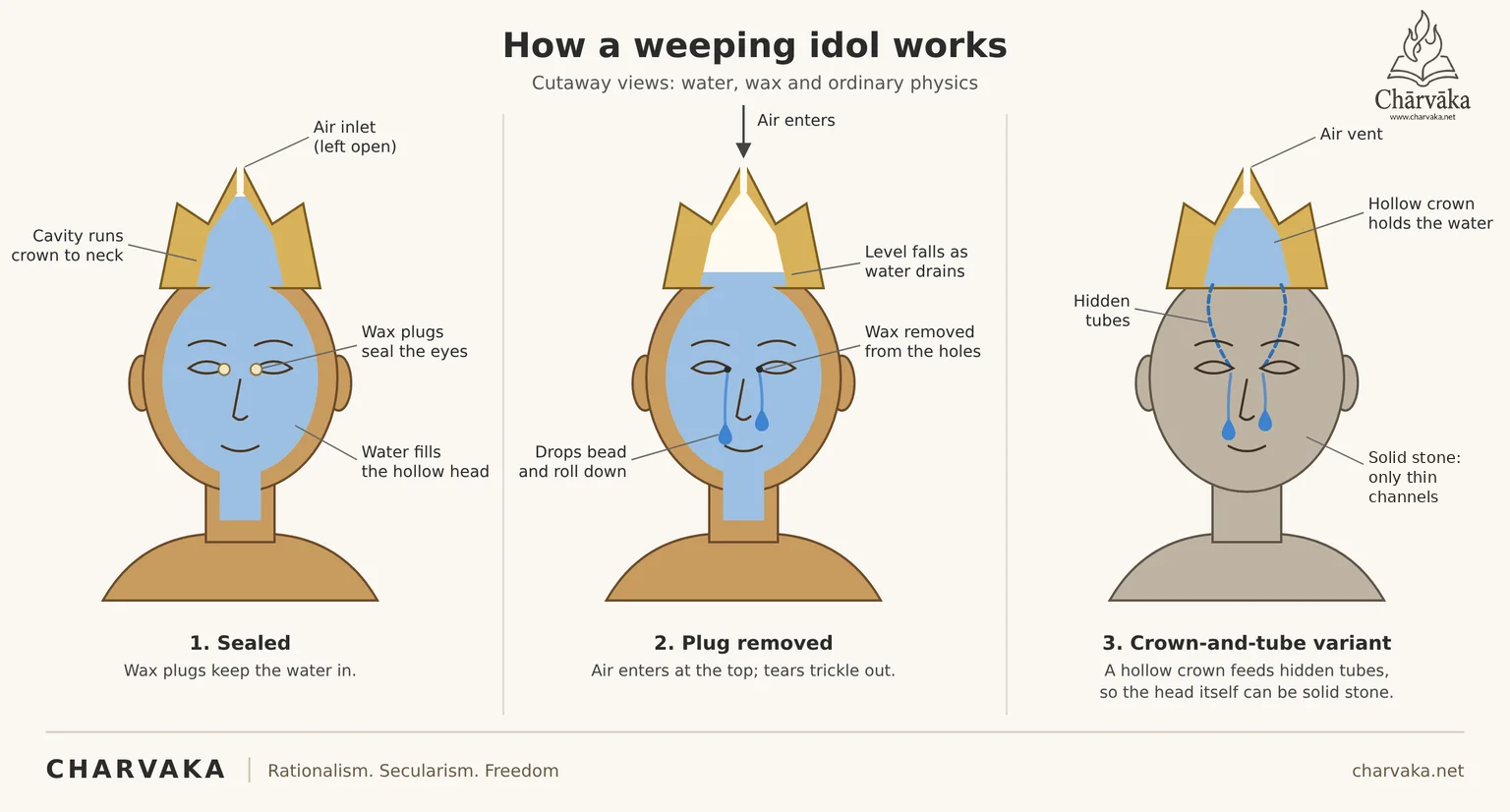
In Nigale’s account, the water was held in a hollow crown and carried to the eyes through a tube. This works like an overhead water tank: water held higher than the outlet flows down to it under gravity. The crown only has to sit above the eyes and be open, or have a small vent, at the top. Its great advantage is that the idol itself can be solid stone. Only the ornament needs to be hollow, and a thin tube is easy to hide beneath jewellery, garlands or cloth.
3. Why the weeping stops
A small cavity holds only a small amount of water. When it is empty, the tears stop, and that ending can look as meaningful as the beginning. It also leaves little evidence: a dry cavity behind the face shows nothing from the outside.
4. Garlaschelli’s demonstration: tears from nowhere
In early 1995, Italy saw a wave of reports of statues and icons of the Virgin Mary weeping, some of them tears of blood. Luigi Garlaschelli, an organic chemist at the University of Pavia and a member of the Italian sceptics’ organisation CICAP, set out to find the simplest way to make a statue weep with no visible hole. His recipe, published as a letter in Chemistry in Britain in July 1995 (Chemistry World), needs only three things:
- a hollow statue made of a porous material, such as plaster or ceramic, whose tiny connected channels soak up liquid by capillary action, the effect that draws water up blotting paper;
- an impermeable outer coat, such as glaze or paint, which keeps the liquid inside;
- a tiny, concealed hole, for example in the top of the head, through which the cavity is secretly filled.
Filled this way, the statue looks perfectly dry. Garlaschelli then scratched away a little of the glaze around the eyes, so slightly that it could not be seen. Liquid seeped out through the exposed pores and formed tear-like drops, apparently from nowhere. He reported that the trick worked very well and baffled everyone who watched. His method is subtler than the wax plug: there is no hole at the eyes to find. An investigator who examines the eyes sees only glaze and plaster.
Garlaschelli applied the same reasoning to the best-known modern case, a plaster plaque of the Madonna in Syracuse, Sicily, reported to have wept in 1953 and later recognised by the Catholic Church. He could not examine the original, which is kept behind glass, but a copy from the same manufacturer turned out to be glazed plaster with a cavity behind the face, exactly the conditions his method requires. In fairness, a Church-appointed commission in 1953 reported that the liquid it collected was human tears. Garlaschelli’s finding shows that such a plaque could be made to weep by ordinary means; it does not prove that the Syracuse plaque was.
5. Other routes to the same effect
- Oils and fats: oil mixed with fat and smeared on the eyes stays solid in a cool room but runs as the temperature rises, for example from lamps, a crowd of worshippers or the heat of the day. Non-drying oils such as olive oil, soaked into a porous statue, can keep “weeping” for long periods.
- Condensation: parts of a statue that warm up slowly, such as metal, glass or dense stone, can stay colder than the surrounding air on a humid day. Moisture then condenses on them, and if these parts include the eyes, the statue appears to weep.
- Suggestion: some reports involve no liquid at all. Hours of devoted staring, heightened emotion and the hope of seeing a miracle can lead a crowd to see what it expects to see.
6. How a weeping idol can be tested
The Mysore story, as Premanand and Nigale tell it, ended the way such cases should: someone was sent to look closely. The same simple checks apply anywhere.
- Examine the top of the head and any crown or ornaments for openings, seams or plugs.
- Remove jewellery, garlands and cloth, and look for tubes or channels.
- Inspect the eyes under magnification for holes, wax or scratched glaze.
- Dry the face and keep the idol under continuous observation. A genuine marvel shouldn’t need an unwatched moment.
- Test the liquid. Water, oil, salt water and blood are easy to tell apart.
- Note who has access to the idol, and when the weeping happens.
The pattern is telling: miracles of this kind tend to stop when the idol is examined, and resume only when access is restricted again.
Source & Attribution
This article is based on Science Versus Miracles by B. Premanand (1930–2009). While the core demonstration and methodology derive from Premanand’s field exposures, the analytical framework was updated in 2026 by Charvaka Desk, with the assistance of AI tools, to include scientific commentary across physics, chemistry, biology, physiology, psychology, and the mechanics of illusion. All revisions have been reviewed and fact-checked by our editors. The revision draws on the following sources:
The weeping-idol incident
- Premanand, B. (1994). Science versus Miracles. Indian CSICOP.
- Nigale, Yadnyeshwar (2012). Superstition: A Rational Discourse (trans. Suman Oak). Lokbhumi Prakashan, pp. 16–17.
Weeping images as omens in Sanskrit literature
- Adbhuta Brāhmaṇa (final section of the Ṣaḍviṃśa Brāhmaṇa). Summary: “Adbhuta Brahmana“, Hindu Blog.
- Omen passages attributed to the Matsya Purāṇa, in an omen compilation translated on Source Library, p. 216.
Mirza Ismail and Mysore
- Gundappa, D. V. “Amin-ul-Mulq – Sir Mirza M Ismail”, Part 8. English translation, Prekshaa.
- “Dewan Sir Mirza Ismail” (on The Hindu Outlook, 14 September 1939). mPositive.
Garlaschelli’s demonstration and weeping statues
- Garlaschelli, Luigi (1995). Letter, Chemistry in Britain. Reprinted in “15 years ago in Chemistry in Britain“, Chemistry World.
- Carroll, Robert T. “Weeping statue”. The Skeptic’s Dictionary.
- “Is a TikTok Famous Statue of the Virgin Mary Really Crying?” Artnet News.
The Syracuse case
- “Sanctuary of the Madonna delle Lacrime and the miracle of tearing”. La Sicilia in Rete.
We follow the evidence, including when it shows we were wrong. If you find an error, tell us in the discussion below, or write to us privately. We will review it and correct the article, with a note of the change.
Leave a Reply