The Practice: Reading a Message in a Sealed Cover
In spiritualist séances, psychic consultations and religious ashrams, the ability to read a hidden message inside a sealed envelope is often presented as the ultimate proof of telepathy, clairvoyance or divine omniscience. The practitioner invites a seeker to write down a confidential question, personal problem or secret number on a slip of paper. The seeker places it in an opaque envelope and seals it themselves, to rule out tampering. The practitioner then holds the envelope to their forehead or passes a hand over it in deep concentration, slowly recites the hidden message, and finally opens the envelope to “verify” the revelation. To an uncritical observer, the performance seems to pass straight through a physical barrier.
The Experiment
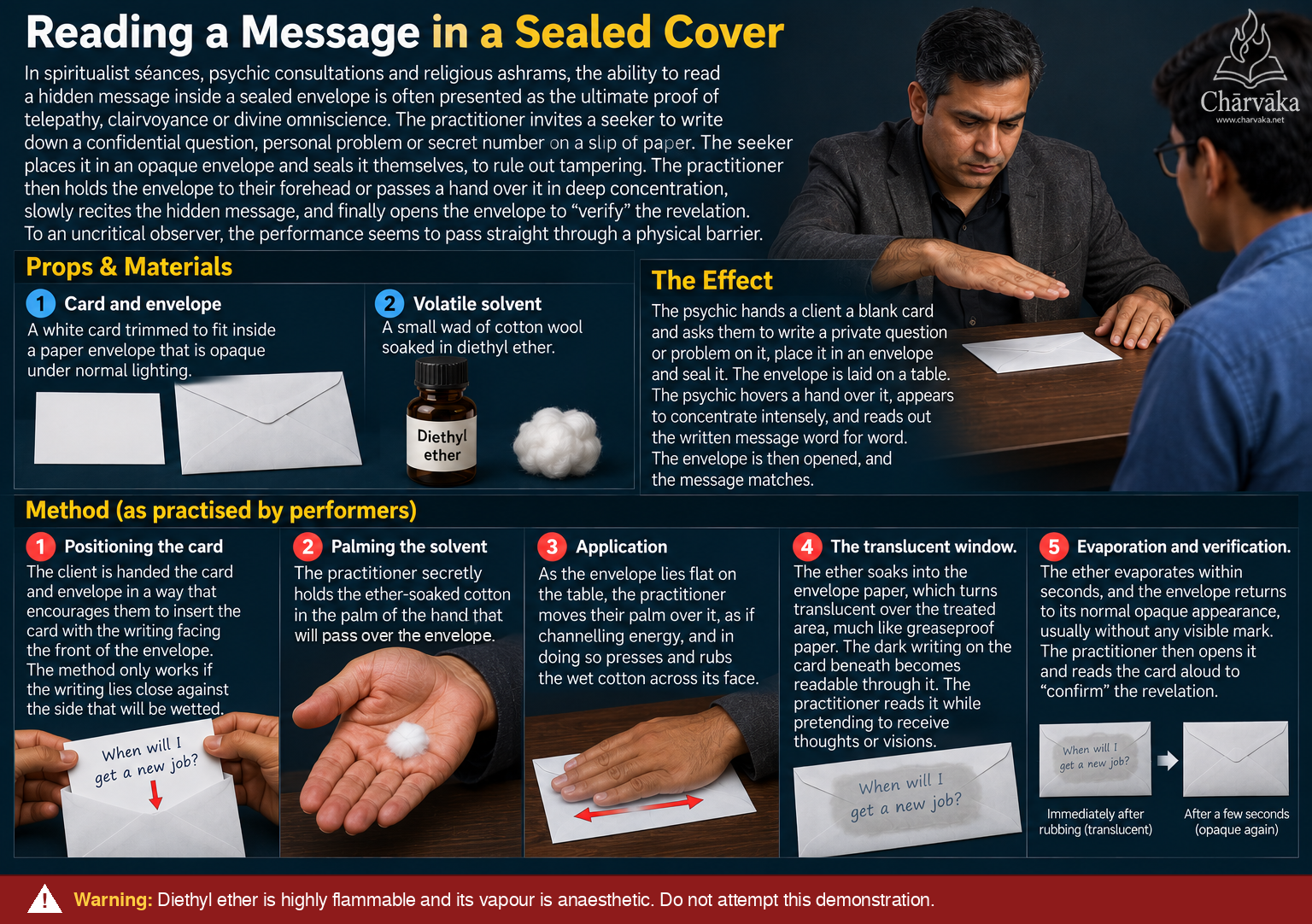
Effect
The psychic hands a client a blank card and asks them to write a private question or problem on it, place it in an envelope and seal it. The envelope is laid on a table. The psychic hovers a hand over it, appears to concentrate intensely, and reads out the written message word for word. The envelope is then opened, and the message matches.
Props & Materials
- Card and envelope: A white card trimmed to fit inside a paper envelope that is opaque under normal lighting.
- Volatile solvent: A small wad of cotton wool soaked in diethyl ether.
Method (as practised by performers)
- Positioning the card: The client is handed the card and envelope in a way that encourages them to insert the card with the writing facing the front of the envelope. The method only works if the writing lies close against the side that will be wetted.
- Palming the solvent: The practitioner secretly holds the ether-soaked cotton in the palm of the hand that will pass over the envelope.
- Application: As the envelope lies flat on the table, the practitioner moves their palm over it, as if channelling energy, and in doing so presses and rubs the wet cotton across its face.
- The translucent window: The ether soaks into the envelope paper, which turns translucent over the treated area, much like greaseproof paper. The dark writing on the card beneath becomes readable through it. The practitioner reads it while pretending to receive thoughts or visions.
- Evaporation and verification: The ether evaporates within seconds, and the envelope returns to its normal opaque appearance, usually without any visible mark. The practitioner then opens it and reads the card aloud to “confirm” the revelation.
The Science Behind the Illusion
The trick relies on how paper scatters light, on the special properties of ether as a solvent, and on misdirection:
1. Why paper is opaque, and how a liquid makes it see-through
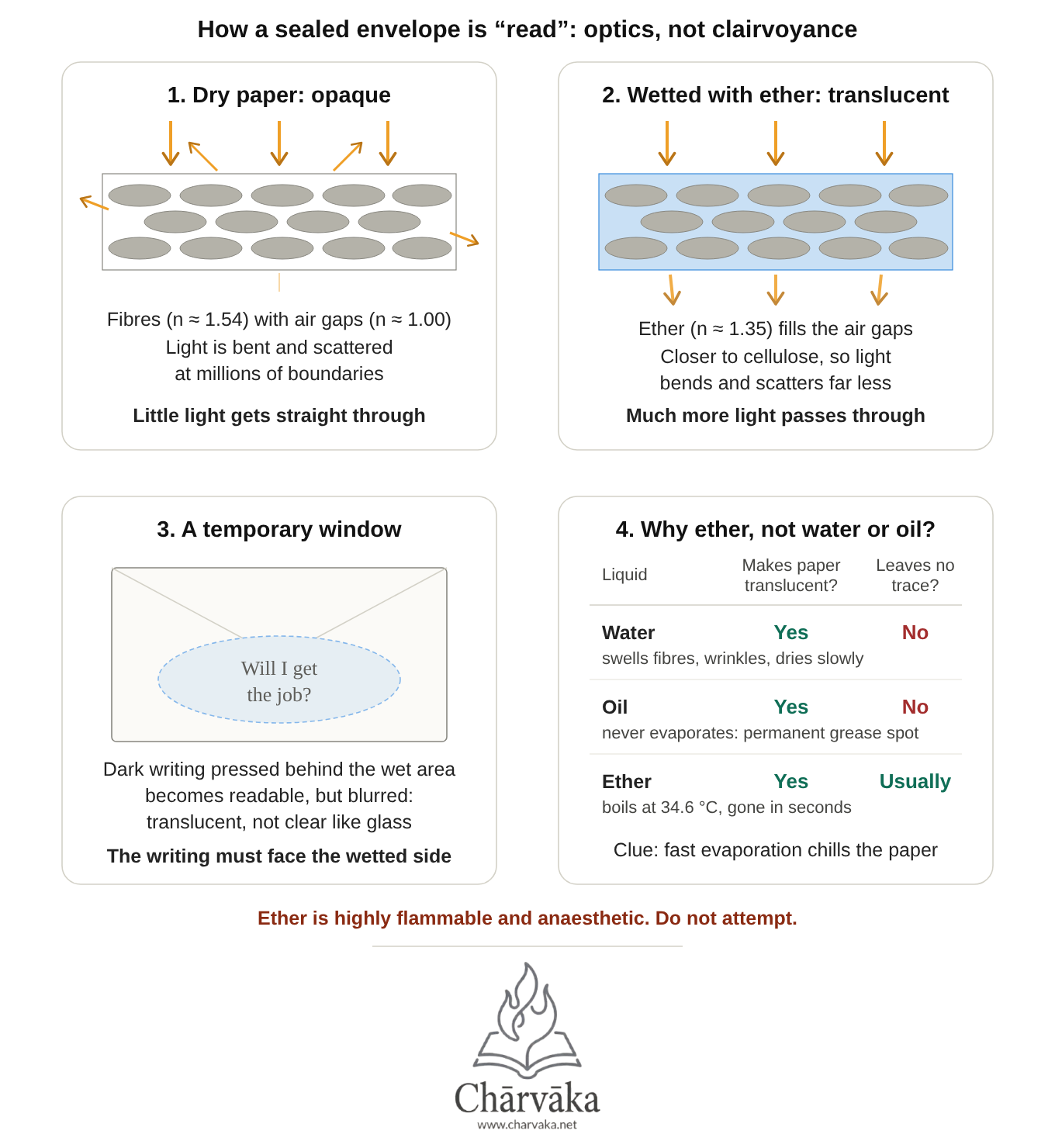
Paper is a tangled mesh of cellulose fibres filled with countless microscopic air pockets. Light bends whenever it crosses a boundary between materials with different refractive indices, and cellulose (n ≈ 1.54) and air (n ≈ 1.00) differ greatly. Light passing through dry paper is therefore bent and scattered at millions of fibre–air boundaries, and very little gets through in a straight line. That is why paper looks white and opaque.
When a liquid soaks into the paper, it replaces the air in those pockets. Diethyl ether has a refractive index of about 1.35, much closer to cellulose than air is. Each boundary now bends light far less, so scattering is greatly reduced, and the paper becomes translucent. Because ether’s refractive index still does not match cellulose exactly, the paper does not become clear like glass. The writing is readable because dark ink pressed close behind the paper contrasts with the now lighter, translucent area. The same effect explains why a grease spot on paper lets light through.
2. Why ether, and not water or oil
Several liquids make paper translucent, but each has a drawback that ether avoids:
- Water makes paper translucent, but it is absorbed into the cellulose fibres and makes them swell. The paper wrinkles, can stay visibly marked, and takes a long time to dry.
- Oil makes paper translucent, but it does not evaporate. The “window” would remain as a permanent grease spot and give the trick away.
- Diethyl ether does not swell the fibres, and with a boiling point of 34.6 °C and a high vapour pressure at room temperature, it evaporates within seconds. When it has gone, the air pockets return, scattering is restored, and the paper looks as it did before. Pure ether usually leaves no visible trace, although it can dissolve some inks, printed designs or adhesives, and impure ether may leave a faint mark.
3. Evaporative cooling
Evaporation takes heat from its surroundings. Because ether evaporates so quickly, it noticeably chills the paper, and the practitioner’s palm. An envelope that feels unexpectedly cold just after the “reading” is a clue that a volatile liquid was used.
4. Misdirection
Passing the hand over the envelope is presented as a mystical gesture to sense “vibrations” or “auras.” In reality, the gesture hides the cotton wool and gives the practitioner a natural reason to look closely at the envelope during the few seconds it is translucent.
Not the Only Method
Ether is only one of several ways sealed messages are “read.” Others include glimpsing the writing as it is written, secretly swapping envelopes, and the “one-ahead” method, in which the performer opens one envelope while pretending to divine the next. A sealed-message demonstration does not have to involve ether to be a trick.
Source & Attribution
This article is based on B. Premanand’s work Science Versus Miracles. While the core demonstration and methodology derive from Premanand’s field exposures, the analytical framework has been updated by Charvaka Desk to include scientific commentary across physics, chemistry, biology, physiology, psychology, and the mechanics of illusion.
Leave a Reply