The Practice: The Oracle’s Fiery Breath
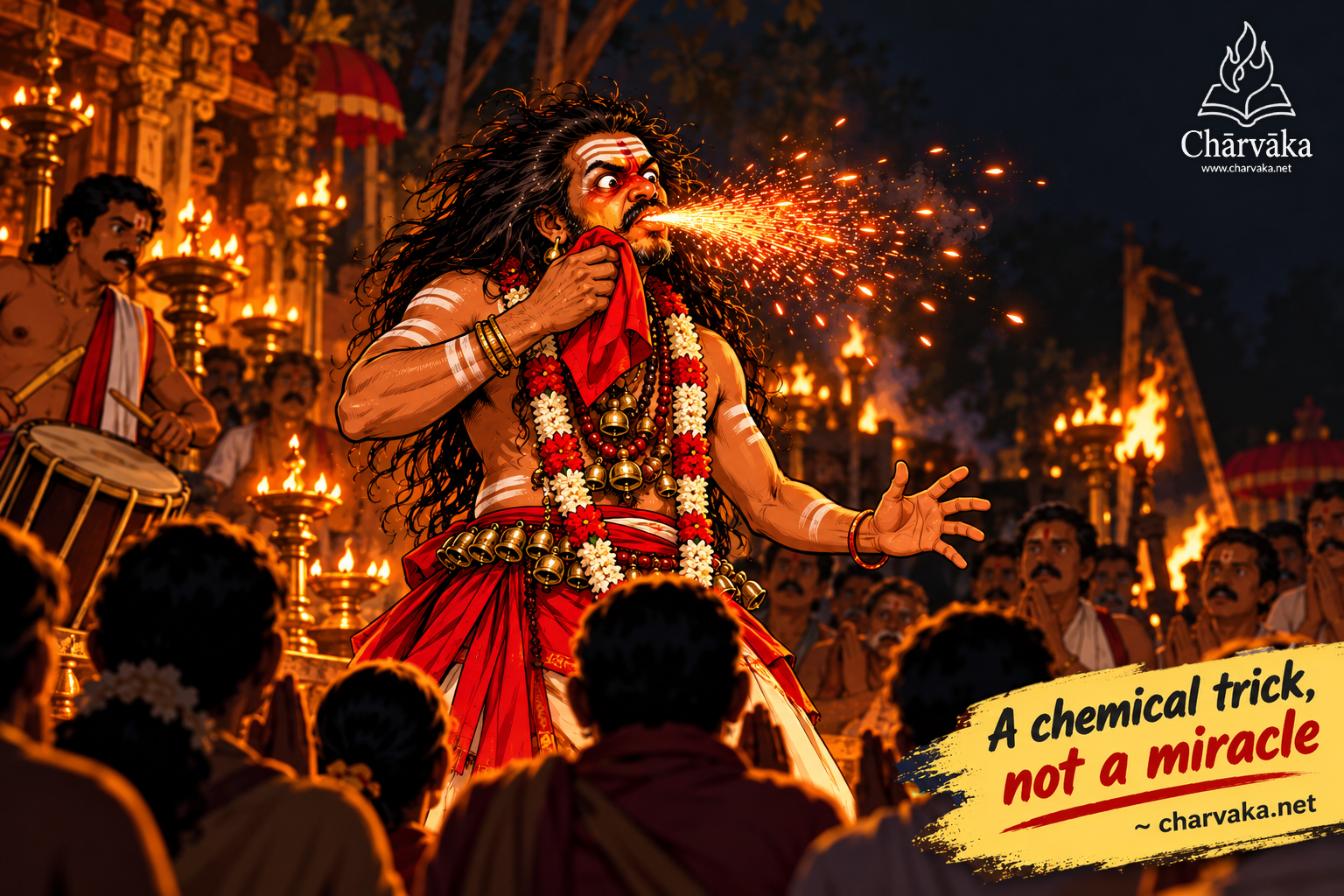
During temple festivals, village rituals and exorcism ceremonies, oracles and godmen often stage dramatic transformations to show that a deity or spirit has taken over their body. As drums beat and chanting rises, the oracle appears to enter a trance, shaking violently and rolling their eyes. Then, as proof of divine presence, the oracle wipes their mouth with a cloth, turns to the gathering, and breathes out a stream of glowing sparks. To believers, it seems that divine fire burns inside the oracle’s body without harming them.
This article explains a dangerous trick involving a chemical oxidiser. Do not attempt it. See the warning above.
The Experiment
Effect
The oracle appears to be possessed and breathes out a stream of glowing sparks from their mouth, apparently without injury.
Props & Materials
- Treated fibre: A small bundle of natural plant fibre, such as jute, that has been treated in advance with potassium nitrate (saltpetre, KNO₃), a chemical oxidiser.
- Cotton wool: Loose cotton wrapped around the fibre.
- Handkerchief or cloth: Used to hide the bundle and to slip it in and out of the mouth.
Method (as practised by performers)
- The hidden bundle: Before the performance, the treated fibre is lit so that it smoulders without flame, like the glowing end of a fuse, and is wrapped in cotton wool.
- Secret insertion: While appearing to wipe sweat or foam from their mouth with the cloth, the performer slips the smouldering bundle into their mouth.
- Breathing out sparks: The performer breathes out steadily through the mouth. The airflow makes the bundle glow brighter and blows glowing particles out through the lips as sparks.
- Removal: Before the heat becomes unbearable, the performer wipes their mouth again and secretly removes the bundle into the cloth.
The Science Behind the Illusion
The effect relies on an oxidiser that lets fibre keep burning inside the mouth, on airflow that feeds the fire, and on brief, partial protection from heat:
1. An oxygen supply built into the fuel
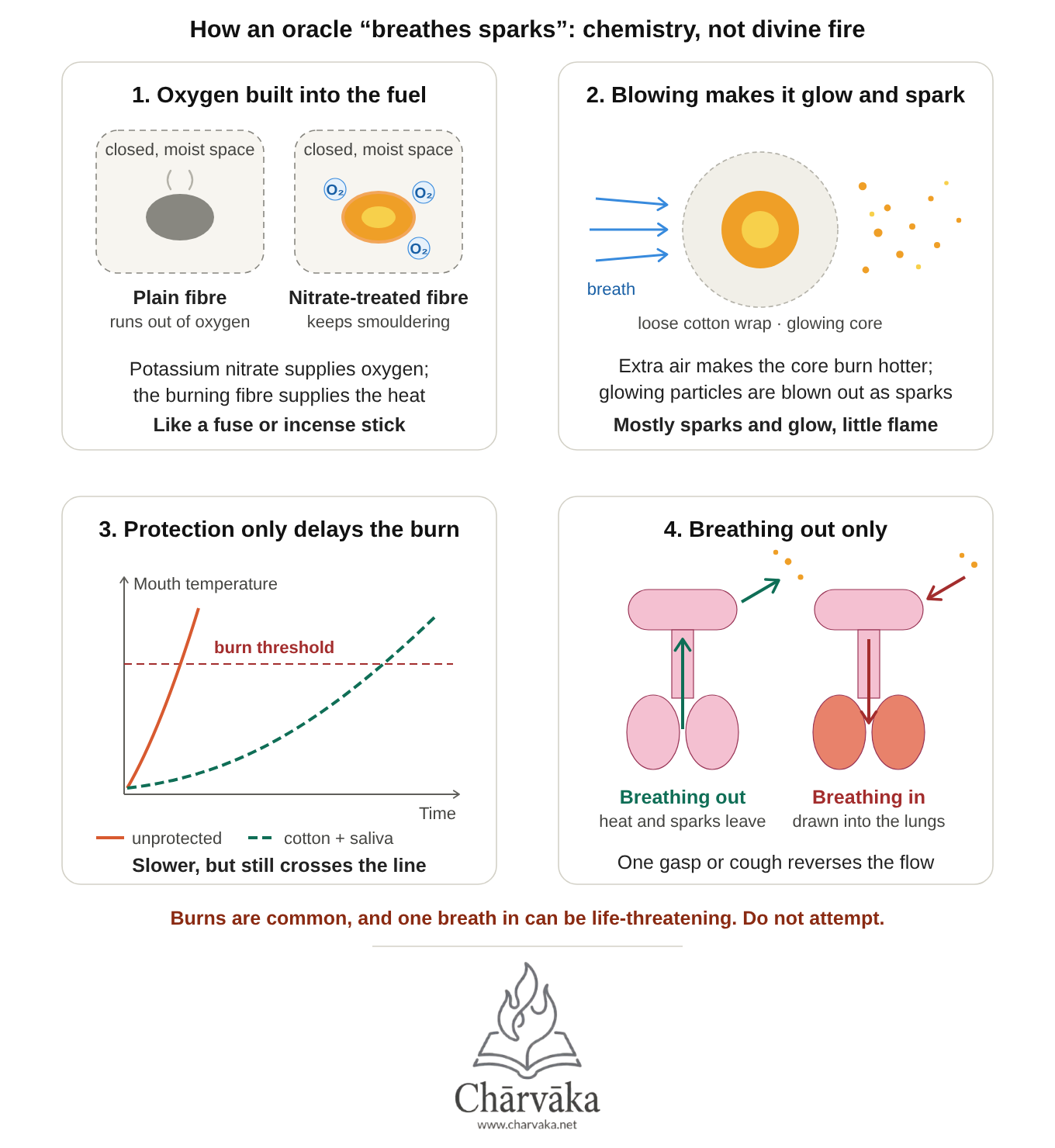
Jute and cotton are mainly cellulose, which burns when heated in air. A small ball of fibre inside a closed, moist mouth would normally go out quickly for lack of oxygen. Potassium nitrate changes this: it’s an oxidiser, a substance that supplies oxygen to a fuel. When strongly heated, nitrate releases oxygen, for example:
This step itself absorbs heat. The heat comes from the fibre burning, with the nitrate supplying oxygen and also reacting directly with the hot charred fibre. This is the same principle that lets a firework fuse or incense burn steadily without a flame. Because the fuel carries its own oxygen, it keeps smouldering even inside the mouth.
2. Blowing makes it glow and throw sparks
Breathing out pushes air through the loose cotton into the smouldering core. The extra oxygen makes it burn faster and hotter, so it glows brightly. Tiny particles of burning char and hot salts break away and are carried out in the breath. They glow for a moment in the air as sparks, then cool. The effect is mostly sparks and glow; little real flame is produced.
3. Why the mouth is not instantly burned, and why it still gets hurt
Two things delay the heat, but neither prevents injury:
- Loose cotton: Air trapped between the cotton fibres slows the flow of heat from the core to the mouth. The cotton itself can char and catch fire, though, so the barrier doesn’t last.
- Saliva: Water absorbs a lot of heat as it warms (its specific heat capacity is 4.18 J/g·°C). A thin layer of saliva briefly cools the surfaces it covers. There is only a little of it, so the protection lasts seconds.
This is why the trick has to be brief, and why performers commonly end up with burns and blisters on the lips, tongue and mouth.
4. Breathing out only
The performer can only breathe out while the bundle is in the mouth, so the airflow carries hot gases, carbon monoxide and sparks away from the body. A single breath in would reverse the flow and pull them into the throat and lungs. The whole trick depends on avoiding a reflex that people cannot always control, which is what makes it so dangerous.
Not Divine Fire
The sparks come from a burning chemical bundle that the performer puts into their mouth, not from inside the body. The apparent immunity to fire is a matter of seconds, and the injuries performers suffer are evidence that no supernatural protection is involved.
Source & Attribution
This article is based on B. Premanand’s work Science Versus Miracles. While the core demonstration and methodology derive from Premanand’s field exposures, the analytical framework has been updated by Charvaka Desk to include scientific commentary across physics, chemistry, biology, physiology, psychology, and the mechanics of illusion.
We follow the evidence, including when it shows we were wrong. If you find an error, tell us in the discussion below, or write to us privately. We will review it and correct the article, with a note of the change.
Leave a Reply