The Legend and the Claim: The Miracle of the Sacred Eagles
At Tirupurakundram in Tamil Nadu, two eagles come to the temple exactly at 12 noon to partake in the prasad offering of the god in the temple. Garuda is believed to be the vahana (vehicle) of Vishnu whose idol is installed in the temple. To the gathering crowds, the uncanny punctuality of wild birds arriving every single day at exact solar noon is presented as indisputable proof of divine intervention and celestial order.
In 1945, I visited the temple to see this miracle. It was found that these two eagles, after being caught, were given food exactly at 12 noon at the temple premises. The food contained opium and thus they became addicted. Later, after verification that they had become addicts, they were let free and every day at 12 noon they came back to the temple to eat the drugged food.
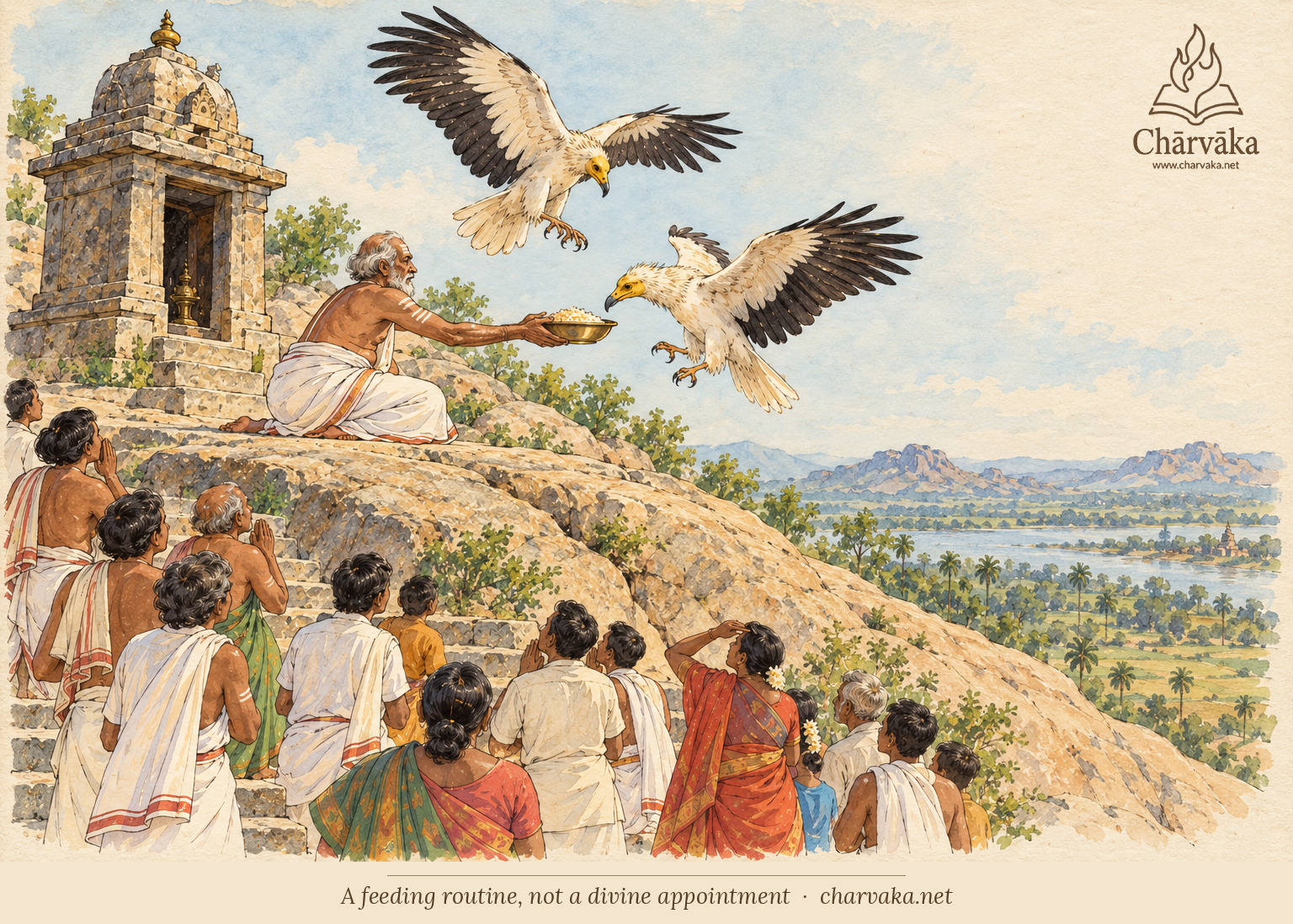
Editor’s note: The town is Thirukazhukundram (also spelt Tirukalukundram), near Chengalpattu; its name means “sacred hill of the birds”, and the site is also known as Pakshi Theertham. The hilltop temple is the Vedagiriswarar temple, dedicated to Shiva. In local legend, the birds were not Garuda but sages cursed by Shiva, who flew daily between Varanasi and Rameswaram and stopped here to be fed. The birds, popularly called eagles, were most likely Egyptian vultures, and accounts say they arrived around midday, often a little before noon, to be fed rice, ghee and sugar by the priest. We have retained Premanand’s original wording.
The Science Behind the Illusion
Explaining the Birds’ Visits
Premanand’s explanation is a drug habit. There is also a simpler explanation that needs no drugs at all, and either is enough to account for the “miracle”.
1. Premanand’s explanation: dependence on opium
Opium contains morphine and related compounds, which act on opioid receptors in the brain. Birds have these receptors too, so a bird fed opium regularly could come to depend on it and return to where it was fed. Premanand’s account of the birds being drugged is his report of what he found; we know of no independent evidence that confirms or disproves it.
2. A simpler explanation: birds learn where and when food appears
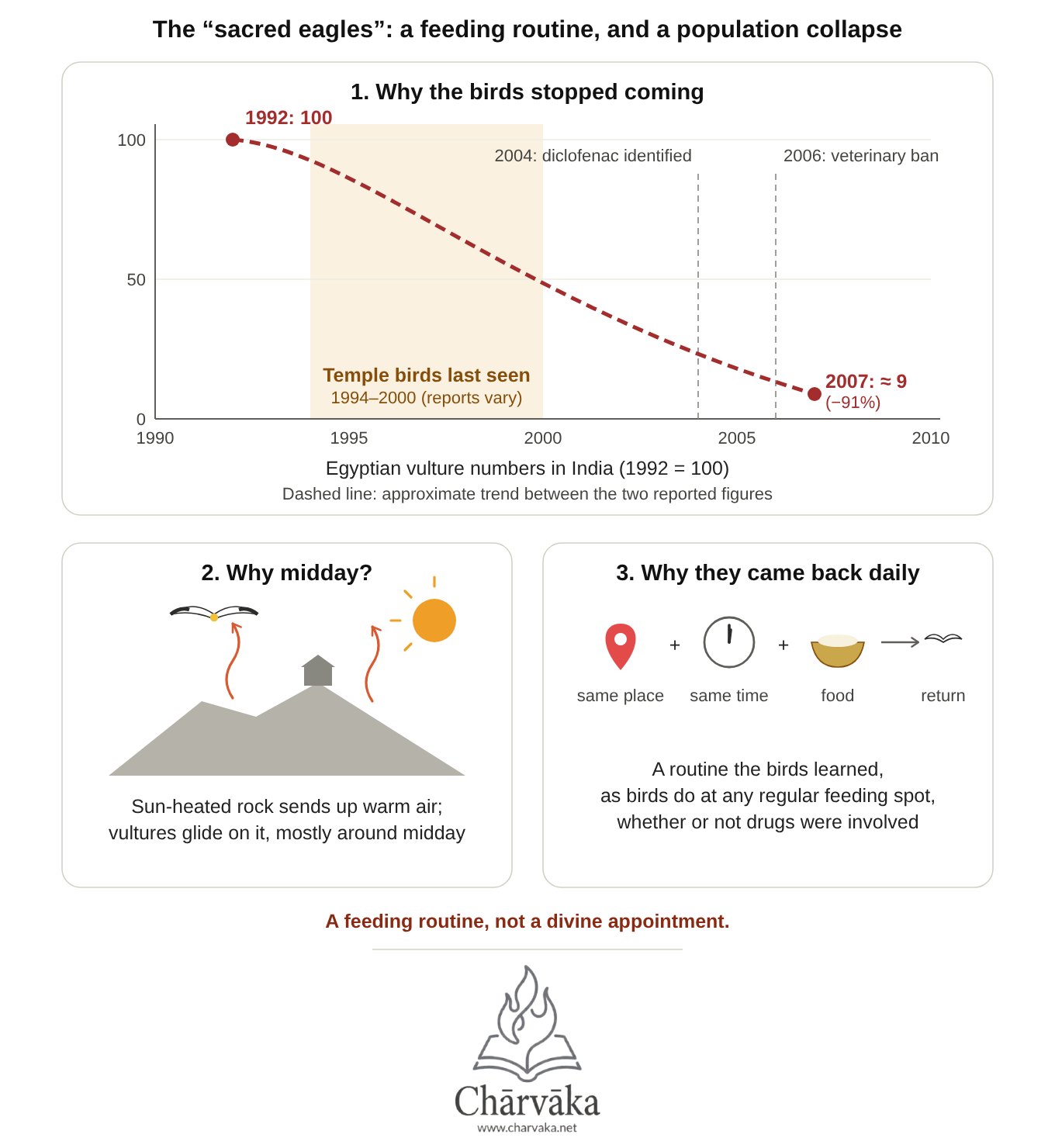
Vultures and kites are scavengers that quickly learn where food is reliably available, and when. Fed at the same place at about the same time every day, they come back daily, in the same way that birds gather at feeding stations and rubbish dumps at regular hours. Animals can learn to anticipate a regular feeding time, becoming active shortly before it. Scientists call this food-anticipatory activity, and it explains why the birds often arrived a little before noon.
3. Why midday?
Egyptian vultures and other soaring birds travel by gliding on rising currents of warm air, called thermals, which are strongest from late morning to the middle of the day. A midday arrival suits the way these birds fly.
4. Why it looked like a miracle
Wild birds arriving at the same hour every day, and taking food from a priest’s hand, is genuinely striking. But it is the kind of behaviour animals learn whenever people feed them on a regular schedule. The punctuality reflects a feeding routine, whether or not drugs were involved, not a divine appointment.
Why the Birds Stopped Coming
The visits ended in the 1990s. Some reports say the birds were last seen in 1994, others in about 2000. Priests and devotees saw their disappearance as a bad omen, a sign of the Kali Yuga or of sinners among the onlookers.
There’s a more likely explanation. During exactly those years, India’s vultures suffered one of the fastest wildlife declines ever recorded. The main cause, identified in 2004, was diclofenac, a painkiller widely given to cattle. Vultures that fed on the carcasses of treated animals died of kidney failure within days. Several vulture species fell by more than 95 per cent, and the government banned veterinary diclofenac in 2006.
The temple’s birds were most likely Egyptian vultures, and their numbers in India fell by about 91 per cent between 1992 and 2007. Diclofenac hasn’t been confirmed as the cause for this particular species, but the pattern of its decline closely matches the others. The birds of Thirukazhukundram probably disappeared for the same reason as millions of vultures across India: not because of any omen, but because their numbers had collapsed.
A Similar Belief at Sabarimala
A related belief is still held by millions of devotees. On the day the Thiruvabharanam, the sacred ornaments of Ayyappa, leave the Valiyakoikkal temple at Pandalam for Sabarimala, around 12 January, a Brahminy kite (Sree Krishna parunthu) is watched for in the sky at about 1 p.m. Its circling above the temple is taken as the sign for the procession to begin, and devotees believe the bird is Garuda, accompanying the ornaments on their journey to the hill shrine for Makaravilakku on 14 January.
Unlike the birds of Thirukazhukundram, this needs no feeding or training at all:
- The bird is common: The Brahminy kite is one of Kerala’s most familiar birds of prey, especially near rivers, temples, towns and markets. On almost any day, there’s a good chance of seeing one.
- The time suits the bird: Kites soar on rising warm air, which is strongest from late morning to early afternoon. A kite circling at 1 p.m. is ordinary behaviour.
- Crowds attract kites: Thousands of devotees, with cooking, food offerings and discarded food, are just what scavenging kites look for.
- Expectation does the rest: When thousands of people are watching the sky for a kite, someone will almost certainly spot one, and any kite overhead counts as the sign. Years when none appeared on cue, or one appeared late, are rarely remembered. Psychologists call this confirmation bias: we notice and remember what fits our expectations.
A kite above a temple in Kerala at midday is not a sign but a near-certainty. What makes it seem miraculous is the meaning given to it, not the bird.
The Makaravilakku itself has a similar history. The light seen on Ponnambalamedu was long believed by many to be divine, until in 2011 the Travancore Devaswom Board acknowledged that it is lit by people. Knowing this doesn’t diminish anyone’s devotion; it only separates what happens from what is claimed.
Source & Attribution
The account of the legend and claim is from Science Versus Miracles by B. Premanand (1930–2009) . This article was revised in 2026 by Charvaka Desk with the assistance of AI tools, and reviewed and fact-checked by our editors, drawing on the following sources:
- Katie Fallon, “Hill of the Sacred Eagles”, Terrain.org
- “Two more vulture species under threat”, Down To Earth
- “Faith, Divinity and Controversy: Decoding the Sabarimala Makaravilakku phenomenon”, The News Minute
- “The myth of Sabarimala’s Makaravilakku is bust, but the controversy over it still rages on”, The South First
We follow the evidence, including when it shows we were wrong. If you find an error, tell us in the discussion below, or write to us privately. We will review it and correct the article, with a note of the change.
Leave a Reply