The Balloon That Won’t Burst
This is the simplest trick in Young Skeptics, and we chose it on purpose. Nobody has ever built a place of worship around a balloon, or grown rich by pricking one! But the way this trick fools people is exactly the way much bigger “miracles” fool whole crowds: the audience assumes that the performer’s balloon is just like theirs, and nobody checks.
Learn to spot the secret here, and you’ll be ready for the real thing: statues that drink milk, ash from an empty hand, and children who “read” with their eyes shut.
🎈 The amazing claim
A man stands on a stage. He hands out balloons and needles. “Prick them!” he says. BANG! BANG! BANG! Every balloon bursts.
Then he picks up a balloon himself. He closes his eyes. Slowly, he pushes a needle into it… and nothing happens. The balloon stays round and full.
“My mind protects it,” he says.
Stop before you read on! What could be different about his balloon? Write down your guess.
🧪 Try It Yourself
What you need
- 🎈 3 or 4 balloons
- 🩹 Clear sticky tape
- 🥢 A thin wooden skewer Ask a grown-up
- 🖊️ A felt pen
📄 Download the worksheet (PDF)
What to do
- Blow up a balloon until it is about three-quarters full, and tie it.
- Look closely. Find the dark, thick spot at the top, opposite the knot. Now look at the pale, shiny sides. Mark a dot on the dark spot and one on a side with the pen.
- Stick a small piece of tape on the side, over your dot.
- Gently twist the skewer into the balloon through the tape. Push slowly.
- Take a new balloon. Twist the skewer gently into the dark spot at the top.
- Finally, take one more balloon and poke the skewer into a plain shiny side, with no tape. (Cover your ears!)
Before each test, guess: BANG or no bang? Then try it and see whether you were right. You can write your answers on the worksheet.
💡 The Science Behind the Trick
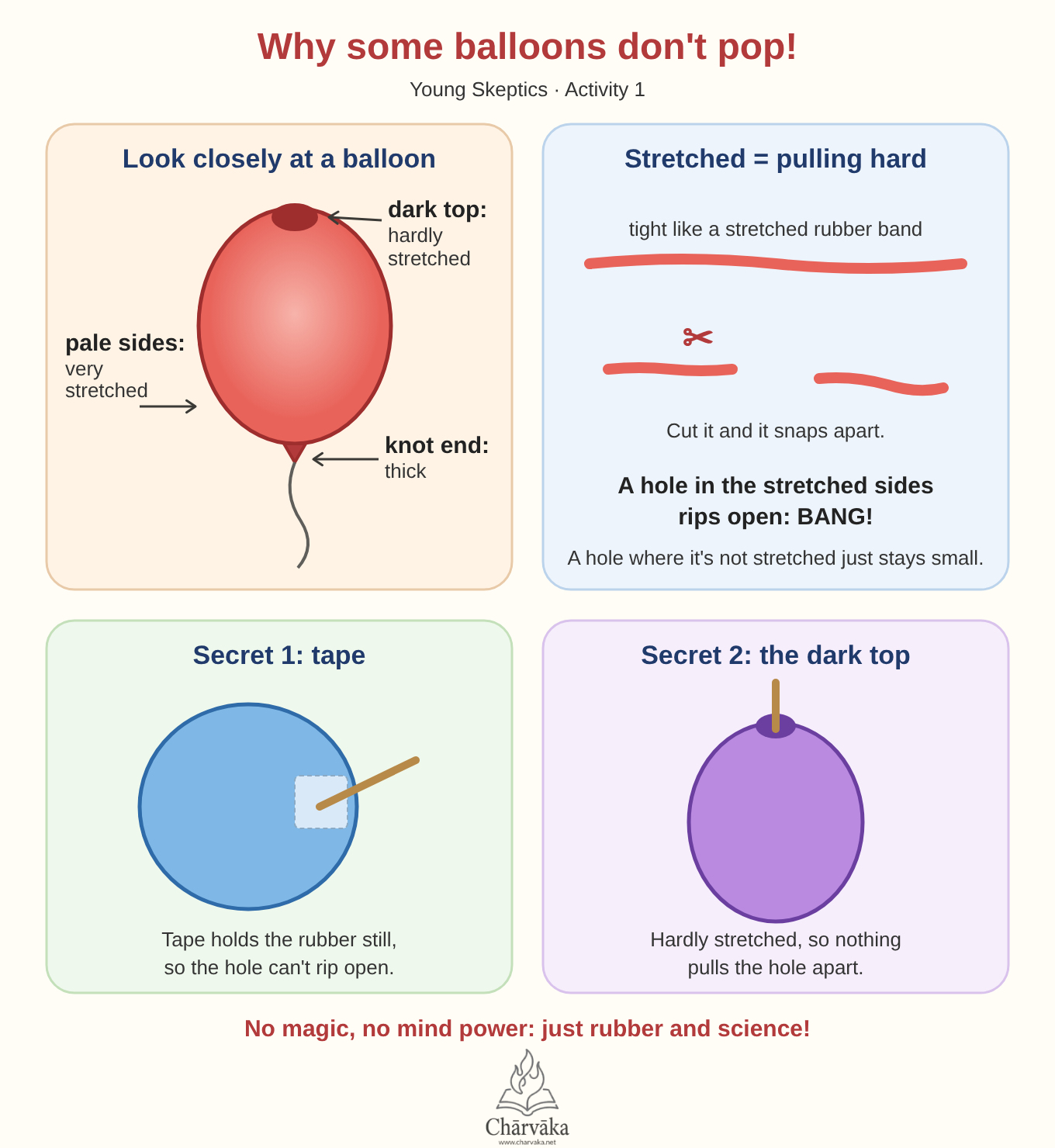
A blown-up balloon is made of stretched rubber. Stretched rubber is pulling hard all the time, like a tight rubber band.
When you make a hole in the stretched sides, the rubber pulls away from the hole. The hole rips open bigger and bigger, faster than you can blink, and all the air rushes out. BANG!
Tape holds the rubber still, so the hole can’t rip open. The dark top and the area near the knot are hardly stretched at all, so there is nothing pulling the hole apart. That’s why the balloon survives.
It’s a bit like a rope. Cut a tight rope, and the ends whip apart. Cut a loose rope, and it just lies there.
So the man’s balloon wasn’t protected by his mind. It was either taped, or pierced at a spot where any balloon would survive.
🧠 Think Like a Scientist
The audience thought, “My balloon burst, so his balloon must be just like mine.” But it wasn’t!
When two things look the same, ask:
are they really the same?
Scientists always check. You can too.
🗣️ Now be the teacher
Ask your family to guess: will a balloon burst if you push a skewer in through a piece of tape? Let them predict, then test it together, side by side with a plain balloon. Then ask them: why did the audience believe the man’s balloon was special? That’s the question a skeptic learns to ask.
Seeing Isn’t Checking · Make It a Fair Test · The Simplest Explanation
For parents and teachers
- Safety: use blunt-ended bamboo skewers rather than needles for younger children, and supervise. Children should push away from themselves and others.
- Latex: check for latex allergy, or use latex-free balloons.
- Noise: warn children before the bangs, especially those who are sensitive to loud noises.
- Clean-up: pick up burst pieces of balloon straight away, as they are a choking hazard for small children.
- Going further: the taped balloon still leaks slowly and goes soft over time. Ask the children why. (The tape stops the rip, but air still escapes around the skewer.)
- The science in more detail: “Crack growth in inflated balloons” (University of Cambridge) and “Stretchy Balloon Science” (Scientific American).
Based on a classic stage trick, written with the assistance of AI tools, and reviewed by our editors. — CHARVAKA DESK