Fifty years of exposing miracles, fostering scientific temper, and advocating rational thought across Karnataka
The Dakshina Kannada Rationalist Association (DKRA), formerly the South Kanara Rationalist Association (SKRA), was founded during the Emergency in 1976. Through five decades of campaigning against superstition and promoting rational thinking, the association has played a pivotal role in Karnataka’s rationalist movement.
The year was 1976. India was in the grip of the Emergency imposed by Prime Minister Indira Gandhi, and the press operated under stringent censorship. Publications were required to remove censored material without leaving blank spaces, making it difficult for journalists to publish anything critical of the government. However, controversies surrounding godmen and their alleged supernatural powers offered a relatively safe subject for public debate.
At the center of this debate was Sathya Sai Baba of Puttaparthi, who claimed to materialise objects out of thin air. His claims were challenged by prominent rationalists Abraham T. Kovoor and H. Narasimhaiah, who sought to subject alleged miracles to scientific scrutiny.
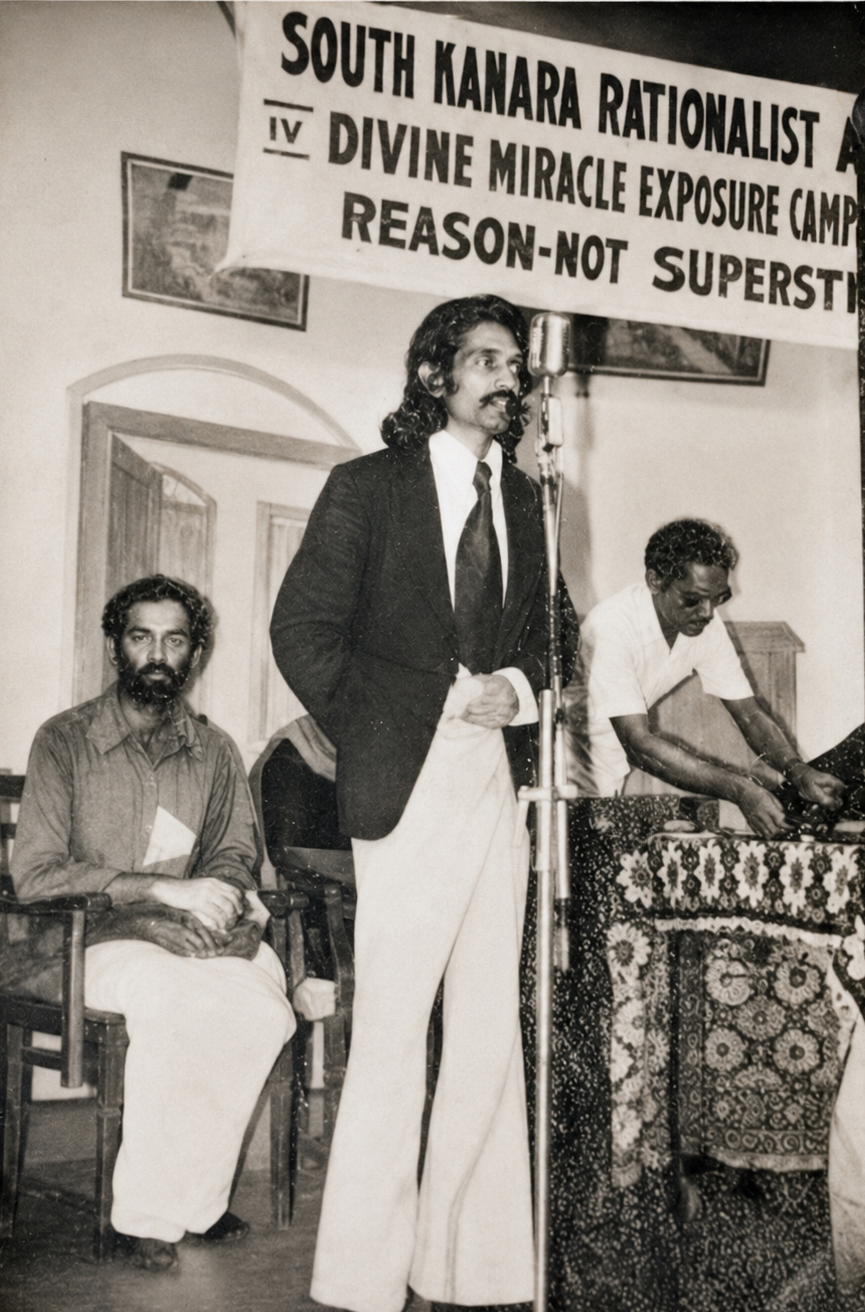
Kovoor, who was born in India and later settled in Sri Lanka, travelled across India conducting what he called “Divine Miracle Exposure” programmes. He offered a reward of ₹1 lakh to anyone who could demonstrate any of the alleged miracles listed in his challenge. His campaign provoked strong reactions from orthodox groups and devotees of various godmen.
It was against this backdrop that the South Kanara Rationalist Association (SKRA) took shape. Twenty-five years later, it was formally registered under the name Dakshina Kannada Rationalist Association (DKRA), following the division of the former South Kanara district into the Udupi and Dakshina Kannada districts.
A Newspaper Controversy Sparks a Movement
The immediate trigger for the formation of the association was a newspaper article published in Manipal that criticized Kovoor and rationalists in general. Narendra Nayak, who was then completing his MSc at Kasturba Medical College, Manipal, was incensed by the article.
Along with Kudpi Rajanikant Shenoy and his brother Rajendra, Nayak decided to write a rejoinder. Although the editor initially refused to publish it, the group persisted, and the response eventually appeared in print.
When the same writer subsequently labeled Kovoor a fraud, the young rationalists challenged him to meet Kovoor in Mangaluru and expose him if his allegations were true. This challenge set the wheels in motion for Kovoor’s proposed visit to the region.
The group approached the Indian Rationalist Association (IRA) to organize a programme in Mangaluru during Kovoor’s next tour of India. The IRA responded that tour dates could only be allocated to established organizations rather than individuals, subject to certain conditions.
Undeterred, the young enthusiasts decided to form an organization of their own. The South Kanara Rationalist Association was formally established on November 25, 1976.

A Small Group with a Big Mission
The association began with around 25 members. Five were above the age of 40, while the majority were 25 or younger. Among the senior members were G.K. Nettar, B.R. Mallya, Raghuvir Kodial, and Dinakar, along with a Mr. Patil who served as registrar of the then Karnataka Regional Engineering College (now NITK).
The younger cohort included Kudpi Rajanikant Shenoy, Vinod Kamath, Manel Annappa Nayak, Prakash Shetty, and Arunachalam Kumar, then a final-year MBBS student at Kasturba Medical College, Mangaluru. Three brothers from the Nayak family—Rajendra, Surendra, and Narendra—were also actively involved.
Students, bank employees, and members of local friendship circles joined the initiative. In its early days, as founders recall, it was an all-male organization.
Its beginnings were modest. Members communicated via postcards and held meetings in an open field near what is now the Karavali Utsav grounds. Yet, the group was united by a common objective: to encourage rational thinking and challenge claims that could not withstand scientific examination.
Early Experiments in Exposing Alleged Miracles
One of the association’s first public programmes was organized at the postgraduate center of Mysore University at Konaje (then known as Mangalagangothri). The event was arranged by Panditaradhya, a lecturer at the institution.
Narendra Nayak represented the association, addressing students and faculty on the importance of rational thought. He also attempted to demonstrate how the production of vibhuti—one of the best-known alleged miracles associated with Sathya Sai Baba—could be replicated using a concealed pouch and tube.
The demonstration did not proceed entirely as planned, as the mechanism became jammed after two attempts. Nevertheless, the incident became a memorable episode in the association’s early history. Although their initial effort to demonstrate the trick yielded mixed results, it marked the beginning of the group’s public outreach.
The Premanand Connection
The association’s activities initially remained limited in scope, and the death of Abraham T. Kovoor in September 1978 created a temporary void in the movement to debunk supernatural claims.
A new figure soon emerged to carry forward that work: Basava Premanand, who continued Kovoor’s mission with immense dedication. The Dakshina Kannada Rationalist Association came into contact with Premanand through Shankar, a magician associated with the Maya Amateur Magicians troupe. Premanand and his brother Dayanand were invited to conduct programmes in the district.
The first programme was held in Udupi, preceded by a street procession. Participants demonstrated feats often presented as supernatural, such as pulling a car with hooks inserted through the skin of the back, placing burning camphor on the tongue, and performing other dramatic demonstrations.
The event took an unexpected turn when Premanand opened his address with a provocative assertion regarding the origin of the syllable “Aum”. A section of the crowd rushed the stage and assaulted him, forcing the event to a halt. Fortunately, the subsequent programme in Mangaluru, organized by the DKRA, proceeded without incident.
The controversy, however, spilled over into the press. A regional newspaper launched a campaign against the rationalists, prompting the association to clarify its stance on atheism and related issues. Some of the magicians who had participated in the demonstrations distanced themselves from the movement, maintaining that they were purely entertainers without ideological commitments.
This episode led to a vital policy decision: the association would henceforth collaborate only with individuals and groups who clearly understood and shared its core objectives.
Subsequent programmes featuring Premanand were organized in collaboration with Samudaya, a progressive cultural organization. These events received an enthusiastic response and helped popularize the rationalist movement across the region. Premanand returned to the district on several occasions, strengthening the association’s public presence and experience.
From Local Initiative to a Statewide Movement
A major opportunity for expansion arrived in 1987 with the launch of the Bharat Jan Vigyan Jatha. Promoting scientific temper by demystifying alleged miracles was central to its mission. The initiative later evolved in connection with the Bharat Gyan Vigyan Samiti.
Through these nationwide programmes, the Dakshina Kannada Rationalist Association gained broader recognition, establishing itself as one of Karnataka’s leading rationalist organizations. Its expanding network fostered collaboration with the Karnataka Rajya Vijnana Parishat, facilitating events through branches across the state.
The association’s reach expanded further in 2004 when Narendra Nayak was unanimously elected president of the Federation of Indian Rationalist Associations (FIRA). The work of the district body and the national federation became closely intertwined, granting local campaigns national visibility.

The movement’s scope also grew beyond exposing miracles. In 2011, the Aid Without Religion Trust was established to assist needy individuals and support secular initiatives without regard to religious considerations, superstition, or unscientific beliefs.
Nayak was subsequently appointed by the National Council for Science and Technology Communication (NCSTC) as a national master resource person. In this role, he trained thousands of science activists and educators across India to demonstrate the scientific explanations behind alleged miracles.
Campaigns Against Superstition and Exploitation
Over the decades, the association has spearheaded diverse campaigns against superstition, pseudoscience, and fraudulent claims. Its work has included challenging deceptive advertisements, debunking claims of “extraocular vision” (blindfolded sight), and questioning practices passed off as supernatural phenomena.
It has also intervened in cases where religious authority was alleged to mask exploitation. The association supported public campaigns addressing allegations at Dharmasthala and actively sought justice for RTI activist Vinayak Baliga, who was murdered after raising questions regarding the financial management of the Venkataramana Temple and Kashi Math.
In line with its commitment to social equality and personal liberty, the association has regularly facilitated and solemnized inter-caste and inter-religious marriages.
Another major effort involved an NCSTC project designed to train at least two resource persons in every district across India to scientifically examine miracle claims. (This project was discontinued after 2014.)
For the association, these initiatives represent a unified mission: empowering citizens to question extraordinary claims, demand empirical evidence, and make life choices grounded in reason rather than fear or blind faith.
The Risks of Standing by One’s Convictions
Advocating rationalism has not been without personal peril. The assassinations of rationalists Narendra Dabholkar, Govind Pansare, and M.M. Kalburgi, along with journalist Gauri Lankesh, highlighted the escalating dangers faced by those who challenge entrenched dogma.
Narendra Nayak was placed under 24-hour armed police protection from 2016 to 2023 following credible threats and survived multiple attempts on his life.
These severe challenges underscore the risks inherent in challenging powerful socio-religious interests. Despite continuous threats, the association has remained steadfast in its commitment to rational thought and scientific inquiry.
Remembering Those Who Stood by the Movement
As the association reflects on its journey, it honors the memory of dedicated comrades who are no longer with us.
Devadas M., who accompanied Narendra Nayak on countless campaign tours, passed away during the COVID-19 pandemic. Prasanna, an electrical engineer, was another devoted activist. Vittala Bhandary, who engaged in rationalist work alongside his father, R.V. Bhandary, also succumbed during the pandemic.
Their contributions remain an enduring part of the movement’s history, alongside the countless members, volunteers, and well-wishers who have generously contributed their time, energy, and resources over the decades.
Fifty Years of Questioning, Learning, and Moving Forward
As the Dakshina Kannada Rationalist Association marks its 50th anniversary in 2026, its journey demonstrates how a small group of passionate young activists grew into an organization with statewide and national impact.
What began amidst the tense political climate of the Emergency developed into a sustained movement to foster scientific temper, challenge superstition, refute unproven claims, and drive social reform. Its history encompasses public demonstrations, educational workshops, inter-organizational alliances, and courageous resilience in the face of danger.
This golden jubilee serves as a call to revitalize the movement. The association emphasizes that the next generation must step forward with fresh energy, innovative ideas, and modern approaches tailored to evolving times.

A series of commemorative events is planned throughout the anniversary year. The inaugural gathering, scheduled for November 22, 2026, at the Karnataka Bank Employees Association Auditorium in Mangaluru, will mark the official launch of the golden jubilee celebrations.
After five decades, the association’s central message remains as vital as ever: scientific temper is not merely about exposing fake miracles—it is about cultivating a habit of critical thinking, evaluating evidence, resisting exploitation, and making reasoned choices.
The next chapter will depend on how effectively the achievements and lessons of the past are carried forward by a new generation dedicated to reason and human rights.
Leave a Reply