800×600
Normal
0
false
false
false
EN-IN
X-NONE
ML
MicrosoftInternetExplorer4
/* Style Definitions */
table.MsoNormalTable
{mso-style-name:”Table Normal”;
mso-tstyle-rowband-size:0;
mso-tstyle-colband-size:0;
mso-style-noshow:yes;
mso-style-priority:99;
mso-style-parent:””;
mso-padding-alt:0cm 5.4pt 0cm 5.4pt;
mso-para-margin:0cm;
mso-para-margin-bottom:.0001pt;
mso-pagination:widow-orphan;
font-size:10.0pt;
font-family:”Times New Roman”,”serif”;}
But, apart from providing material help and hospitality, Khetri is important in his life for other reasons too. It is from Pandit Narayandas of Khetri that he learnt the maha-bhashya (the
grand critique) of Panini Sutra. He reverently called the Pandit his
“Professor”. Moreover, he also discussed scriptures with two other
scholars of Khetri, namely Shankarlal and Sundarlal. Pandit Sankarlal
was to become a disciple of Swamiji.
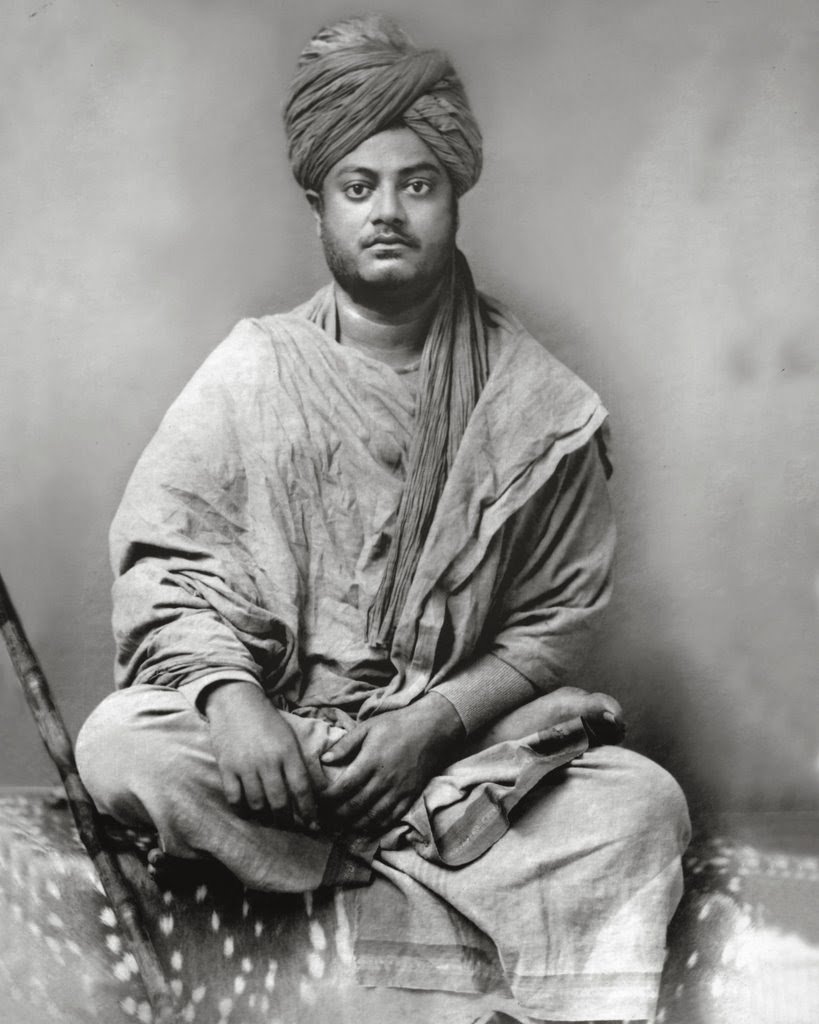
It
is to this Pandit Sankarlal that he wrote a letter from Seth Ramdas
Chhabildas’s home in Bombay on 20 September 1892[2],
some eight months before leaving for America.
One may note that subsequent to writing this letter he once again visited
Khetri. In this letter, he made some
unusually terse comments on the ‘dearth of those sciences which are the results
of observation and generalization.’ These
comments and the general viewpoint expressed in the letter are strangely at
variance with what he would preach just a few months later in America. Let us examine what Swamiji has to say in this
letter about the characteristics of “Hindu” science or the lack of
it.
Vivekananda writes:
I would tell you something else. The Hindu mind was ever deductive and never synthetic or inductive. In
all our philosophies, we always find hair-splitting arguments, taking for granted
some general proposition, but the proposition
itself may be as childish as possible. Nobody ever asked or searched
the truth of these general propositions. Therefore, independent thought we have none to speak of, and hence the
dearth of those sciences which are
theresults of observation and
generalization.
proceeding any further, we would note that although Vivekananda is here apparently towing the
lines propagated by Vidyasagar, Akshay Kumar
Datta and early Bankim Chandra, there are substantial differences between the two viewpoints.
Vivekananda, all our philosophies
suffer from the alleged abhorrence of
experiment and observation. Both
recent and Vivekananda’s contemporary research point to the fact that, if anything, this idea is one-dimensional and
oversimplified. Vivekananda’s classmate at the Scottish Church
College and the doyen of
Indian philosophy, Brajendranath Seal very clearly stated: ‘The
Sankhya-Patanjali system accounts for the Universe on principles of cosmic
evolution; the Vaisesika-Nyaya lays down the methodology of science, and elaborates
the concepts of mechanics, physics and chemistry. The Vedanta, Purva-Mimamsa,
and in a less degree the Bauddha, the Jaina, and the Charvaka systems make
incidental contributions on points of specific interest, but their main value
in this regard is critical and negative.’ [3]
Other scholars have at various times, in their own way, pointed to the
difference between the various strands of Indian philosophies so far as the
development of empirical ideas is concerned. Simon Blackburn notes that ‘Nyaya
generally tends towards a realist metaphysics, and anticipated many later
western concerns, for instance with the problem of distinguishing true from
misleading perceptions, with induction, and the nature of knowledge via
testimony.’ [4]
Recalling the advice offered by Javali,
‘a sceptical pundit’, to Ram (‘Follow
what is within your experience and do not trouble yourself with what lies
beyond the province of human experience’),
Amartya Sen observes: ‘This
observational focus is, of course, in line with the materialism of Lokayata and
the Carvaka system.’ He goes even
further, showing that ‘the rationale of the Lokayata approach is quite close to
a methodological point that Francis Bacon would make with compelling clarity in
1605 in his treatise The Advancement of
Learning.’ Indeed, the flowering of Indian science in the Gupta period owed much to this ‘tradition of
scepticism and questioning.’ [5]
Recently Prof. Ramkrishna Bhattacharya, while calling Charvaka ‘the most
uncompromising materialist school of philosophy in ancient India’, has also demonstrated that ‘there is enough evidence to show that
the Cārvāka-s … did admit inference in sofar as it was grounded in
perception.’ He also establishes ‘the
fact that there existed a pre-Cārvāka school of materialism in India.’ [6]
How can then one so sweepingly comment that ‘independent thought we have none
to speak of, and hence the dearth of those sciences which are the results of
observation and generalization’ ? Even
if we leave out everything else, was not Indian medicine clearly a triumph of this empirical approach?
Vivekananda’s had so embarrassed the editor of the volume that in a footnote he
felt compelled to inform that ‘In later days he [Vivekananda] acknowledged that
India gave birth to many sciences, though they developed elsewhere.’[7]
We shall presently come to what the
‘changed’ Vivekananda preached, but here it should be noted that although he
has often made contradictory remarks on many things (for example, on the utility or otherwise of the caste
system), such an editorial attempt to draw attention to his ‘later’ change of opinion is rare indeed. One does,
however, appreciate the editor’s predicament. First of all, here is a great man known for
his super-human intellect and memory and yet making a plain faux pas. This is
all the more surprising because nine years prior to this letter Akshay Kumar
Datta had presented in the celebrated introduction to the second volume of his Bharatbarshiya
Upasak Sampradaya a detailed and differential account of the Indian
philosophies from the Baconian standpoint.
Even earlier, in 1873 Bankim Chandra in his essay ‘The Study of Indian
Philosophy’ [8]
had analysed the successes and the lapses
of the Indian philosopher-scientists. How could Vivekananda miss these eminent
analyses?
a global manner demolishes his Hindu-nationalist image completely. On the face
of it, he was following Vidyasagar’s dictum that ‘the Samkhya and Vedanta are
false systems of philosophy’. This
cannot but embarrass a missionary editor. Strangely enough, the Bengali edition
of the works of Swami Vivekananda, while incorporating a translation of this
letter, does not carry this editorial caveat.
raises the all important question: why did the ‘Hindus’ fail in empirical
science? He confidently answers:
of the climate forcing us to love rest
and contemplation better than activity, and the Brahmins as priests never undertaking
journeys or voyages to distant lands. There were voyages and people who travelled far; but
they were almost
always traders,
i.e., people for whom priestcraft and their own sole
love for gain had taken away all
capacity for intellectual development. So their observations, instead of adding to the store of human knowledge,
rather degenerated it. For, their
observations were bad, and their
accounts exaggerated and tortured into
fanatastical shapes, until they passed
all recognition.
oppressive summer heat, circumscribed priests and the outgoing traders’ “sole
love for gain” — these are the factors that stood in the way of the
development of empirical science in India. It is because of these
factors that the tired Hindu mind became
idle and estranged from reality on the one hand and crassly this-worldly on the other.
And yet, quite a few hypotheses trying to explain the decline of
Indian science were ready at hand. In 1883, Datta had lamented that because of
the absence of an empiricist philosopher
like Bacon or a positivist like Comte, the great achievements of Kapila or Kanada
could not “grow, blossom and fructify”. Bankim Chandra in 1873, while
agreeing that excessive reliance on deductive logic was at the root of the
decay, had accused theology as being chiefly responsible for this. We have seen how the Baconian
Vidyasagar in 1853 had denounced Sankhya
and Vedanta as ‘false systems of philosophy’. Another illustrious contemporary
of Vivekananda’s, Prafulla Chandra Ray had later diagnosed that Sankara’s advaitabad on the philosophical side and
the post-Buddha casteism on the social side were among the major factors
responsible for the decline of the once-glorious Indian science. None of these
thinkers had condemned ‘Hindu’ philosophies en masse for this decline.
elsewhere. It was impossible for him to critically examine the above factors
for ideological reasons. Hence the either/or approach. Just consider: 1) Being
a follower of the anti-Buddha Sankaracharya
who preached advaitabad, how could Vivekananda
denounce mayavad as one of the
harmful influences? 2) Being a theist who
embraced ritualistic deity-worship, how could he accept, even examine,
the materialistic, empirical logical method of the Charvakas based on
experiment? 3) Being a religious leader
for whom theology formed the inviolable basis for all argument, how could he,
like Bankim, castigate an excess of theology as detrimental to the growth of empirical
thinking? 4) Being a Hindu nationalist who considered the pre-Buddha Indian
social system ideal, he always prevaricated in denouncing the caste system. In
one place he would say that by stultifying competition, this system has
finished the Hindus. In another place he would say with equal confidence that
by stultifying competition, this system had helped sustain the Hindus through
the vicissitudes of history. Unable for ideological reasons to consider any of
the above hypotheses as the causative
factors for the decline of Indian science, his entire ire fell on the
narrow-minded priests. This ire is entirely justified. However, without a
mention of the chief philosophical and social reasons, this castigation of the
priests alone smacks of a kind of escapism.
for India’s
failure in science, the weakest link is the traders’ ‘love for gain’. For it is an established fact
of history of science that it was the
traders’ love for gain that had promoted science everywhere — in Egypt, in China,
in Europe, in the Arab countries, even in
Buddhist India.
Swami Vivekananda has correctly reminded
us that Vivekananda had changed his
opinion expressed in this letter of 1892. The fact is, he took the equally
uncritical path to land at the opposite pole. A few examples will suffice. In 1896
he opined that the ‘Hindu philosophical doctrines’ are in wonderful conformity with ‘all the
discoveries of modern science’; so much so that ‘whatever the lacunae, they are
all on the side of modern science’. [9]
He went
on to assert: ‘Modern scientists are gradually coming round to agreeing
with the ancient sages and to the extent that the scientists agree with the
ancient sages, there is no problem.’ And
yet, just four years before this, he believed that ‘independent thought we have none to speak of,
and hence the dearth of those sciences which are the results of observation and
generalization.’ One wonders through
what research, through the discovery of what new facts did he arrive at this
diametrically opposite view? The explanation is sometimes offered that he was
speaking to the West and eulogising India’s past was a sine qua non for a nationalist like him.
If this be true, then it must be accepted that the truth-content of his
statements is virtually nil; what mattered was the immediate propaganda-value. Was
he not too great a thinker to be belittled thus?
Vivekananda and Jogesh Chandra
profitable to discuss a similar kind of change of opinion in the great polymath
Jogesh Chandra Roy-Vidyanidhi (1859-1956), a little-discussed
contemporary of Vivekananda’s. Jogesh Chandra
has discussed these matters in
detail in his magnum opus Aamaader
Jyotish O Aamaader Jyotishi (Our Astronomy and Our Astronomers, 1903). This
professor of botany and physics at the Ravenshaw
College, Cuttack, was ‘under the impression that there
is nothing worth knowing in our astronomy.’ Then he met Mahamahopadhyay Samanta Sri Chandrasekhar
Samanta, who did not know English. ‘After a short acquaintance with him’
Jogesh Chandra could realize that ‘even in the common panjikas then in vogue there were some interesting
calculations and that prior to the invention of the telescope and the advent of
Copernicus in Europe, our astronomy compared very well with European astronomy.’
[10]
Jogesh Chandra noted that in the absence of astronomers who could calculate the
paths of the planets even without the help of telescopes, ‘anarchy
prevailed’ in the world of panjikas.
Chandrasekhar was, however, a man who
could make such calculations. Encouraged by his feat, Jogesh Chandra started
studying Indian astronomy in real earnest and published in 1903 his classic.
It’s interesting to note that while he was elated at the achievement of
Chandrasekhar, he was not blinded by it.
Rather he mentioned that ‘I am not saying that his calculations are
mistake-proof. However, when pointed out, he would accept them without batting
an eyelid.’ [11]
 |
| Jogesh Chandra Roy |
In a famous speech at California
in 1900 Vivekananda had claimed: ‘And the Indians knew about gravitation a
thousand years before Newton
was born.’ [12] In his book, Jogesh Chandra specifically dealt
with the statement of Bhaskaracharya on which Vivekananda — and many others —
based this claim. Discussing Bhaskaracharya’s arguments Jogesh Chandra writes:
‘Thus, this earth-mass has no receptacle; it is held firmly in space by its own
force. The great cosmos, the world, the humans, the demons all reside on its
surface. What then of the series of receptacles described in the puranas? Bhaskar answers, “If this earth had a
receptacle in the shape of a concrete body or of an animal, then that receptacle itself would
require another receptacle to hold it and so on. This leads to infinite
regression. … Again, if you say the
receptacle has an end, then it must be
admitted that this final receptacle has remained steady through its own force.
But, if that receptacle can hold on its own, why cannot the earth? … ” [13]
discussed this, Jogesh Chandra raises the question: ‘But, if the earth is
situated in space, why does it not fall down?’ He quotes Bhaskaracharya to
answer this question:
bodies are attracted towards the earth by a force of attraction. It appears to us that the body is falling;
whereas in point of fact, it is being attracted
by the earth. The earth is enveloped on all sides equally by space, so where would it fall? Whoever may reside wherever on earth, he would feel it to be underneath him and himself remaining upon it. Two persons
standing at the two extremities
of the earth’s diameter are both standing
with their heads down, like the
shadow of a person standing on a river bank. Humans situated at the nether part of the earth are
standing as steadily as we.’ [14]
footnote: ‘Utpal has beautifully commented that “If the earth must fall,
where would it fall? Downwards? But what is meant by downwards? Pratiyogishchapekshadhah. There is space
on all sides of the earth.’ That the notions
‘up’, ‘down’ etc. are all relative is now known to everyone thanks to the
popular books on the theory of relativity; but the clarity with which this
apparently strange concept was put forward eight hundred years ago cannot fail
to elicit admiration.
an Indian nationalist, Jogeshchandra was naturally proud of the great achievements
of Varahamihira, Acharya Aryabhata and Bhaskaracharya. But at the same time he
took pains to clarify that to speculate on some force akin to gravitation and
to prove its working scientifically — which is what Newton did — are entirely
different things. In a footnote he added
in rather acidic terms that “some dilettantes” cite Bhaskarcharya’s explanation
(‘It appears to us that the body is falling; whereas in point of fact, it is
being attracted by the earth’) to ‘belittle Newton’s discovery. These people
must know, there’s a hell-and-heaven difference between the two.’ [15]
One might mention in passing that later Meghnad Saha was to elaborate on this
in much more aggressive terms.
difference between Jogesh Chandra and Vivekananda is thus obvious. The former was a man of ‘hard’ science; no amount
of effusive nationalism could make him forget scientific methodology. On the
other hand, Vivekananda was primarily a man of theology and philosophy. His
overriding commitment was not to scientific methodology but to ideological expediency.
Thus, while lecturing in the West, his patriotism carried him away so much that
he often failed to do justice to facts of science and history. That is why he
could jump from one pole to the other and be an extremist at both the poles.
minus myth), Kolkata, 1998, pp. 73-78. Translation mine.
Vivekananda , Advaita Ashrama, Mayavati, Champawat, Uttaranchal, (First
Edition 1940), Fifteenth Impression, May 2006, pp. 27-28
Positive Sciences of the Ancient Hindus (1915), Sahitya Samsad Calcutta Reprint 2001, p.1
Dictionary of Philosophy, OUP, Oxford,
1996, p. 266
2003, pp. 26-27
Editrice Florentina, Firenze 2009, pp. 9-10
Samsad, Calcutta
(1969), Reprint 1998, pp. 142-148
p. 14. Translation mine
Roy-Vidyanidhi, Aamaader Jyotish O
Aamaader Jyotishi (Our Astronomy and Our Astronomers, Kolkata, 1903, Introduction . Translation
mine
Roy-Vidyanidhi, p. 134
Roy-Vidyanidhi, p. 341
Roy-Vidyanidhi, p. 342
Roy-Vidyanidhi, p. 341
Leave a Reply