Bending Spoons
With Mind Power?
🥄 A world-famous “power”
A performer holds an ordinary metal spoon between his fingers. He stares at it, strokes it gently, and asks the audience to concentrate. Slowly, the spoon begins to droop… and bend! He says he isn’t pushing it at all: his mind is doing it.
In the 1970s, spoon bending became famous all over the world. Performers bent spoons on television, and some scientists even tested them in laboratories. Today, “spoon-bending” is still sold as a mind-power skill in workshops and online videos.
Stop before you read on! If the mind can’t bend metal, how could a spoon seem to bend in front of your eyes? Write down your guesses.
🧪 Try It Yourself
What you need
- 🥄 A metal spoon for Part 1 (it won’t be bent)
- 🥄 An old, cheap, thin spoon for Part 2 Ask a grown-up
- 🖊️ A felt pen or a sticker
- 🪞 A mirror, for practice
- 🧑🤝🧑 A friend
📄 Download the worksheet (PDF)
Part 1: The bend that isn’t there
- Hold the spoon upright, with the tip of the bowl resting on the table and the handle pointing up.
- Wrap both hands around the handle, one above the other, so that the handle is completely hidden. Only the bowl shows below your little finger.
- Your audience must sit in front of you, looking at the backs of your hands. Practise in the mirror first.
- Say “Concentrate…”, then slowly tilt your hands forward towards the table. Let the hidden handle slide down behind your hands, flat towards the table, while the bowl stays where it is.
- From the front, it looks exactly as though the spoon is bending! Then lift your hands and show that the spoon is perfectly straight. “It must have healed!”
Part 2: The secret bend
There are two ways to make a real bend look like a miracle. Performers have used both.
Way A: bend it during the show. This is how magicians reproduce the famous “mind-power” performances.
- Hold the old spoon with both hands, the bowl in one hand and the handle in the other, resting your hands on the table.
- Ask your audience to look at something else for a moment: “Look at my other hand… concentrate!” or point to the ceiling and ask, “Did you hear that?”
- In that moment, while all eyes are elsewhere, bend the spoon quickly at its neck, the thin part where the handle meets the bowl. Pressing it against the edge of the table makes it easier. It takes less than a second.
- Now hold the spoon so that the bend points straight towards the audience, so that it still looks straight. Stroke the neck gently, then very slowly turn the spoon sideways. The bend comes into view, so it seems to be bending right now.
Way B: bend it before the show. This is the easier way, good for beginners.
- Out of sight, before the show, bend the spoon a little at its neck. Thin, cheap spoons bend surprisingly easily with your thumbs.
- Hold it with the bend pointing straight at the audience, stroke it, and slowly turn it sideways, just as in Way A.
Either way, there is no miracle: just a bent spoon, and a moment when nobody was looking.
Part 3: The detective test
- Now your friend is the detective. They bring their own spoon, which you have never touched, and mark it with a pen or sticker so that it can’t be swapped.
- They keep watching the spoon the whole time. Can you “bend” it with your mind?
Before each part, guess: will the spoon seem to bend, or stay straight? Then try it and see whether you were right. Write your answers on the worksheet.
💡 The Science Behind the Trick
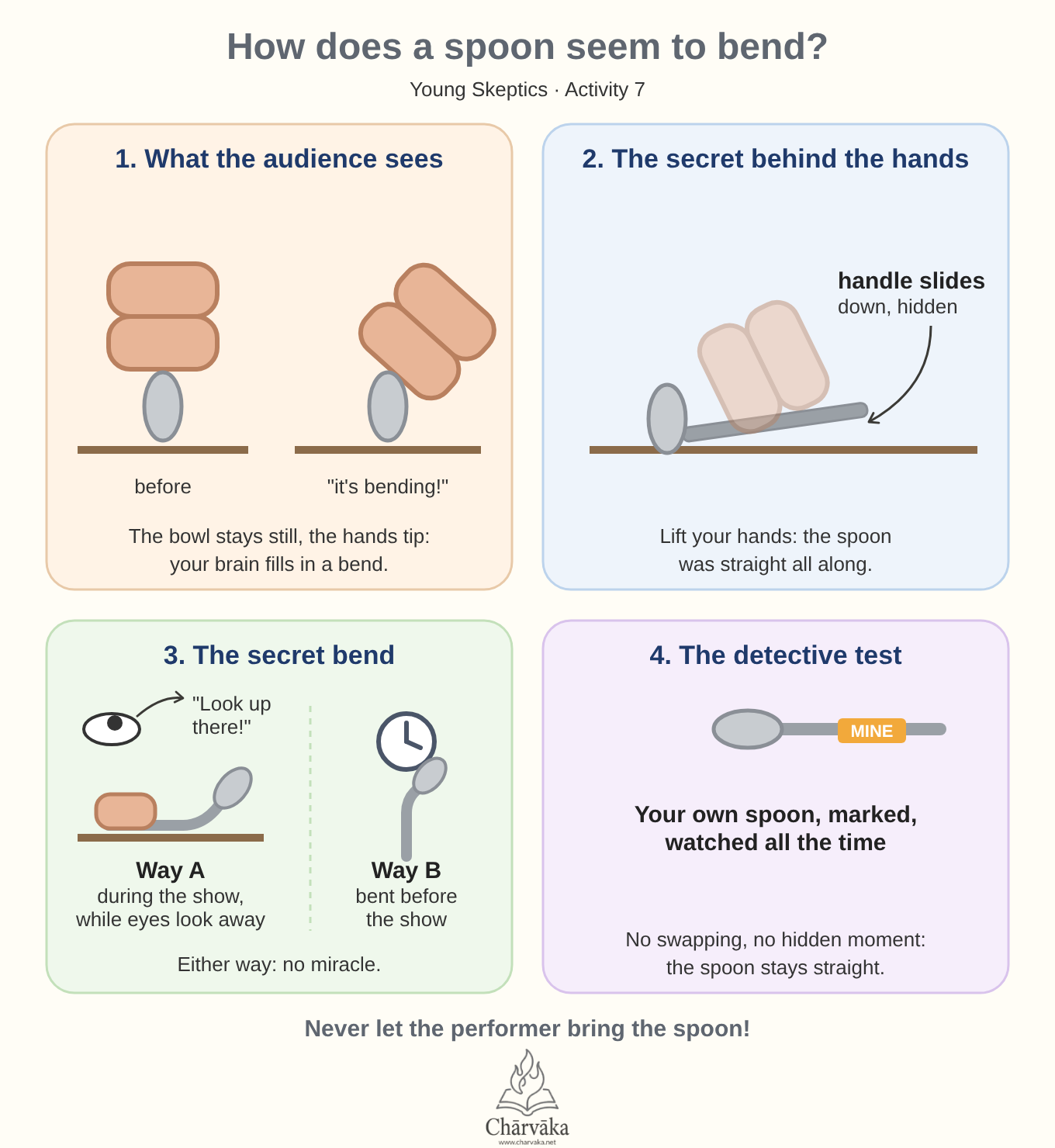
Your eyes fill in the gaps. In Part 1, the audience can’t see the handle. They see the bowl stay still and the hands tip forward, and their brain fills in the missing part: “the spoon is bending”. Our brains are always guessing what we can’t see, and usually they’re right. Magicians use the times when they’re wrong.
A moment is all it takes. Bending a thin spoon takes less than a second. The performer only needs one moment when the audience is looking somewhere else, which magicians call misdirection. Afterwards, nobody remembers that moment, because they didn’t see it.
Where you stand matters. A bend that points straight at you is almost invisible, because you are looking along it. Turn the spoon sideways, and the same bend is obvious. That’s why the performer turns the spoon slowly: the bend was already there, whether it was made before the show or a few seconds earlier.
The neck is the weak point. A spoon’s neck is its thinnest part, and the long handle works like a lever: a small push at the end of the handle makes a big force at the neck. With a cheap spoon, ordinary thumbs are strong enough. Bend it back and forth a few times and the metal gets weaker and weaker, until it can even snap. This is called metal fatigue.
Why the detective test works. It stops both ways at once. A spoon you bring and mark yourself can’t be swapped for one bent before the show. And when you keep watching it, without looking away even once, the performer has no unwatched moment to bend it during the show.
🧠 Think Like a Scientist
Scientists are clever, but they aren’t trained to catch tricks. Magicians are. That’s why, when someone claims a magic power, it helps to have a magician watching too.
Never let the performer bring the spoon.
Bring your own, and mark it!
A real power would bend any spoon, under any conditions. A trick needs the performer’s own spoon, his own angle and a moment when nobody is looking.
🗣️ Now be the teacher
Teach your family the fair-test rule: use your own spoon, mark it, and keep it out of the performer’s hands until the test begins. Ask: why does marking the spoon matter? (So that it can’t be swapped for a prepared one.)
🎩 Meet James Randi, the Magician Who Caught the Tricksters

(1928–2020)
James Randi, known as “The Amazing Randi”, was a famous stage magician. He could escape from locked boxes and handcuffs, but he became even more famous for catching people who claimed real magic powers.
In the early 1970s, a performer called Uri Geller was amazing television audiences by bending spoons, he said, with his mind. Before one of his appearances on a popular American TV show, Randi advised the host to use the show’s own spoons and keep them out of the performer’s hands until the show began. That night, the spoons did not bend.
Later, Randi sent two young magicians, Steve Shaw and Michael Edwards, to a laboratory that was studying psychic powers. For about three years, they fooled the scientists with ordinary magic tricks, including spoon bending. The scientists had not used labels that couldn’t be swapped, even though Randi had warned them. In 1983, Randi revealed the hoax, so that scientists would learn to test more carefully.
He offered a prize of one million dollars to anyone who could show a real psychic power under fair test conditions.
Nobody ever won it. Like Abraham Kovoor in Sri Lanka and India, Randi showed that the best person to test a “miracle” is someone who knows how tricks are done.
For parents and teachers
- Safety and permission: Part 2 needs an old, cheap, thin spoon; children should bend it gently with their hands, pressing only against a smooth, rounded table edge, never a sharp one. It must be one that the family doesn’t mind spoiling, used with a grown-up’s permission. Don’t bend the same spoon back and forth many times: metal fatigue can make it snap and leave a sharp edge.
- The fair test idea: Part 3 uses the same principle as the villagers’ banana in Activity 5: the performer must not control the materials. Ask children why marking the spoon matters. (So it can’t be swapped for a prepared one.)
- About the methods: performers who claim real powers do not reveal their methods. Way A and Way B are how magicians reproduce the effect, which shows that no special power is needed.
- Going further: older children can look up the idea of “controls” in experiments, and discuss why Randi thought magicians should help scientists design tests of psychic claims.
- The real story: the 1970s television appearance is described in the Associated Press obituary “James Randi, dazzling magician and skeptic, dies at 92” (2020); Project Alpha in “Project Alpha: In 1979, magicians infiltrated a laboratory” (IFLScience). About Randi: “James Randi” (Wikipedia).
Based on the methods of stage magicians and the investigations of James Randi, with the assistance of AI tools, and reviewed by our editors. — CHARVAKA DESK