Ash From
an Empty Hand
✨ The amazing claim
A holy man waves his empty hand in the air. He turns it over, rubs his fingers together… and grey, sweet-smelling sacred ash pours out into a devotee’s palm. Where did it come from? His followers say he made it out of thin air, by divine power.
For many years, some famous godmen in India drew huge crowds with this “miracle”. People treasured the ash as a blessing, and believed the godman could also heal them and solve their problems.
Stop before you read on! If ash can’t really come from nothing, where could it be hiding? Write down your guess.
🧪 Try It Yourself
What you need
- 🖍️ A stick of soft white blackboard chalk
- 🥄 A spoon or a small stone, to crush it
- 💧 A few drops of water
- 🧑🤝🧑 A friend to fool
- 🪞 A mirror, for practice
📄 Download the worksheet (PDF)
Part 1: Make the secret pellet
- Crush a little chalk into fine powder with the back of the spoon.
- Add just two or three drops of water, and squeeze the powder into a small ball, about the size of a pea. Let it dry for half an hour. (A small, soft piece of chalk works too.)
- This little pellet is your secret. When you rub it between your fingers, it crumbles into powder that looks just like ash.
Part 2: Practise the “miracle”
- Hold the pellet between the bottoms of your middle finger and ring finger, where they join your hand. Squeeze your fingers gently together to hold it.
- In front of the mirror, show the back of your hand, and wave it gently in the air. The pellet is hidden behind your fingers.
- Look up at your audience and talk to them, so they watch your face, not your hand. Then turn your hand over, curl your fingers, and rub the pellet with your thumb.
- Let the “ash” trickle down into your friend’s open palm. The more slowly you rub, the longer the supply seems to last!
Part 3: The detective test
- Now swap roles. Your friend becomes the detective. Before you start, they check both sides of your hands, with your fingers spread wide apart, and look in your sleeves.
- Try to make ash appear while they watch your hands, not your face. Can you do it?
Before each test, guess: will the “ash” appear, or will the trick fail? Then try it and see whether you were right. Write your answers on the worksheet.
💡 The Science Behind the Trick
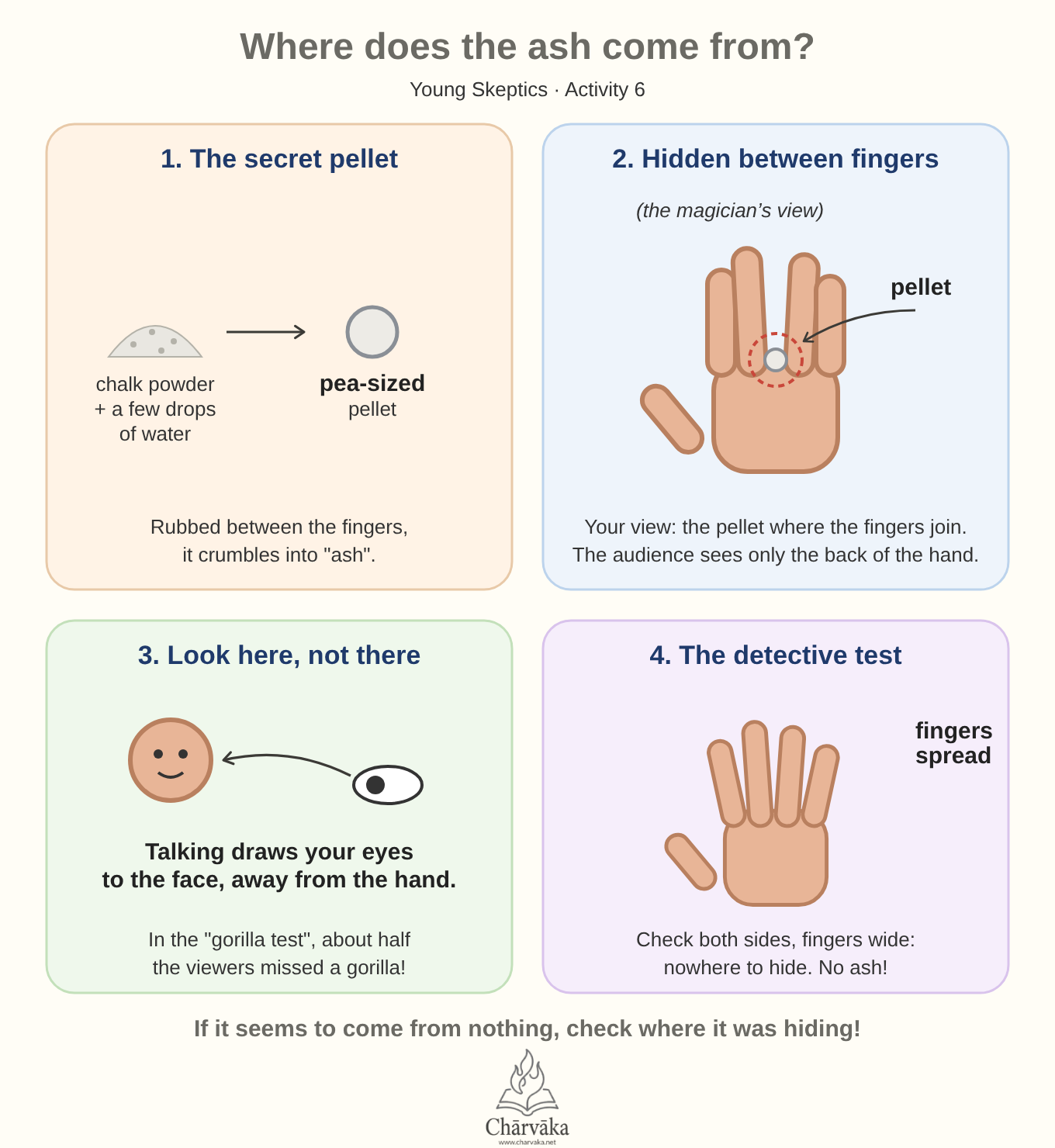
Nothing comes from nothing. Matter can’t appear out of empty air. If ash appears, it must have come from somewhere, and in this trick it was in the hand all along. A pressed pellet of powder holds together until it is rubbed, and then it crumbles back into powder. Godmen were reported to use pellets of ash or other powders in just this way.
Where you look, and where you don’t. Our brains can only pay close attention to a few things at once. When the performer looks at you and talks, your eyes follow his face, and you stop watching his fingers. Magicians call this misdirection.
Scientists have shown how strong this is. In a famous experiment, people watched a video and counted how many times a team passed a basketball. Halfway through, a person in a gorilla suit walked right through the middle of the game. About half the viewers never noticed the gorilla at all! If people can miss a gorilla, they can easily miss a tiny pellet.
Why the detective test works. When someone checks your hands with your fingers spread apart, there is nowhere left to hide the pellet. And when they watch your hands instead of your face, misdirection stops working.
🧠 Think Like a Scientist
The devotees saw ash appear from a hand that looked empty. But looking empty and being empty are not the same thing.
If something seems to come from nothing,
check where it was hiding.
A real miracle would still work under close watch, with the hands checked first. A trick needs you to look somewhere else.
🗣️ Now be the teacher
Teach your family the detective test: before anyone shows a “miracle”, check both hands, with the fingers spread, and the sleeves, and watch the hands, not the face. Ask: why does looking at the performer’s face help the trick? That’s misdirection.
📖 Meet Abraham Kovoor, the Miracle Buster
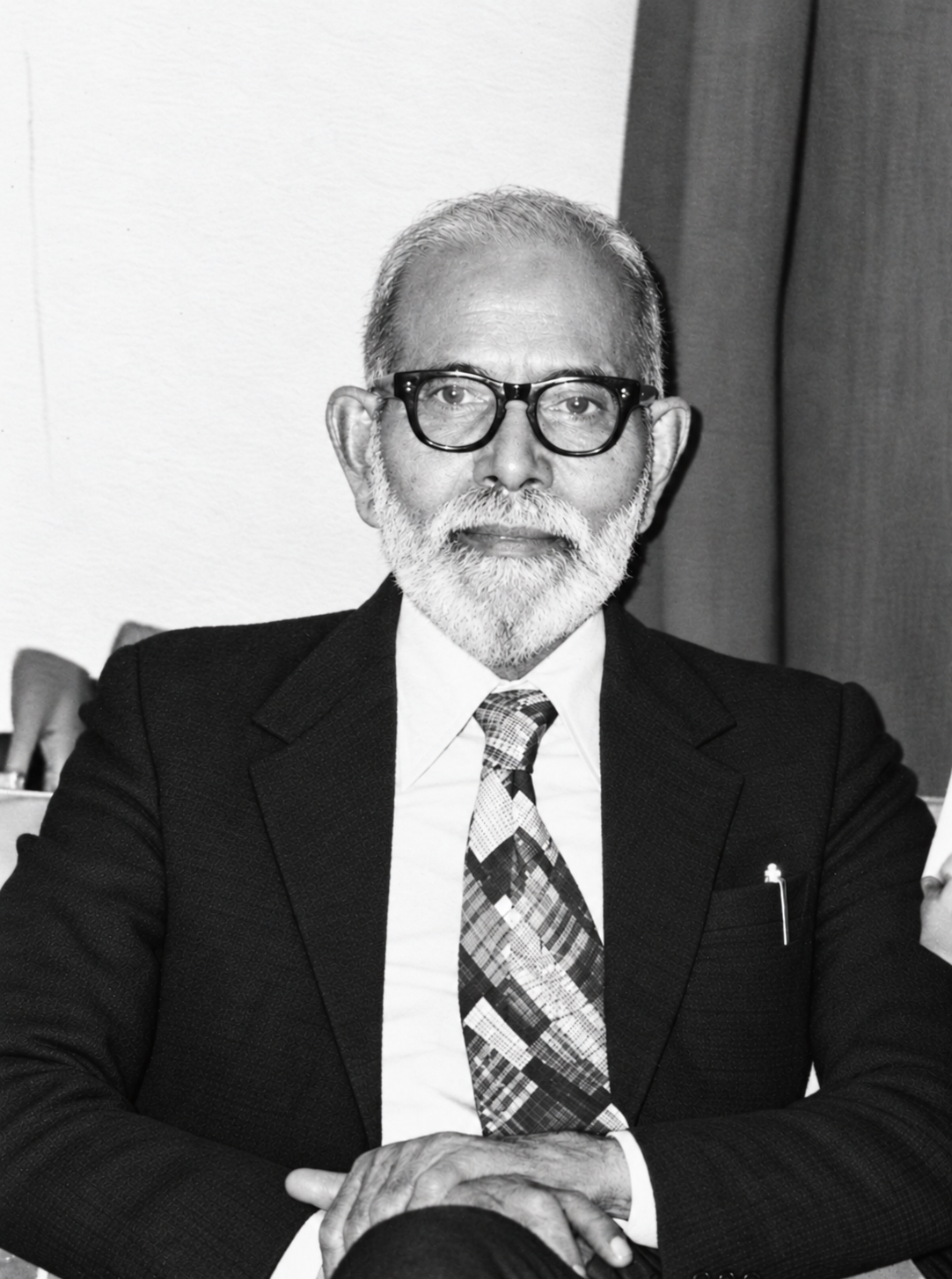
(1898–1978)
Abraham Kovoor (1898–1978) was born in Tiruvalla, Kerala, the son of a clergyman. He studied science in Calcutta, and in 1928 he moved to Sri Lanka, then called Ceylon, where he taught botany and other sciences in colleges for more than thirty years.
After he retired in 1959, he spent the rest of his life teaching people to think for themselves. As president of the Ceylon Rationalist Association, he travelled all over Sri Lanka and India, speaking in hundreds of towns. At his talks, he produced “sacred ash” from his own empty hands, handed it out, and then showed the audience exactly how he did it.
In 1963 he offered a prize, later raised to one lakh rupees, to anyone who could show a real miracle under fair test conditions, such as reading the number of a currency note sealed in an envelope. In fifteen years, nobody won it. One of his favourite sayings was:
“He who does not allow his miracles to be investigated is a crook.”
Kovoor wrote books such as Begone Godmen! (1976), and Gods, Demons, and Spirits (1980), and a Malayalam film, Punarjanmam (1972), was based on one of his cases. Even after death he helped science: he left his body for medical students to study, and his eyes to an eye bank.
Seeing Isn’t Checking · Our Senses Have Blind Spots · Who Has to Prove It?
For parents and teachers
- Safety: use ordinary chalk, not talcum powder, which should not be breathed in. Children should not put the powder in their mouths or rub it near their eyes. Wash hands afterwards.
- Blind faith, and respect: sacred ash is used with devotion in many homes and temples, and that is not what this lesson questions. The lesson is about blind faith in “materialisation”: accepting that something appeared from nothing without checking. Encourage children to test rather than mock.
- The history: producing vibhuti from an apparently empty hand was the best-known “miracle” of Sathya Sai Baba (1926–2011). Rationalists argued that it was sleight of hand. Abraham Kovoor demonstrated the trick on his lecture tours of India, and in 1976 he challenged Sai Baba to perform under test conditions, which Sai Baba refused. Later rationalists, including B. Premanand, carried on these demonstrations. See “Abraham Kovoor” (Wikipedia) and his profile on Humanist Heritage (Humanists UK).
- The gorilla experiment: by psychologists Daniel Simons and Christopher Chabris. See “Bet You Didn’t Notice the Invisible Gorilla” (NPR). Children can find the original video online by searching “selective attention test”.
Based on the demonstrations of Abraham Kovoor and the rationalists who followed him, with the assistance of AI tools, and reviewed by our editors. — CHARVAKA DESK