The 1995 Milk Miracle:
Can a Statue Drink?
🥛 A true story
On 21 September 1995, a remarkable piece of news spread across India: statues of Ganesha were drinking milk! People held spoons of milk to the statues, and the milk seemed to vanish.
Within hours, the news had travelled by telephone, newspaper and television. Huge crowds queued at temples, and then the same thing was reported from many other countries. In Delhi, so much milk was bought for the statues that the city’s shops ran out within hours.
That very day, scientists began explaining what was happening, on television and in the newspapers. They offered the statues milk mixed with colour, and showed where it really went. Within a day, the “miracle” had stopped.
Stop before you read on! If the statues weren’t really drinking, where could the milk have gone? Write down your guess.
🧪 Try It Yourself
We’ll use just one spoonful of milk, and coloured water for the rest, so that nothing is wasted. Use a toy or an ordinary ornament, not a figure that your family worships.
What you need
- 🗿 A small white figure, such as a marble or white china ornament. An upside-down white mug works too.
- 🥛 One spoonful of milk
- 🍽️ A white plate or tray
- 🥄 A teaspoon
- 💧 A cup of water with a pinch of turmeric or a drop of food colour
- 🥤 An ordinary object: a steel tumbler, a stone or a glass bottle
- 🧻 A strip of paper towel
📄 Download the worksheet (PDF)
What to do
- Stand the white figure on the white plate.
- White on white: fill the spoon with milk. Hold it so that the edge of the milk just touches the figure, at the nose, the trunk or an edge. Hold very still and watch the spoon. Does the milk go down, as if the figure is “drinking”? Can you see where it went?
- Add colour: wipe the figure dry, then do the same with the coloured water. Now look closely at the figure and the plate. Where did the water go?
- Fair test: now try something that nobody would call holy: the steel tumbler turned upside down, the stone or the glass bottle. Touch the spoon to it in the same way. Does it “drink” too?
- Bonus test: dip just the end of the paper-towel strip into the coloured water, and hold it there for a minute. What does the water do?
Before each test, guess: will the water disappear from the spoon, or stay? Then try it and see whether you were right. Write your answers on the worksheet.
💡 The Science Behind the “Miracle”
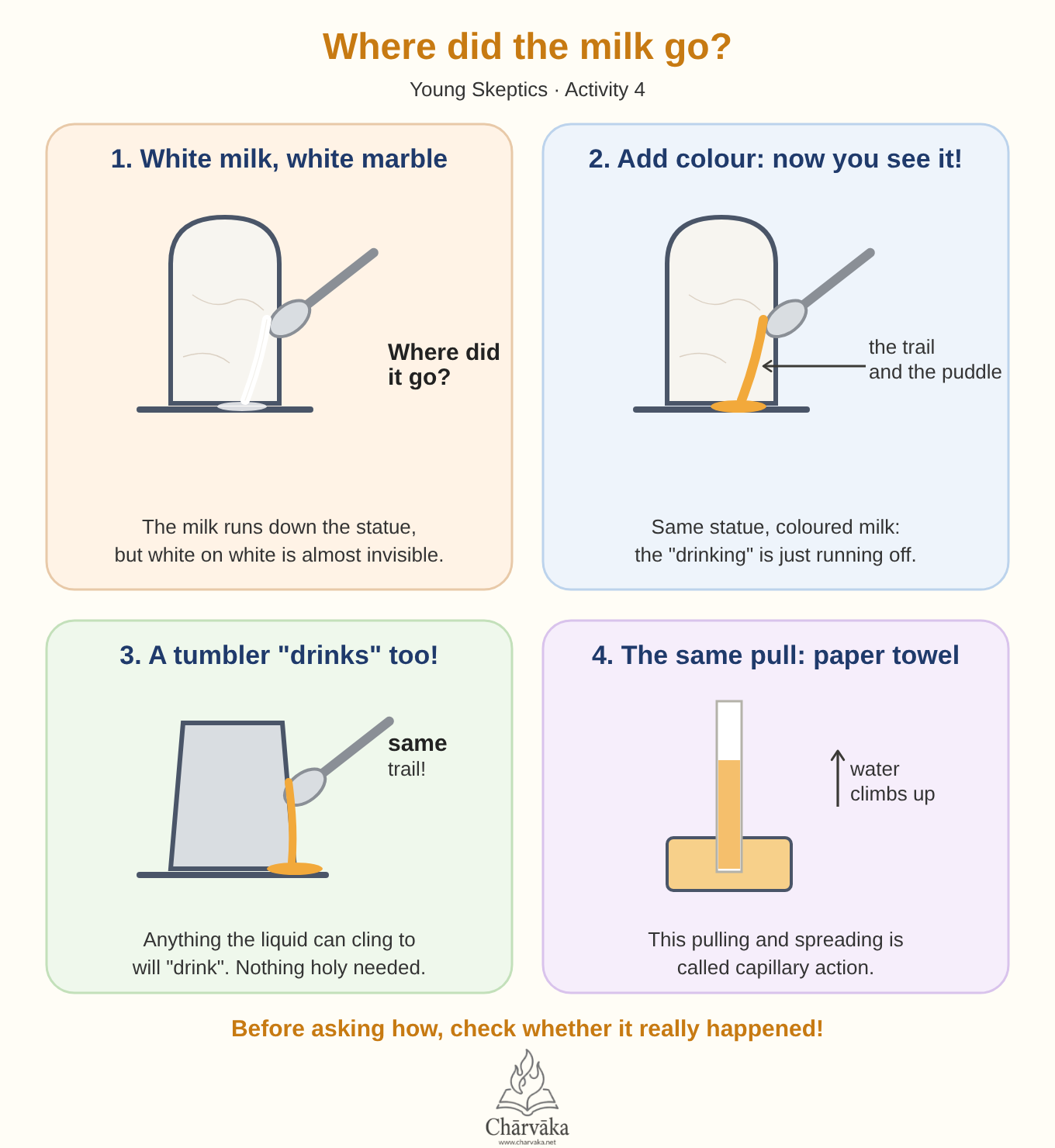
Liquids are “sticky”. The tiny particles in water and milk cling to each other, and they also cling to many surfaces they touch. You can see this when a raindrop clings to a window, or when water runs along the outside of a glass as you pour.
When the spoon touches the statue, the liquid clings to the statue and is pulled out of the spoon. It spreads as a thin film down the front of the statue, pulled by gravity, and collects at the bottom. This pulling and spreading is called capillary action, and it’s also what makes the water climb up your paper towel.
Why nobody saw it: many of the statues were made of white marble. A thin film of white milk running down white marble is almost invisible, especially on a statue that is already wet, in a crowded temple decorated with flowers. That’s why the coloured milk was so important: it showed the trail running down the statue, and the puddle at the bottom.
And here is the real giveaway: an ordinary tumbler or stone “drinks” just as well. If anything that liquid can cling to will “drink”, the statue isn’t doing anything special. In 1995, people even reported statues of Mahatma Gandhi and of the Virgin Mary “drinking”, which is exactly what you’d expect if it was ordinary science, and not a sign from any one god.
🧠 Think Like a Scientist
Millions of people asked, “How is the statue drinking?” Very few asked, “Is it really drinking? Where did the milk go?”
Before you ask how something happened,
check whether it really happened.
The news also spread because everyone seemed to believe it, on TV and by word of mouth. Today, stories like this spread even faster on WhatsApp and social media. When a surprising story reaches you, ask: has anyone actually checked?
🗣️ Now be the teacher
Ask your family to predict whether an ordinary steel tumbler will “drink” too. Then test it together, and follow the coloured water. Ask: if an ordinary object does it, what does that tell us about the statue? That’s a fair test with a control.
Seeing Isn’t Checking · Make It a Fair Test · Popular Isn’t Proof
For parents and teachers
- Blind faith, and respect: this lesson is about blind faith: believing a claim because many others believe it, without anyone checking. In 1995, millions of people accepted the “miracle” on trust, and the evidence was there to see on every statue. Many families worship Ganesha, and some children may have relatives who saw the event, so use a toy or ornament, never a family’s worship figure, and encourage children to test rather than mock. Respecting people does not mean accepting every claim made in the name of faith.
- Not wasting food: the experiment uses coloured water. You might discuss with older children how much milk was poured away in 1995, while many children in India did not have enough to drink.
- Going further: try figures made of different materials. Unglazed clay soaks up some of the water as well, while shiny plastic may make the water run off in drops. Ask why the effect seemed to stop within a day. (The excitement faded, and once people knew to look for the trail, they could see where the milk went.)
- The real story: “The Hindu Milk Miracle” (Mental Floss); “1995 Ganesh Milk ‘Miracle’” (Thought & Action), which also records the statues of Gandhi and the Virgin Mary that “drank”; T. Jayaraman of the Institute of Mathematical Sciences, Chennai, who explained it the same day, “Obscurantism vs Science”; and, for the believers’ account at the time, “It’s a Miracle!” (Hinduism Today, November 1995).
Based on the “milk miracle” of 21 September 1995, with the assistance of AI tools, and reviewed by our editors. — CHARVAKA DESK