The Idol That Rose
From the Earth
🌱 The amazing claim
A holy man announces that a god has spoken to him in a dream. A sacred idol, he says, lies hidden in the earth at a certain spot, and it will rise out of the ground by itself.
He marks the spot, and the prayers begin. Songs are sung day and night, and the ground is sprinkled with holy water again and again. Two or three days later, the crowd gasps: the top of an idol is pushing up through the soil, all on its own! Word spreads. People come from far away to see it, and donations pour in. Soon there is talk of building a shrine on the spot, and the holy man becomes rich.
Stop before you read on! What could make a heavy idol rise up through the ground? And why do you think the ground had to be watered so often? Write down your guesses.
🧪 Try It Yourself
What you need
- 🫘 About 3 cups of dry chickpeas (kabuli chana) or Bengal gram (kala chana)
- 🥤 Three plastic cups or tumblers, all the same size (not glass)
- 🧸 Three small toy figures, all alike, or three bottle caps
- 🪴 Some soil or sand
- 💧 Water
- 📏 A ruler and a marker pen
📄 Download the worksheet (PDF)
Part 1: Prepare the secret
- Label your cups A, B and C.
- Fill cups A and B about half full with dry chickpeas. Fill cup C half full with soil only, with no chickpeas.
- Stand a toy figure on top of the chickpeas (or the soil) in each cup.
- Cover each toy with soil, until it is just hidden. Smooth the top so nobody could tell anything is buried there.
- Draw a line on the outside of each cup, level with the top of the soil.
Part 2: The “miracle”, and the fair test
- Cup A, the “miracle”: slowly pour water onto the soil until it soaks right through to the chickpeas at the bottom.
- Cup B, no water: leave it dry. It has chickpeas, but no “holy water”.
- Cup C, no chickpeas: water it exactly like cup A.
- Leave all three cups overnight. In the evening and the next morning, add a little more water to cups A and C, just as the ground was sprinkled during the prayers.
- The next day, look closely. Has anything appeared above the soil? Measure how far the soil has risen above your line in each cup.
Part 3: The detective test
- Gently dig into cup A. What do you find under the toy? Compare the chickpeas with a few dry ones. What has happened to them?
Before you start, guess: in which cups will the toy rise, and in which will it stay buried? Then test it and see whether you were right. Write your answers on the worksheet.
💡 The Science Behind the Trick
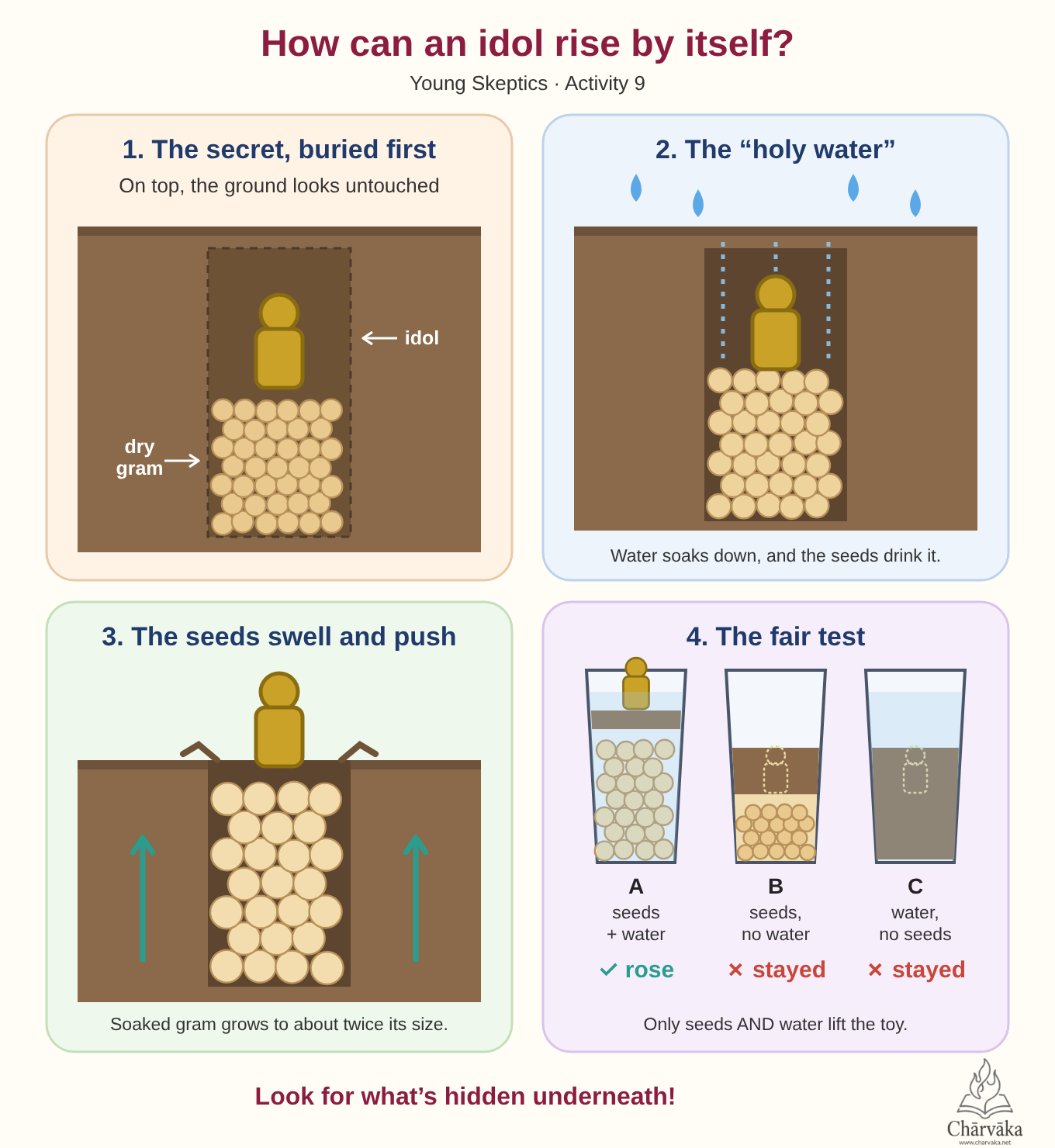
Thirsty seeds. A dry seed holds very little water. When it gets wet, it soaks water in through its skin and swells up. Soaked chickpeas grow to about twice their size. Scientists call this soaking-up imbibition.
Small seeds, big push. When thousands of seeds are packed together under the ground, each one pushes against its neighbours as it swells. They have nowhere to go but up, and together they push with great force, enough to lift a heavy idol, or even to crack a glass jar. That’s why you used plastic cups!
Why all that holy water? The seeds only swell if they keep getting wet. So the “holy water”, sprinkled again and again during the prayers, was really doing the work: it was soaking the seeds hidden under the idol.
Soaking, not sprouting. Some people think the seeds lift the idol by sprouting. In fact, almost all the push comes from the swelling, which starts within hours, long before any sprouts appear.
Why the fair test works. Cup B had seeds but no water, and cup C had water but no seeds. Only cup A, with both, should rise. That tells you exactly what lifted the toy: not prayers, not songs, but wet seeds.
🧠 Think Like a Scientist
The crowd watched the idol come out of the earth, and saw no one touch it. But nobody asked the most important question: what was under the ground before the prayers began?
When something seems to happen by itself,
look for what’s hidden underneath.
A simple test would have settled it: dig up the spot before the prayers start, with everyone watching. If an idol can really rise by itself, digging first does no harm. A trickster, of course, would never agree!
🗣️ Now be the teacher
Ask your family to predict which of your three cups will rise. Check together the next day, then dig into cup A. Ask: what one simple step would have exposed the “miracle” before the prayers even began? (Digging up the spot first, with everyone watching.)
The Simplest Explanation · Make It a Fair Test · Who Has to Prove It?
🕵️ Meet B. Premanand, the Guru Buster
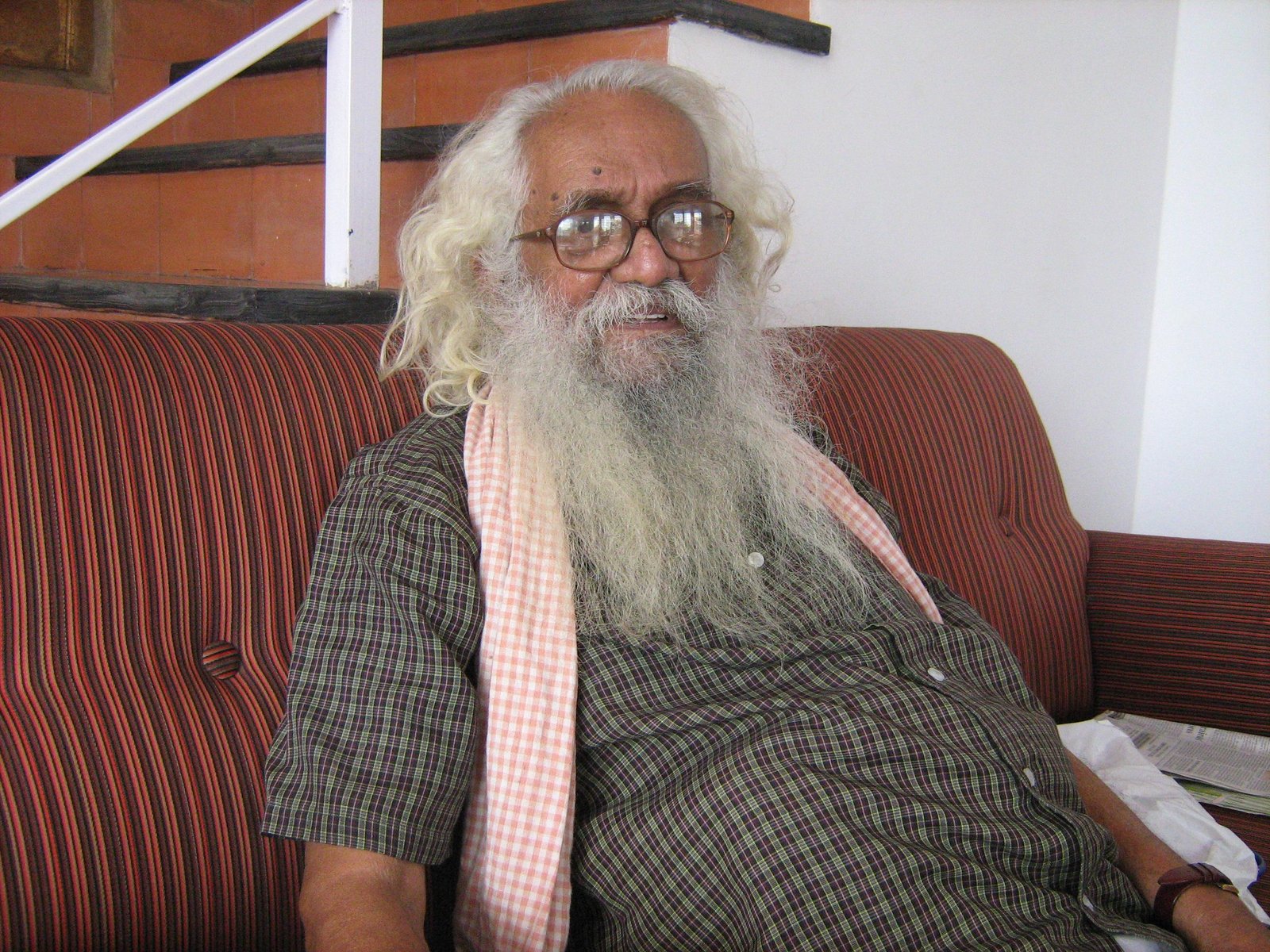
(1930–2009)
Basava Premanand was born in Kozhikode, Kerala, in 1930. As a boy he was fascinated by mysterious powers, and as a teenager he went looking for a guru who could really perform miracles. He visited swami after swami, and each time he found the same thing: a trick.
In 1969 he went to a talk by Abraham Kovoor, who was touring India exposing “miracles”. That talk changed his life. From then on, Premanand did the godmen’s “miracles” himself, in front of crowds, and then showed everyone how they were done. For more than thirty years he travelled to villages and towns, ran science workshops and visited dozens of countries.
After Kovoor died, Premanand carried on his famous challenge: one lakh rupees to anyone who could show a real miracle under fair test conditions. Nobody ever won it. He wrote Science Versus Miracles, which explains about 150 “miracles”, including the rising idol in this activity, and he published a magazine called The Indian Skeptic. He was so fearless that he even went to court against India’s most famous godman.
He believed that anyone, young or old, could learn to see through a miracle.
Like Kovoor, he helped science even after death: when he died in 2009, his body was given to a medical college, so that future doctors could learn from it.
For parents and teachers
- Safety: use plastic cups, not glass: swelling seeds can crack glass. Dry chickpeas are a choking hazard for children under three. Don’t eat the soaked chickpeas from the experiment, and throw them away after a day or two, before they go mouldy. Wash hands after handling the soil.
- If it doesn’t rise: make sure the water reaches the chickpeas, and don’t bury the toy too deep: just enough soil to hide it. A heavier toy rises more slowly. Give it a full night.
- The real thing: “discovering” buried idols is still used to raise money. In Etah, Uttar Pradesh, in 2018, a farmer buried a brass idol he had bought months earlier, then “found” it and collected about ₹75,000 in a day; he later told police he had planned to become a godman (“Clash nails up farmer’s lie about Hanuman ‘miracle’”, The Asian Age, 2018). In Unnao, Uttar Pradesh, in 2022, a family said a goddess had told them in a dream where idols lay buried; the idols had been bought online for ₹169, and the online shop’s delivery man helped police expose them (“Three men arrested for purchasing idols online, placing them in field to claim ‘miracle’”, Outlook, 2022). In both cases the idols were simply buried; the swelling-seed method that makes an idol rise is described by B. Premanand in Science Versus Miracles.
- Going further: measure the rise every few hours and draw a graph. Try other seeds, such as rajma, moong or dried peas: which push hardest? Older children can weigh the chickpeas before and after soaking, to see how much water they drink.
- About B. Premanand: see “Basava Premanand” (Wikipedia) and “Basava Premanand, the godman-buster” (ThePrint, 2019).
Adapted from Science Versus Miracles by B. Premanand (1930–2009), with the assistance of AI tools, and reviewed by our editors. — CHARVAKA DESK