The Pendulum That Knows the Answer
🔮 The amazing claim
A woman holds a ring on a thread over a person’s hand. She asks a question, and waits. Slowly, the ring begins to swing: round in a circle for “yes”, back and forth for “no”. Nobody is pushing it!
She says the pendulum picks up hidden energy. People use pendulums like this to find lost things, choose medicines, and even “predict” whether a baby will be a boy or a girl.
🛒 Pendulums for sale
This isn’t just an old belief. Today, big online shopping websites in India sell “dowsing pendulums” made of crystal, brass and copper, often for a few hundred rupees. Some are sold for “divination and energy healing”, “Reiki” or “Vastu”. Some come with a printed board to swing them over, or with metal “dowsing rods” for an “aura energy check”. Some listings say that hundreds of people bought one last month.
Look closely, like a detective. A pendulum may come with a certificate saying that the crystal is real quartz or a real gemstone. But the certificate is about the stone, not about any power. And when many people buy something, it shows that it is popular, not that it works.
Stop before you read on! Who, or what, is really moving the pendulum? Write down your guess.
🧪 Try It Yourself
What you need
- 🧵 A thread about 30 cm long
- 💍 A ring, key or metal nut
- 📄 A sheet of paper and a pen
- 🥤 Two cups that you can’t see through
- 🪙 A coin
- 📚 A pile of books
- 🧑🤝🧑 A friend
📄 Download the worksheet (PDF)
Part 1: Does it move?
- Tie the ring to one end of the thread. On the paper, draw a big plus sign (+). Write YES at the ends of one line and NO at the ends of the other.
- Rest your elbow on the table. Hold the end of the thread between your finger and thumb, so that the ring hangs just above the middle of the plus sign. Keep your hand as still as you can.
- Look at the YES line and think “yes… yes… yes…”. Wait a minute. What does the ring do?
- Now close your eyes and keep thinking “yes”. Ask your friend to watch the ring. Does the swing grow bigger or smaller?
- Open your eyes. This time, rest your hand firmly on the pile of books, so that your fingers can’t wobble at all. Think “yes” again. What happens now?
Part 2: Does it know?
- Turn away. Your friend hides the coin under one of the two cups, then turns away too, so they can’t give you any clues.
- Hold the pendulum over each cup in turn and ask, “Is the coin here?” Choose the cup where it swings “yes”.
- Lift the cup and check. Do this 10 times, and count how many times the pendulum was right.
Before Part 2, guess: how many times out of 10 will the pendulum find the coin? Here’s a clue: if you just guessed every time, you would be right about 5 times out of 10. Write your answers on the worksheet.
💡 The Science Behind the Trick
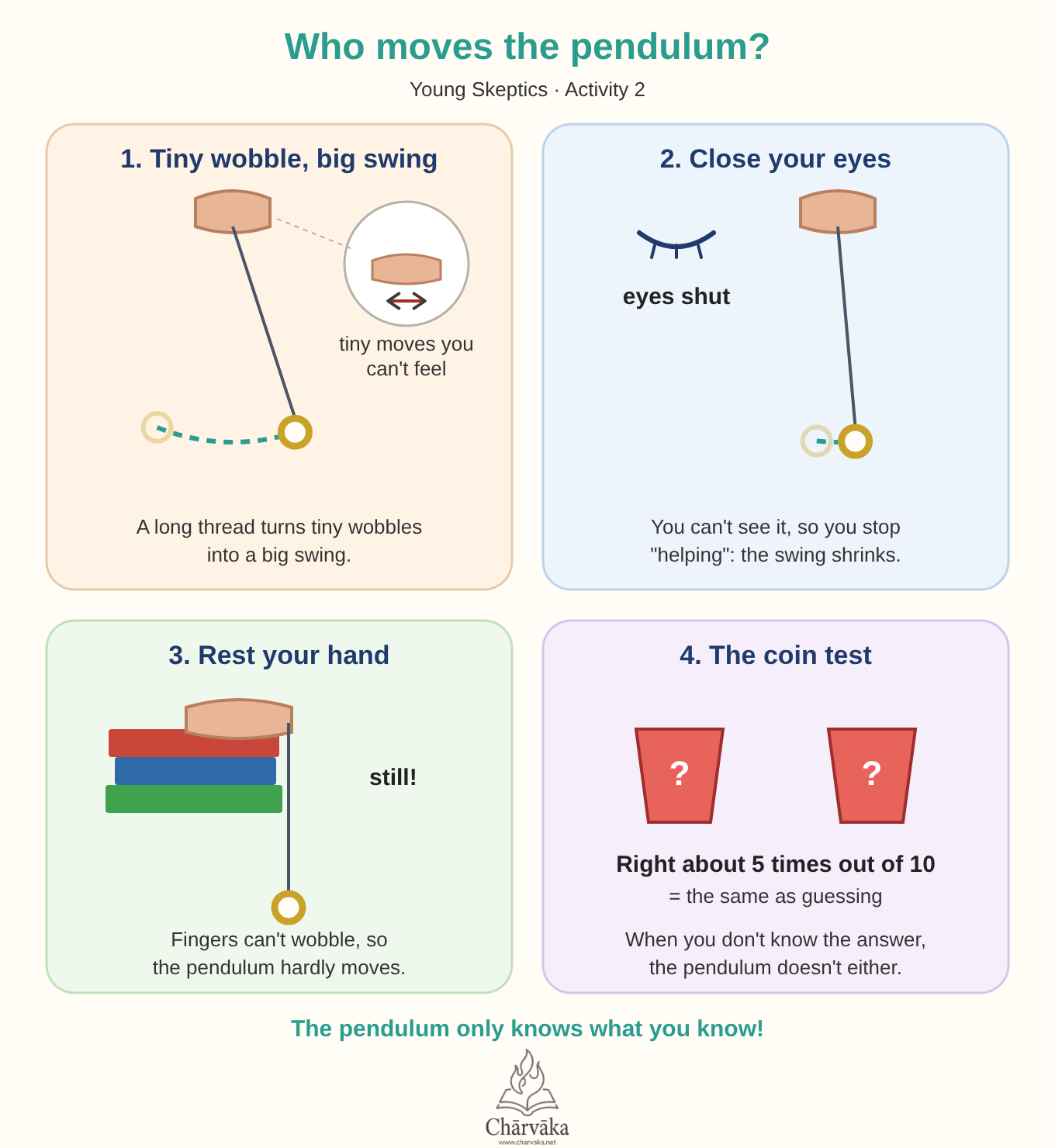
Nobody pushed the pendulum… or did they? You did, without knowing it.
When you expect something to happen, your muscles make tiny movements that are far too small for you to notice. Scientists call this the ideomotor effect: an idea in your mind becomes a movement in your body.
A pendulum on a long thread turns those tiny wobbles into a big swing, just as small pushes at the right moment make a playground swing go higher and higher.
That’s why the swing shrinks when you close your eyes: you can no longer see it, so you stop “helping” it. And when your hand rests on the books, your fingers can’t wobble, so the pendulum hardly moves at all.
In the coin test, the pendulum could only know what you knew. You didn’t know where the coin was, so the pendulum was just guessing too. Most people get about 5 out of 10, the same as guessing.
The woman with the ring wasn’t lying. She really didn’t feel herself moving it. That’s what makes the ideomotor effect so tricky: it fools honest people. The same effect moves Ouija boards and water-divining sticks.
🧠 Think Like a Scientist
Feeling sure isn’t enough. The woman felt sure the pendulum moved by itself, and you probably did too!
Even honest people can fool themselves.
A good test is one where you can’t.
That’s why the coin test is so clever: when you don’t know the answer, your hidden wishes can’t steer the pendulum. Scientists call this a blind test, and they use it to test medicines, too.
The test works on any pendulum: a ring on a thread from home, or an expensive crystal one from a shop. If someone in your family has a shop-bought pendulum, ask them to try the coin test with you. A ring and a thread, which cost nothing, do exactly the same job.
🗣️ Now be the teacher
Let someone in your family try the pendulum and watch it swing. Then run the coin test together: hide the coin so that nobody holding the pendulum knows where it is, and count the results out of 10. Ask: how many would guessing alone get? That’s a blind test, and now you know how to run one.
📖 Who First Tested This?
More than 200 years ago, in 1812, a French chemist called Michel Chevreul did the very same tests. He found that the pendulum soon slowed down when he was blindfolded, and stopped when he rested his arm on a support. He realised that his own hand was moving it, without his noticing. Later, in India, B. Premanand showed audiences the same thing in his book Science Versus Miracles.
How We Fool Ourselves · Could It Be Chance? · Popular Isn’t Proof
For parents and teachers
- Safety: keep rings, coins and nuts away from children under three, who could swallow them.
- A gentle point: some families use pendulums or similar methods. Encourage children to test, not to mock: the lesson is that sincere people can be misled by their own bodies.
- Talking about shopping: older children can look at real product listings with you and spot the claims: “energy healing”, “aura check”, “certified”. Ask: what would we need to see to believe the pendulum really works? (A fair, blind test like the coin test.) Discuss why sellers mention how many people bought a product, and why popularity is not evidence.
- Going further: try a longer and a shorter thread. A longer pendulum swings more easily from tiny movements. Ask the children why the coin test needs the friend to turn away too. (So that the friend can’t give unconscious clues, which would make it no longer a blind test.)
- The science in more detail: H. H. Spitz and Y. Marcuard, “Chevreul’s Report on the Mysterious Oscillations of the Hand-Held Pendulum”, Skeptical Inquirer (2001).
Based on the experiments of Michel Chevreul and on Science Versus Miracles by B. Premanand (1930–2009), with the assistance of AI tools, and reviewed by our editors. — CHARVAKA DESK