Ram Puniyani
Pakistan
has been facing innumerable troubles, not entirely due to its own faults. The
whole politics of oil, the designs of Empire and the subservience of
Mullah-Military complex to the US
designs have brought in lot of misery in the region. Currently one is painfully
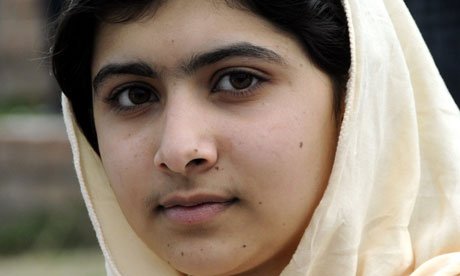
witnessing the plight of a young girl, Malala Yususzai, (Age 15) who is
battling for her life after she was shot twice by the Taliban. (October 2012)
Her ‘crime’ has been that she dared to defy the Taliban dictats and expressed
her longing for education for herself, and for the education of other girls.
When Taliban became powerful in Swat valley they shut down girls’ schools and
women were banned from social space till Pakistan got control over the area,
but still Taliban’s influence in the area did not vanish.
has been facing innumerable troubles, not entirely due to its own faults. The
whole politics of oil, the designs of Empire and the subservience of
Mullah-Military complex to the US
designs have brought in lot of misery in the region. Currently one is painfully
witnessing the plight of a young girl, Malala Yususzai, (Age 15) who is
battling for her life after she was shot twice by the Taliban. (October 2012)
Her ‘crime’ has been that she dared to defy the Taliban dictats and expressed
her longing for education for herself, and for the education of other girls.
When Taliban became powerful in Swat valley they shut down girls’ schools and
women were banned from social space till Pakistan got control over the area,
but still Taliban’s influence in the area did not vanish.
During this period Malala, a young girl, then aged 12,
started writing her diary for BBC Urdu, and later a film with her in the center
was made by New York Times, ‘A Class Dismissed’. She emerged as the major voice
of rebellion against the fundamentalist assertiveness of Taliban, the reason
for which she was shot by them due to which she is currently struggling for her
life. Taliban like all fundamentalist streams uphold the oppressive patriarchal
values, where social space is a strict ‘no no’ for women, who are supposed to
take care of Kitchen, Children and their life has to revolve around
instructions of Mullahs. In the transition from feudal society to the
democratic norms, the major change is that of caste/class and gender transformation.
There is no straightforward formula for this. In the countries where the
democratic revolutions were complete, the feudal norms of caste-gender
hierarchy were overthrown along with the rule of Kings-Feudal elements.
started writing her diary for BBC Urdu, and later a film with her in the center
was made by New York Times, ‘A Class Dismissed’. She emerged as the major voice
of rebellion against the fundamentalist assertiveness of Taliban, the reason
for which she was shot by them due to which she is currently struggling for her
life. Taliban like all fundamentalist streams uphold the oppressive patriarchal
values, where social space is a strict ‘no no’ for women, who are supposed to
take care of Kitchen, Children and their life has to revolve around
instructions of Mullahs. In the transition from feudal society to the
democratic norms, the major change is that of caste/class and gender transformation.
There is no straightforward formula for this. In the countries where the
democratic revolutions were complete, the feudal norms of caste-gender
hierarchy were overthrown along with the rule of Kings-Feudal elements.
In colonies the introduction of newer set of norms of modern
education, industrialization and the consequent changes in the society did
bring in social movements, enabling society to come out of the grip of older
set of values. The grip of older dominating forces, kings-landlords, was not
done away with totally in most post colonial states. The newer classes, the
industrialists-workers-educated classes came up side by side with the declining
section of society, the feudal elements. The declining sections did not
disappear and so they tried to preserve and assert their values and social
norms under the garb of religion, politics in the name of religion, what is
popularly referred to as communalism. As such it is abuse of religions’
identity to uphold and impose the norms of feudal society in the newer
language.
education, industrialization and the consequent changes in the society did
bring in social movements, enabling society to come out of the grip of older
set of values. The grip of older dominating forces, kings-landlords, was not
done away with totally in most post colonial states. The newer classes, the
industrialists-workers-educated classes came up side by side with the declining
section of society, the feudal elements. The declining sections did not
disappear and so they tried to preserve and assert their values and social
norms under the garb of religion, politics in the name of religion, what is
popularly referred to as communalism. As such it is abuse of religions’
identity to uphold and impose the norms of feudal society in the newer
language.
In colonies, particularly talking of Indian sub continent,
the subjugated sections of society, the low caste and the women had a marathon
struggle on hand to strive for equality and to come to the social space, this
struggle is not yet over despite sixty years of Independence in the Indian part
of the post partition area, while in Pakistan the process has been slower and
has seen a massive reversal after the Zia ul Haq-Maulana Maududi regime. The
same got further worsened with the coming up of Mujahideen-Taliban- Al Qaeda, a
process supported or rather engineered by United States and Saudi Arabia. The
ideological use of Wahhabi version of Islam to train Mujahedeen-Taliban
interprets Islam in a backward way to enslave the women and other weaker
sections of society.
the subjugated sections of society, the low caste and the women had a marathon
struggle on hand to strive for equality and to come to the social space, this
struggle is not yet over despite sixty years of Independence in the Indian part
of the post partition area, while in Pakistan the process has been slower and
has seen a massive reversal after the Zia ul Haq-Maulana Maududi regime. The
same got further worsened with the coming up of Mujahideen-Taliban- Al Qaeda, a
process supported or rather engineered by United States and Saudi Arabia. The
ideological use of Wahhabi version of Islam to train Mujahedeen-Taliban
interprets Islam in a backward way to enslave the women and other weaker
sections of society.
In India
the trajectory has been parallel to some extent. As fundamentalism, political
assertion in the garb of fundamentals of religion, rose in the West
Asia-Pakistan, in India
we see the rise of communalism in the name of Hindu religion with parallel
agenda, which has pushed back the march of caste and gender towards equality.
During 19th century, Indian women had to face something very close to what
Malala and large section of girls-woman are facing today in Taliban dominated
area. Savitribai Phule, who began the school for girls, had to face the wrath
of the conservative sections of society. As Malala has to hide the books under
her shawl, a woman named Rash Sundari Devi in Bengal
had to hide her longing for reading, as touching a printed paper was regarded
as sin. In her autobiography Aamar Jeevan (My Life) she tells the challenges
she faced as a woman who wanted to learn. She learnt reading by picking up
newspapers when men folk were not at home. Lot
of rumors were spread to stall education of girls. The struggle of Pandita Rama
bai, Anandi Gopal and many of their contemporaries, to get education, was
equally harrowing. Even today girls’ education is lagging behind in its reach
and importance in large parts of the country.
the trajectory has been parallel to some extent. As fundamentalism, political
assertion in the garb of fundamentals of religion, rose in the West
Asia-Pakistan, in India
we see the rise of communalism in the name of Hindu religion with parallel
agenda, which has pushed back the march of caste and gender towards equality.
During 19th century, Indian women had to face something very close to what
Malala and large section of girls-woman are facing today in Taliban dominated
area. Savitribai Phule, who began the school for girls, had to face the wrath
of the conservative sections of society. As Malala has to hide the books under
her shawl, a woman named Rash Sundari Devi in Bengal
had to hide her longing for reading, as touching a printed paper was regarded
as sin. In her autobiography Aamar Jeevan (My Life) she tells the challenges
she faced as a woman who wanted to learn. She learnt reading by picking up
newspapers when men folk were not at home. Lot
of rumors were spread to stall education of girls. The struggle of Pandita Rama
bai, Anandi Gopal and many of their contemporaries, to get education, was
equally harrowing. Even today girls’ education is lagging behind in its reach
and importance in large parts of the country.
In earlier part of 20th Century in United States
when the social transformation for caste (class) and gender began, the
conservative Christian groups opposed this social change by bringing out ten
small booklets called Fundamentals, which argued against women and workers
rights in the language of religion. It is from these booklets that
the term Fundamentalism emerged. The fundamentalist tendencies have resurfaced
world over during last three decades or so, and have been promoted by the
Imperialist powers in West Asia in particular.
Similarly when Hitler rampaged the democracy in Germany
in the name of Race, he dictated that the life of women should revolve around Kitchen Church and Children. Similar things,
coated with sugary syrup are being beamed through the Television serials in India, where
the unending Saas bhi Kabhi Bahu thi… serials dominate the television and give
the message of subordination of women. To add to the impact of these serials,
the Godmen, hordes of them who have mushroomed during this period, talk of such
norms in a refined language and they do have higher acceptability and sanctity.
when the social transformation for caste (class) and gender began, the
conservative Christian groups opposed this social change by bringing out ten
small booklets called Fundamentals, which argued against women and workers
rights in the language of religion. It is from these booklets that
the term Fundamentalism emerged. The fundamentalist tendencies have resurfaced
world over during last three decades or so, and have been promoted by the
Imperialist powers in West Asia in particular.
Similarly when Hitler rampaged the democracy in Germany
in the name of Race, he dictated that the life of women should revolve around Kitchen Church and Children. Similar things,
coated with sugary syrup are being beamed through the Television serials in India, where
the unending Saas bhi Kabhi Bahu thi… serials dominate the television and give
the message of subordination of women. To add to the impact of these serials,
the Godmen, hordes of them who have mushroomed during this period, talk of such
norms in a refined language and they do have higher acceptability and sanctity.
Pakistan
society today is the victim of many phenomenons at the same time. While US
created the Frankenstein’s monster of Taliban-Al Qaeda, today the same US-Nato
wants to do away with them through drone attacks. These drone attacks are
hardly a solution to the cancer which they have planted in this part of the
World. The large section of Pakistan
society is realizing and standing with the aspirations of Malala, knowing
fully-well that she does represent the longing of girls of her age. Most
parents in the region want their girls to be educated and wish them a future of
knowledge and enlightenment. Many a scholars of Islam remind us that
learning-education, both for men and women has a high place in the teachings of
Prophet, while there are many others who draw from other sources to justify the
shootings of Malalas. There are peace rallies in Pakistan which are telling the
Talibans, ‘Bandukon Wale Darte hain Ek Nanhi Ladki se’ (Those with guns are
scared of of a little girl). This section also knows the dilemmas of their
country have roots in, the ideology from Saudi, the machinations of CIA
operating through the military mullah complex.
society today is the victim of many phenomenons at the same time. While US
created the Frankenstein’s monster of Taliban-Al Qaeda, today the same US-Nato
wants to do away with them through drone attacks. These drone attacks are
hardly a solution to the cancer which they have planted in this part of the
World. The large section of Pakistan
society is realizing and standing with the aspirations of Malala, knowing
fully-well that she does represent the longing of girls of her age. Most
parents in the region want their girls to be educated and wish them a future of
knowledge and enlightenment. Many a scholars of Islam remind us that
learning-education, both for men and women has a high place in the teachings of
Prophet, while there are many others who draw from other sources to justify the
shootings of Malalas. There are peace rallies in Pakistan which are telling the
Talibans, ‘Bandukon Wale Darte hain Ek Nanhi Ladki se’ (Those with guns are
scared of of a little girl). This section also knows the dilemmas of their
country have roots in, the ideology from Saudi, the machinations of CIA
operating through the military mullah complex.
The ‘Malala moment’ is a serious turning point for Pakistan. Which
way it wants to go, which way it can make space for itself? The past cannot be
changed. Today’s problems created by Taliban and its clones need a serious
engagement, a ‘do or die’ situation for Pakistan’s democracy. The
persistence of Taliban is a malignant disease eating up its vitals. It needs to
be put behind, this ideology and this mindset has to be thrown in the dustbin
of history with total willpower, determination and efforts. Those in the
subcontinent need to hold their hands for democracy and freedom from
imperialist domination. We, in the region, need to strive towards solidarity
for a democratic South Asia to bury the
ideologies operating in the name of religion. We all need to stand with the
cause of Malala!
way it wants to go, which way it can make space for itself? The past cannot be
changed. Today’s problems created by Taliban and its clones need a serious
engagement, a ‘do or die’ situation for Pakistan’s democracy. The
persistence of Taliban is a malignant disease eating up its vitals. It needs to
be put behind, this ideology and this mindset has to be thrown in the dustbin
of history with total willpower, determination and efforts. Those in the
subcontinent need to hold their hands for democracy and freedom from
imperialist domination. We, in the region, need to strive towards solidarity
for a democratic South Asia to bury the
ideologies operating in the name of religion. We all need to stand with the
cause of Malala!
Leave a Reply