Abraham Kovoor
Believers in reincarnation often
try to prove that their belief is neither blind nor silly by citing certain
so-called scientific evidences. On such evidence, they say, is through hypnotic
regression. They put great emphasis on certain alleged rebirth stories revealed
through hypnotic regression. Two such “authentic” cases often cited
by them are those of Bridey Murphy and Simandini.
try to prove that their belief is neither blind nor silly by citing certain
so-called scientific evidences. On such evidence, they say, is through hypnotic
regression. They put great emphasis on certain alleged rebirth stories revealed
through hypnotic regression. Two such “authentic” cases often cited
by them are those of Bridey Murphy and Simandini.
We reproduce below what the
distinguished researcher and author Sprague de Camp and his wife Catherine deCamp have written about these two cases:-
distinguished researcher and author Sprague de Camp and his wife Catherine deCamp have written about these two cases:-
I
“In the 1950s Morey Bernstein of
Colorado, dabbled in hypnotism, undertook to hypnotise the wife of an
acquaintance. The name of the woman was Virginia Tighe, although in his report,
Bernstein called her “Ruth Simmons”. When Bernstein hypnotised Mrs.
Tighe, he told her to “regress”; that is to go back to her childhood
and describe the scenes. Then he urged her to go back to a time before her
birth.”You will find”, he told her,
“that there are other scenes in your memory. There are other scenes from
far away lands and distant places in your memory”. (Bernstein, P.124).Sure enough – as anybody who
knows about hypnotism could have foreseen – Mrs. Tighe just did that. The
scene, albeit “thin”, were said to be those of nineteenth century Ireland. The
personality speaking through the body of Mrs. Tighe claimed to be Bridget
(“Bridey”) Murphy, an Irishwoman who had flourished more than a century
previously, married one Brian McCarthy, and died in the fullness of her years.All this resulted in a
best-seller by Bernstein, The Search for Bridey Murphy; a national
reincarnation fad; Bridey Murphy clubs and amateur hypnosis circles; a mass of
articles in magazines and newspapers about the case; and two or three suicides by people impatient to get on with their next incarnation.Investigation of Bridey Murphy in
Ireland
failed to establish her existence. However, investigation of Mrs. Tighe
accounted for a great deal. For one thing, her speech, both in grammar and
vocabulary, was solidly North American English except for a few artificial
additions like “colleen”. Gaelic words were consistently mispronounced
in the manner typical of one who has read them but never heard them spoken, since
the rules for pronunciation of Irish are very different from those of English.The various elements in Virginia
Tighe’s description of herself as Bridey were all sooner or later accounted for
in terms of Mrs. Tighe’s own childhood memories. The climax came when a
reporter discovered in Chicago a real Bridey
Murphy: a woman of Irish birth who had lived across the street during Virginia’s childhood,
and who was now a youthful-looking grandmother, very much alive”.
II
“In the 1890s, there lived in Geneva, a young woman
known to the literature by the pseudonym” Helena Smith” (real name,
Elise Muller). Mile Smith had a good job in a local company and practised
mediumship on the side. She had been a dreamy child whose habit of reverie had
strengthened into trance mediumship. Despite health, good looks and a
respectable background, she disliked and despised her environment. She affected
an air of regal hauteur and snubbed her suitors as mere bourgeois.Mile Smith’s romantic leanings
appeared in the list of spirits who spoke through her. These included Victor
Hugo, Marie Antoniette, and the famous eighteenth-century charlatan Cagliostro,
who strangely enough did not understand his native Italian.The most remarkable spirits,
however were those from India
and the planet Mars. It transpired that in an earlier life, in the fourteenth
century, Helene had been the daughter of an Arab Sheikh. Under the name of
Simandini, she became the eleventh wife of an Indian Prince Sivrouka. When
Sivrouka died, she dutifully burned herself up on his pyre.
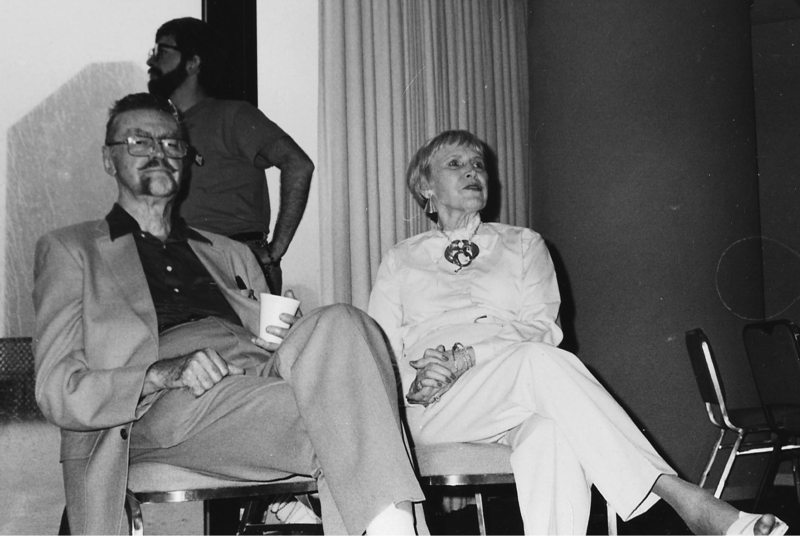
Catherine Crook de Camp with her husband, L. Sprague de Camp In her Martian incarnation Helena appeared as a
Martian princess. The princess’s aggressive young boy friend also put in an
appearance, describing and drawing pictures of the landscape of his native
Mars. This landscape was lush tropical scene, even less probable than the Mars
of Edgar Rice Burroughs. (Much less probable than the revelations of Mariner
pictures!)Helene came to the notice of the
French astronomer Theodore Flournoy, who was dabbling in psychic research. At
first Flournoy was impressed. When Helene was taxed with the fact that
Simandini did not seem to know any Arabic, she wrote a sentence in perfectly
good Arabic. Sacred name! Said Flournoy to himself; how could this ordinary,
middle-class Swiss girl come by all this learned matter?His puzzlement deepened when he
learned that there had been a real prince Sivrouka, who had died when Helene
said he did. Then Flournoy took a second look at the matter – the long critical
scrutiny that slays so many beautiful theories. Helene, it seemed had been
browsing in the stacks of the Geneva Public Library. What she saw, she retained
– not on the conscious level, but in her unconscious, whence it could be raised
in trance states. He found that the Arabic sentence was a motto on the flyleaf
of one of the books in this library. Helene wrote it not from right to left as
a real Arab would do, but mechanically, left to right. Her Martian language she
had invented by using made-up words along with French sounds, grammar and word
order.However absurd, Helene’s
impersonations were a smashing success. Despite Flournoy’s exposure of her
sources, an American woman, with more money than sense, gave the reincarnated
princess a life income. Helene quit her job, devoted her life to inspirational
psychic painting, and spent her last years tottering on the verge of
insanity” …“A hypnotic subject, in a
genuine trance, tries to please his hypnotist. If the hypnotist tells him to
conjure up a former incarnation, the subject strives to invent one. Moreover,
Bernstein does not seem to have known that multiple personality is a mental
disorder, which can become serious if encouraged. A prudent person would not
let an. amateur remove his appendix. Such an operation is tricky enough even
when done by a professional”.
(Spirits, Stars, and Spells,
P.245-52 by L. Sprague de Camp And Catherine C, de Camp)
P.245-52 by L. Sprague de Camp And Catherine C, de Camp)
Courtesy: Abraham Kovoor: Soul,
Spirit, Rebirth and Possession; Published by B Premanand, Indian CSICOP,
Podannur, Tamil Nadu; Date of Publication: 17-02-2000
Spirit, Rebirth and Possession; Published by B Premanand, Indian CSICOP,
Podannur, Tamil Nadu; Date of Publication: 17-02-2000
Leave a Reply