Lord Ram has served the BJP very well so far. It was the Ram temple issue around which the seeds of divisive politics were sown all over the country. The Rath Yatra of Lal Krishna Advani precipitated deeper polarization and was followed by a trail of violence. The well-planned Babri demolition further intensified communal violence and the politics conducted in the name of religion across the nation.
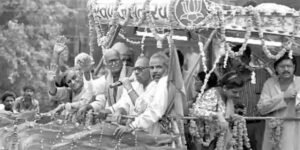
The reward for this was the strengthening of the BJP’s electoral base, through which the party gradually came to the fore. From a marginal party in the national scheme of things, it emerged as the single largest party in 1996. By the 2014 elections, it managed to secure a simple majority (282 Lok Sabha seats, with 31% of the vote). The promise of building the temple has been constantly on the agenda of the BJP, but that has functioned as a carrot—one that may not materialize as an immediate construction, but keeps serving the BJP’s purpose of deceiving and polarizing the electorate.
This promise of a Ram Temple serves as an allurement for sections of society. It has been made despite the full knowledge that the issue remains pending in the Supreme Court and cannot be legally constructed at present. The RSS combine also recognizes that while demolitions can be incited illegally, construction cannot be carried out unlawfully; nevertheless, the propaganda serves as a potent electoral tool.
As the Uttar Pradesh elections of 2017 approach, the issue of the Ram Temple is being invoked yet again. At a Dussehra rally in Lucknow in October 2016, Prime Minister Narendra Modi invoked the slogan of “Jai Shree Ram”. This was the battle cry of the RSS combine during the buildup to the Babri demolition in 1992. A few days later, while inaugurating a power plant, PM Modi was greeted with the same war cry—symbolic of the Hindu nationalism that has formed the core agenda of the BJP-RSS.
To supplement these efforts along communal lines, the BJP declared a project for a Ram Museum in Ayodhya. Not to be left behind, the Uttar Pradesh government led by Akhilesh Yadav decided to announce a Ram Leela theme park around the same time. While the Ram temple remains the trademark of BJP politics, seeing the electoral dividends it has yielded for the ruling party, other political parties are also attempting to jump into the fray. Even Congress scion Rahul Gandhi, during his Kisan Yatra, paid a visit to the Hanuman Garhi temple in Ayodhya.
To keep the issue burning, Vinay Katiyar of the BJP—who was part of the demolition movement in 1992—stated that the museum and theme park were not the real objective, calling them mere “lollipops” and insisting that the primary goal remains the construction of the temple itself. While RSS supremo Mohan Bhagwat has been declaring that the temple will be built within his lifetime, other figures within the RSS combine have been more explicit, claiming that the temple will be constructed during the tenure of the Modi government.
Per the Allahabad High Court judgment, the land of the Babri mosque was ordered to be divided into three parts: one-third to the Babri Masjid Action Committee, one-third to the Ram Chabutra (Ram Lalla), and one-third to the Nirmohi Akhara. This judgment utilized popular faith as its foundation. This was a rare instance where the prevalent faith of believers was made the primary ground for a judicial verdict, effectively conflating history with faith.
Lord Ram has been a significant cultural, religious, and mythological entity in South Asia. While filing an affidavit regarding the Ram Setu issue, the UPA government noted that the Lord is a mythological figure. This statement was heavily criticized by spokespersons of the RSS, who overlooked the distinction between history and mythology. While one cannot deny the existence of Lord Ram on cultural and mythological levels, claiming it as documented history is an entirely different matter. With the rise of communal politics, Lord Ram is being presented as a historical figure on the one hand—allowing communalists to claim the Babri Masjid land on the grounds that it was his exact birthplace.
On the other hand, the broader cultural existence of Ram is being reduced to a narrow religious identity. One recalls that Dr. M. M. Basheer, a prominent scholar of the Ramayana from Kerala, was forced to stop his newspaper column on the epic because he is Muslim. Similarly, actor Nawazuddin Siddiqui was prevented from playing the role of the character Maricha in his village Ram Leela due to his faith. The communalization of Lord Ram represents a distressing turn in this narrative.
Over the past few years, the assault on democratic values through communal strategies has shifted the center of gravity in Indian politics toward religious identity. This explains why Rahul Gandhi felt compelled to visit a temple in Ayodhya as a public event. It also explains why the Samajwadi Party, while promoting theme parks like the Ram Leela park, has simultaneously permitted communal tensions to persist in UP. Starting with Muzaffarnagar in 2013, the SP played an ambiguous role that ultimately aided the BJP’s agenda of polarization.
The strategy of the BJP relies on low-intensity communal polarization to consolidate Hindu votes; in parallel, the Samajwadi Party calculates that such insecurity makes Muslim voters vulnerable, prompting them to gravitate toward the SP for protection.
The BJP has now equipped itself with additional emotive issues. It seeks to politicize surgical strikes in its favor by claiming that such decisive action has taken place for the first time, attributing it to the leadership of PM Modi and his training within the RSS. Rhetoric and chest-thumping dominate sections of the media. The BJP also utilizes the issue of beef to bolster its electoral campaigns. Consequently, the grounds of constitutional democracy—issues related to material existence, socio-economic rights, and justice—are being supplanted by emotive appeals. Restoring the democratic order remains an urgent imperative.
Leave a Reply