This is Part II of the essay “From Proto-materialism to Materialism: The Indian Scenario”. Part I can be accessed here.
7. Inventory of Sources for Studying Materialism in India
What are the sources for studying the course of development from proto-materialism to materialism proper? A philosophical system in India implies the existence of a base (mūla) text comprising a number of aphorisms (sūtras), and at least one commentary (along with sub-commentaries, if any). Most systems, not just the orthodox six (ṣaḍ-darśanāni), conform to this pattern. The sources for the study of materialism in India are as follows:
- Proto-materialism in the Upaniṣads – Uddālaka Āruṇi in the Chāndogya Upaniṣad (c. sixth century BCE).
- Proto-materialism in the Three Baskets (Tipiṭaka) and other Buddhist semi-canonical works, generally called “the doctrine of annihilation” (ucchedavāda), documented in the Pāyāsi Sutta and the Sāmañña-phala Sutta, both in the Dīgha Nikāya (fifth century BCE).
- Proto-materialism in Jain canonical works such as the Sūtra-kṛtāṅga Sūtra (fifth century BCE) and paracanonical texts (such as the Nandī Sūtra), variously called bhūtavāda, tajjīva-taccharīravāda, etc.
- Proto-materialism in the two epics, the Rāmāyaṇa (Book 2) and the Mahābhārata (Book 12 in particular), redacted between the fourth century BCE and the fourth century CE.
The second phase witnessed the birth of full-fledged materialist doctrines. This development is recorded in the following works:
- Materialisms in the Maṇimēkalai (between the fourth century and the seventh century CE) and the Vasudevahiṃḍī (sixth/seventh century CE).
- Materialisms in non-philosophical texts: Vātsyāyana’s work on erotics, the Kāmasūtra (sixth century CE); Bāṇabhaṭṭa’s romance, the Kādambarī (sixth century CE); Śrīharṣa’s secondary epic, The Life of Naiṣadha (Naiṣadhacarita, thirteenth century CE), etc.
Finally, a unified system emerged that came to be known as Bārhaspatya, Nāstika, Lokāyata, and Cārvāka. Right from the eighth century CE, these names and a few others (such as bhūta-caitanya-vāda, dehātmavāda, etc.) were used interchangeably in the works of the opponents of materialism. The last known stage, which superseded all previous ones, offered:
- The base text of the Cārvākas, the Paurandara-sūtra, and (most probably) its auto-commentary, the Paurandara-vṛtti (in or around the eighth century CE). Both survive only in fragments (for details see Bhattacharya 2009/2011: 83, 90).
- A commentary on an earlier base text by Kambalāśvatara, and other commentaries—besides Purandara’s own—on the Paurandara-sūtra by Bhāvivikta (known by name only), Aviddhakarṇa, and Udbhaṭabhaṭṭa (from the seventh to the tenth century CE), available only in fragments.
- Doxographical and quasi-doxographical works, from A Compendium of Six Philosophies (Ṣaḍ-darśana-samuccaya) by Haribhadra (eighth century) and The Collection of Principles (Tattva-saṅgraha) by Śāntarakṣita (eighth century), down to the Collection of All Philosophies (Sarva-darśana-saṃgraha) by Sāyaṇa-Mādhava and other digests, all composed between the eighth century and the eighteenth century.[i]
Materialism, then, is not a doctrine or set of doctrines that appeared in the same garb in India and Greece. The question of rebirth, although found in Plato (see Phaedo 71e, 1997: 62) and most prominently in Pythagoras, was never a mainstream doctrine in Greek philosophy, nor was it part of Greco-Roman religion. However, in the Indian context, materialism first appears as a denial of the idea of life after death (parajanma). This had both philosophical and religious implications. Not only the Vedists but also the Buddhists and Jains (to name only the major religious sects) were firm believers in rebirth in one form or another. It was a credo—an article of faith—for all of them. Thus, materialism had to contend with all religious as well as philosophical sects and groups, both theist and atheist (chiefly the Buddhists and Jains). In other words, as a negativist doctrine found in the exposition of Ajita Kesakambala’s preachings, the deniers of the other-world and of rebirth were the main objects of criticism and targets of attack at every stage of philosophical battle.[ii] The same is true of the Prakrit words ṇāhiyavādī and natthiyavāī (nāstikavādī in Sanskrit) in The Wanderings of Vasudeva (Vasudevahiṃḍī, pp. 169.17 and 175.13 respectively). In Jain works too, nāstika in its various Prakrit forms is an umbrella term designating all materialists, accidentalists, and non-believers in “true religion”.
8. Materialist Ontology
The basic doctrines of materialism, particularly its epistemology, took time to develop. The first element we encounter, as stated above, is its ontology—namely, its opposition to the concept of life after death. This also implies the denial of rebirth and of the doctrine of karma (karman). Thus, the idea of reward and retribution in the form of attaining heaven or being consigned to hell in accordance with one’s deeds in this world (that is, during one’s earthly existence) is rejected. This is indeed something unique in the history of world philosophy. Philosophers, whether in Greece or in other lands, had always pondered the origin of phenomena, as did some Indian philosophers. There was no unanimity of opinion among them; several such contending views are recorded in Śvetāśvatara Upaniṣad 1.2.
What happens after death, however, is a question that concerns belief in (a) the existence of an extracorporeal soul, (b) heaven and hell as actual places, and (c) adṛṣṭa as well as karmaphala (the results of one’s deeds). These three concepts are closely associated with religious beliefs, though not necessarily theistic ones. Both Mīmāṃsā and Buddhism are atheistic; nevertheless, their belief systems encompass the third item. Materialism, by denying all three, strips away the mystique of death, thereby rendering these concepts redundant. Materialist ontology hits at the root of all religious beliefs. Post-mortem rites are considered a mere waste of energy and resources, branded as utterly irrational (cf. Jābāli’s speech in the Rāmāyaṇa 2.100, which corresponds to the views of both Pāyāsi and Ajita Kesakambala in the Dīgha Nikāya).
The first instance of rebutting proto-materialism is met with in the Kaṭha Upaniṣad (c. 600 BCE). Presumably, the composition of this Upaniṣad was commissioned to stem the tide of skepticism concerning the immortality of the spirit. Who else but Yama—the lord of the abode of the dead (yamālaya), akin to Hades/Pluto in Greco-Roman mythology—could be a better choice to sermonize on the question of life after death? The structure of the Upaniṣad suggests a definite closure at the end of Book I; the “recital of benefits” (phalaśruti) stanzas (1.3.16–17) assure great merit to both the reader and the listener of the work. The whole of Book II has the appearance of being a later addition, although there is no manuscript support in favor of this conjecture as yet.[iii]
9. New Meanings of āstika and nāstika
The story of King Veṇa in the Viṣṇudharmottara Mahāpurāṇa (1.108) highlights the materialists’ denial of the post-mortem existence of an extracorporeal soul or spirit. Medhātithi glosses the word nāstika in the legal treatise Manusmṛti (4.30 and 11.65) as one who denies the other-world (nāsti paralokaḥ), citing a line: “There are no such things as given (in sacrifices), oblations, rites . . .”, which is taken from the Viṣṇudharmottara Mahāpurāṇa (1.108.19).
However, in other instances (such as his glosses on Manu 2.11 and 4.163), Medhātithi and other commentators explain the word nāstikya (“nāstikahood”) as disbelief in the infallibility—and hence the authority—of the Veda, or a refusal to admit the Veda as the ultimate verbal testimony, the word of words. Thus, over time, the old pair āstika and nāstika acquired a new set of meanings: namely, the adherent to the Veda and the non-adherent. These became the widely accepted meanings of the pair in Brahmanical philosophical literature. In common parlance, however, the words later came to suggest the “theist” and the “atheist”.
God, in Indian philosophies generally, never occupied a position as paramount as the Veda. Even though in earlier literature (for example, in the Maitrī Upaniṣad) avaidika (7.10) and nāstikya (3.5) suggest the non-Vedic and the denier of the other-world and/or of the Veda respectively, it is only in the Brahmanical philosophical literature of the Common Era that āstika and nāstika came to signify exclusively the believer in and the reviler of the Veda (cf. Manu 2.11: nāstiko veda-nindakaḥ).[iv] In the writings of the Buddhists and Jains, however, the earlier meaning of nāstika (denier of the other-world) persisted. Denial of the authority of the Veda meant nothing to them, as they were themselves opposed to the doctrine of Vedic inerrancy; the new meaning did not affect them. This later sense of nāstika came to signify the materialists (more particularly Cārvāka/Lokāyata) as well as the Buddhists and Jains, as all were considered heretical and heterodox by Brahmanical authorities. The label was employed to denote all heterodox popular cults—the so-called pāṣaṇḍins, some of whom are mentioned in the Maitrī Upaniṣad (7.8).
10. Devotion to the Veda
This devotion to the Veda (vedabhakti) is indeed unique in world history. The Christian reverence for the Bible as the “Book of Books” or the Muslim deference to the Qur’an is hardly comparable to this fidelity. Bankim Chandra Chattopadhyaya (Chatterjee), the well-known literary figure of nineteenth-century Bengal, was a devout Hindu in his own way. After a phase of youth atheism (roughly until the mid-1870s), he became a devotee of Kṛṣṇa—though he never joined any of the numerous sects or sub-sects of Bengal Vaiṣṇavism. Nevertheless, in his devout old age as in his irreverent youth, he refused to accept the exalted position of the Veda (see B. Chattopadhyaya 1973: 278, 1060 et seq.).
The status of this Holy Writ was placed above every other text or object, including God Himself. In fact, one could deny the existence of God in India and go scot-free without facing punishment or social ostracism, but denying the infallibility of the Veda was viewed as a cardinal sin (for the view of canonical law books concerning the nāstikas, see Kane vol. 4, 1973: 15–16, 33–34). Thus, two philosophical schools, Mīmāṃsā and Sāṃkhya, which denied the existence of God or gods, were accepted as affirmativists (āstikas) because they acknowledged the supreme authority of the Veda as much as systems like Nyāya-Vaiśeṣika and Yoga. On the other hand, the Cārvākas, along with the Buddhists, Jains, and other popular religious cults (the so-called Little Tradition), stood condemned because of their refusal to align with the Veda.
This supreme esteem for the Veda is another aspect of the Indian scenario that distinguishes it from philosophical systems and schools throughout the rest of the world.
11. Two Pre-Cārvāka Materialist Schools
The Tamil epic Maṇimēkalai, composed by Sīthalai Sāttanār, has already been mentioned above. It is a highly valuable document for the study of Indian philosophical systems in general and materialism in particular, although it has rarely been utilized at home or abroad—perhaps because it was written in Old Tamil rather than Sanskrit. However, several English translations (at least three are known to me; see References) provide a fascinating account of the philosophical systems current in South India during the early centuries of the Common Era. Exact dating of the epic is not yet possible; all that can be said is that it was composed between the fourth and seventh centuries CE.
During her wanderings, Princess Maṇimēkalai, the heroine of the epic, meets the teachers of several philosophical systems: Lokāyata, Bauddha, Sāṃkhya, Nyāya, Vaiśeṣika, and Mīmāṃsā (27.78–80). All these names are evidently borrowed from Sanskrit with minor, easily recognizable phonetic variations.[v] Even without knowing Tamil, one can read the transliterated Roman script and identify the systems with ease. The names of the masters (āciriyar in Tamil, ācārya in Sanskrit) are also mentioned: Bṛhaspati, Jina (Buddha), Kapila, Akṣapāda, Kaṇāda, and Jaimini respectively (27.81–82). Here too, all the names can be readily understood from the Tamil text, except perhaps Bṛhaspati, who appears as Pirekarpati (see Appendix). Here, for the first time, we also read of the instruments of cognition (pramāṇas) recognized by these schools (27.83–85). Thus, we are given a glimpse of a particular juncture when proto-materialist and proto-idealist ideas had been redacted into more or less organized systems after the second or third century CE, each bearing a distinct name. These names mostly refer to the essence of the doctrines rather than to their founders or redactors, though the founders’ names were not forgotten.
More interesting is the fact that the Tamil epic speaks not of one, but of two materialist schools: bhūtavāda (pūta vāta in Tamil) and Lokāyata. Bhūtavāda, an exact synonym for materialism in Sanskrit, is not altogether unknown, as it recurs in later times. Śīlāṅka (ninth century CE), the Jain commentator, mentions this name in his commentary on the Sūtra-kṛtāṅga-sūtra (see glosses on 1.1.7, 1978: 10–11; also ibid.: 19, “five-elementalists and others,” pañca-bhūta-vādyādayaḥ).[vi]
The name of the second school, Lokāyata, is well known as a synonym for Cārvāka, although in the Pali and Sanskrit Buddhist tradition, lokāyata invariably stands for disputatio—the science and art of disputation—rather than a philosophical system (see Bhattacharya 2009/2011: 189, 195–96; Franco 2011: 629–33). Yet from the sixth century CE onward, Lokāyata also signifies materialism in the Brahmanical tradition, as seen in the Kāmasūtra, Kādambarī, etc. (see R. Bhattacharya 2015).
This is how the bhūtavādin in the Maṇimēkalai expounds the materialist doctrines he adheres to and distinguishes his views from Lokāyata:
“When fig leaves are macerated with sugar and other substances, fermentation takes place. This phenomenon is similar to consciousness and sensation, which develop when certain elements are put together. Then, when these elements separate and return to their individual state, consciousness gradually vanishes, like the resonance of a drum that little by little fades and dies away.
“By combining together, the various categories of elements in which consciousness is present give birth to living beings, while inert elements, on combining together, produce the various forms of inanimate matter. These two categories work independently as regards their formation, duration, and disappearance. Each living being is animated by a consciousness to which its components give rise at the very moment of its coming into existence. Such is the natural course of things. The other aspects of our doctrine concerning the tattvas [principles], the world’s constituent parts, which I could expound, are identical to the concepts of the Lokayatas, the pure materialists.
“Of the means of proof, only direct perception (pratyakṣa) is acceptable. All other means of knowledge, including deduction (anumāna), must be rejected. There exists no reality other than the one we perceive in the present and the enjoyments we derive from it.
“It is absurd to believe in the existence of another life in which we would gather the fruits of our deeds in this one. Our existence, as well as our joys and sorrows, terminate with our life.” (Trans. A. Daniélou and T. V. Gopala Iyer, 1993: 140).
Thus, prior to the arrival of the new materialism of the Cārvākas (in or around the eighth century CE), there existed at least two pre-Cārvāka materialist schools with their own distinct ontology and epistemology. The Maṇimēkalai forms the link between proto-materialism and old materialism on the one hand, and between old materialism and new materialism on the other.[vii] The significance of the Tamil epic in this respect cannot be overemphasized, although it remains little known even in the Indological circles of North India, to say nothing of Western students of non-Western philosophy.
12. Appearance of the Cārvākas
It is from the eighth century CE that we first hear the name Cārvāka, often used in the plural. Apparently, cārvākāḥ (“the Cārvākas”) referred collectively to a new group of materialists. They were also the last of the materialists to appear in India. After the twelfth century or thereabouts, all materialists—whether Cārvākas or pre-Cārvākas—seem to have disappeared from the scene. Yet as long as they existed, they were considered the chief antagonists to be fought tooth and nail by all idealists and fideists. Not only did adherents of Nyāya-Vaiśeṣika, Vedānta, and Mīmāṃsā take up their pens to combat the materialist view, but so too did the Buddhists and Jains (who were themselves branded as “negativists” by Brahmanical philosophers for their non-adherence to the Veda).
In the course of their polemics, opponents rarely bothered to distinguish between Cārvākas and non-Cārvāka or pre-Cārvāka materialists (see Bhattacharya 2013b: 133–49). From the eighth century onward, the name Cārvāka became the generic term for all materialists. When referring to materialists who spoke of five elements instead of four (the Cārvākas accepted only four and were thus known as bhūta-catuṣṭaya-vādins), Guṇaratna (sixteenth century CE) calls them “some sections of the Cārvākas” (cārvākaikadeśīya, 1914: 300). Most probably, he drew all his views concerning materialists—including the existence of five-elementalists (bhūta-pañcaka-vādins) alongside four-elementalists—from Śīlāṅka (see above).
In the great philosophical debates that raged in India from the eighth to the twelfth century, the common enemy of all systems—whether orthodox (Vedist) or heterodox (anti-/non-Vedist)—was the Cārvāka/Lokāyata. The seminal contribution made by the Cārvākas was the partial recognition of inference as a valid instrument of cognition. The pre-Cārvākas were staunch upholders of perception as the one and only instrument of knowledge, rejecting all others. The Cārvākas, however, declared that inferences based on perception and verifiable by perception were acceptable. However, all inferential conclusions based on verbal testimony (such as the Vedas) and concerning supernatural entities (such as God, heaven, hell, or an omniscient being) were denied because they did not derive from perceptible sources. Purandara made this distinction explicitly clear (qtd. Kamalaśīla, 1981: 528), and Udbhaṭabhaṭṭa, another commentator on the base work, drew a sharp distinction between “probanses well-established in the world” and those “established in the scriptures” (qtd. Vādideva Sūri, 1988: 265). In certain other aspects as well, points of difference existed between the Cārvākas and pre-Cārvākas (for a detailed study, see Bhattacharya 2013a: 8). Otherwise, the schools were largely in agreement.
13. Summing Up
To sum up: materialism in India developed in a manner quite distinct from its Western counterparts. The basic difference lies in the cultural background: rebirth was never part of the “world picture” (to borrow E. M. W. Tillyard’s phrase from The Elizabethan World Picture) of the ancient Greeks, whereas it served as the foundational premise for all idealist systems and religious traditions in India—not only Brahmanical sects but also the heterodox Buddhist and Jain systems. Coupled with the doctrine of karma, it formed an essential part of the worldview inherited from the foundational texts of these three communities from the sixth century BCE onward, and it continues to be held by a vast majority of the Indian population today.
This is why both proto-materialism and its fuller, modified form—Cārvāka/Lokāyata—assumed a shape quite distinct from their Greek counterparts in India. As P. V. Kane observed in a different context: “The theory of karma and the theory of transmigration of souls (of pre-existence and post-existence) are inextricably mixed up in Indian thought from at least the ancient times of the Upaniṣads” (1973, vol. 4: 39). This demonstrates how a community’s enduring matrix of concepts and beliefs continues to shape the human mind long after its original mythology has ceased to hold sway.
Appendix
Maṇimēkalai 27.78–82. Interlinear Translation:
pāṅkuṟum   ulōkāyatamē   pauttam
Systematic Lokāyatam     Bauddham

cāṅkiyam   naiyāyikam   vaicēṭikam
Sāṅkhyam   Nyāyam       Vaiśeṣikam

mīmāñcakam ām camaya    āciriyar
Mīmāṃsā    systems      founders

tām        pirukaṟpati  ciṉaṉē   kapilaṉ
Respectively Bṛhaspati  Jina     Kapila

akkapātaṉ  kaṇātaṉ      caimiṉi
Akṣapāda   Kaṇāda       Jaimini
Literal Translation:
These are the systems that accept logic: Lokāyata, Buddhism, and Sāṅkhya; Nyāya, Vaiśeṣika, and Mīmāṃsā.
The teachers of these six: Bṛhaspati, Buddha, Kapila, Akṣapāda, Kaṇāda, and Jaimini.
(Trans. Prema Nandakumar 1989: 149. Diacritical marks added.)
Notes
[i] I have consciously omitted several Buddhist, Jain, and Brahmanical philosophical texts or commentaries. They are mostly designed to refute—or rather denigrate—materialism. Their authors were not averse to misrepresenting or even distorting materialist doctrines in the course of expounding the opponent’s view (technically known as pūrva-pakṣa; for instances, see R. Bhattacharya 2013b: 133–49). The same caution applies to poems and plays that are fully or partially philosophical in orientation, such as Kṛṣṇamiśra’s allegorical play Rise of Moon-like Intellect (Prabodha-candrodaya), Haribhadra’s Prakrit narrative The Tale of Samarāditya (Samarāicca-kahā), Jayantabhaṭṭa’s closet play The Tocsin of the Sacred Text (Āgama-ḍambara), and Siddharṣi’s allegorical tale Upamiti-bhava-prapañca-kathā. Their accounts can be accepted only to a limited extent—with a grain of salt, so to speak.
[ii] To Buddhist philosophers of the Common Era, materialism meant the doctrine of annihilation (ucchedavāda) as enunciated by Ajita (and Pāyāsi), which denied the other-world and rebirth. See the commentaries of Bhāviveka, Nāgārjuna (auto-commentary), Buddhapālita, and Candrakīrti on Nāgārjuna’s Madhyamakaśāstra 18.6–7 (vol. 2, 1989: 63–64, 67). Lokāyata is mentioned separately in a different context (ibid., on 16.1, vol. 2, 1989: 3, 153), most probably in the sense of disputatio.
[iii] See Max Müller 1884: xxiii; Whitney 1890: 104. Müller, however, observed: “I have little doubt, for instance, that the three verses 16–18 in the first Vallī of the Kaṭha-Upanishad are later additions, but I should not therefore venture to remove them” (1884: xxv). Whitney endorses this observation as a “very plausible suggestion,” adducing further evidence: “The last pāda [quarter verse] of 18 is the same with 12d, above . . .” (note on 1.1.18, 1890: 96).
[iv] I am indebted to Professor Mrinal Kanti Gangopadhyaya for drawing my attention to this matter. It should be noted in this connection that the Smṛtis and Purāṇas mostly use the word nāstika, rarely Cārvāka or Lokāyata; only their commentators employ the latter names.
[v] Some technical terms, however, remain in Tamil, while others retain their original Sanskrit forms (see Appendix). The Tamil text (available online) and the English translations by Krishnaswamy Aiyangar, Alain Daniélou (with T. V. Gopala Iyer), and Prema Nandakumar are worth consulting.
[vi] Rahul Sankrityayan, it may be recalled, translated the term “scientific materialism” as vaijñānika bhautikavāda. It is the title of one of his Hindi works written during his incarceration in Hazaribagh Jail for participating in the anti-imperialist movement (see Sankrityayan 1974).
[vii] The points of difference between the two have been discussed in R. Bhattacharya 2013a: 8.
References
- Aiyangar, S. Krishnaswami. Manimekalai in Its Historical Setting. London: Luzac & Co., 1928.
- Bedekar, V. M. “The Doctrines of Svabhāva and Kāla in the Mahābhārata and Other Old Sanskrit Works.” Journal of the University of Poona (Humanities Section), No. 13, 1961.
- Bhattacharya, Ramkrishna. “The Base Text and Its Commentaries: Problems of Representing and Understanding.” Argument (Cracow), Vol. 3, No. 1, 2013, pp. 133–49 (2013b).
- Bhattacharya, Ramkrishna. “Development of Materialism in India: The Pre-Cārvākas and the Cārvākas.” Esercizi Filosofici, Vol. 8, 2013, pp. 1–12 (2013a).
- Bhattacharya, Ramkrishna. “The First Cause: Rivals of God in Ancient Indian Thought.” Indian Skeptic, Vol. 14, No. 8, December 2001, pp. 19–23 (2001).
- Bhattacharya, Ramkrishna. “Reflections on the Jābāli Episode in the Vālmīki Rāmāyaṇa Ayodhyākāṇḍa.” Journal of Indian Philosophy, 2015 (2015a).
- Bhattacharya, Ramkrishna. Studies on the Cārvāka/Lokāyata. Firenze: Società Editrice Fiorentina, 2009; London: Anthem Press, 2011 (2009/2011).
- Chāndogya Upaniṣad. (See Eighteen Principal Upaniṣads).
- Chattopadhyaya, Bankim Chandra. Baṅkim Racanāsaṃgraha, Pravandha Khaṇḍa prathama o śeṣa aṃśa (in Bengali). Calcutta: Saksharata Prakashan, 1973.
- Chattopadhyaya, Debiprasad, in collaboration with M. K. Gangopadhyaya, eds. Cārvāka/Lokāyata. New Delhi: Indian Council of Philosophical Research, 1990.
- Chattopadhyaya, Debiprasad. History of Science and Technology in Ancient India, Vol. 2. Calcutta: Firma KLM, 1991.
- Dīgha Nikāya, Parts 1–3. Ed. Jagadish Kashyap. Patna: Pali Publication Board (Bihar Government), 1958.
- Eighteen Principal Upaniṣads. Eds. V. P. Limaye and R. D. Vadekar. Poona: Vaidika Samsodhana Mandala, 1958.
- Eliade, Mircea. From Primitive to Zen. London: Collins, 1979.
- Franco, Eli. “Lokāyata.” In Brill’s Encyclopedia of Hinduism, Vol. 3. Leiden: E. J. Brill, 2011, pp. 629–42.
- Frauwallner, Erich. History of Indian Philosophy, Vol. 2. Delhi: Motilal Banarsidass, 1973. (Translation of Geschichte der indischen Philosophie, Band II. Salzburg: Otto Müller Verlag, 1956).
- Freeman, Kathleen. Ancilla to The Pre-Socratic Philosophers. Oxford: Basil Blackwell, 1952.
- Guṇaratna. Tarkarahasyadīpikā. In Haribhadra, Ṣaḍdarśanasamuccaya, ed. Luigi Suali. Calcutta: The Asiatic Society, 1905–14.
- Halbfass, Wilhelm. Tradition and Reflection: Explorations in Indian Thought. Delhi: Sri Satguru Publications, 1992.
- Kamalaśīla. Tattvasaṅgrahapañjikā. In Śāntarakṣita, Tattvasaṅgraha, ed. D. Shastri. Varanasi: Bauddha Bharati (reprint), 1981.
- Kane, P. V. History of Dharmaśāstra, Vol. 4. Poona: Bhandarkar Oriental Research Institute, 1973.
- Kosambi, D. D. An Introduction to the Study of Indian History (1956). Mumbai: Popular Prakashan, 1975.
- Kosambi, D. D. The Culture and Civilisation of Ancient India in Historical Outline (1965). New Delhi: Vikas, 1972.
- Lenin, V. I. “Philosophical Notebooks.” In Collected Works, Vol. 38. Moscow: Foreign Languages Publishing House, 1961.
- Mahābhārata, The. Critically edited by V. S. Sukthankar et al. Poona: Bhandarkar Oriental Research Institute, 1933–1966.
- Maitrāyaṇī Upaniṣad. (See Eighteen Principal Upaniṣads).
- Majjhima Nikāya, The, Parts 1–3. Ed. Rahula Sankrityayan. Patna: Pali Publication Board (Bihar Government), 1958.
- Maṇimēkalai (The Dancer with the Magic Bowl). Trans. Alain Daniélou with T. V. Gopala Iyer. New Delhi: Penguin Books, 1993.
- Maṇimēkalai. Trans. Prema Nandakumar. Thanjavur: Tamil University, 1989.
- Manusmṛti with commentaries by Medhātithi and others. Ed. J. H. Dave. Bombay: Bharatiya Vidya Bhavan, 1972–84. (Manu)
- Nāgārjuna. The Madhyamakaśāstra of Nāgārjuna with Akutobhaya (auto-commentary), Madhyamakavṛtti by Buddhapālita, Prajñāpradīpa by Bhāviveka, and Prasannapadāvṛtti by Candrakīrti. Ed. and restored to Sanskrit by Raghunath Pandeya. Delhi: Motilal Banarsidass, Vols. 1–2, 1988–89.
- Nandī Sūtra with the commentary of Śrīmanmalayagiri. Mumbai: Srimati Agamodaya Samiti, 1924.
- Olivelle, Patrick. The Early Upaniṣads: Annotated Text and Translation. New York: Oxford University Press, 1998.
- “Pāyāsirājaññasuttanta.” In Dīgha Nikāya, Parts 1–3, ed. Jagadish Kashyap. Patna: Pali Publication Board, 1958.
- Plato. Complete Works. Indianapolis/Cambridge: Hackett Publishing Company, 1997.
- Radhakrishnan, S. Indian Philosophy, Vol. 1. Delhi: Oxford University Press, 1980 (reprint).
- Rāmāyaṇa. (See Vālmīki Rāmāyaṇa, The).
- “Sāmañña-phala-sutta.” In Dīgha Nikāya.
- Saṅghadāsagaṇi Vācaka. Vasudevahiṃḍī, Prathama Khaṇḍa. Eds. Caturavijaya and Punyavijaya (1930–31). Gandhinagar: Gujarat Sahitya Akademi, 1989.
- Sankrityayan, Rahula. Vaijñānika Bhautikavāda (1942). New Delhi: Lokabharati Prakashan, 1974.
- Sīthalai Sāttanār. (See Maṇimēkalai).
- Śīlāṅka. Ācāraṅgasūtram and Sūtrakṛtāṅgasūtram with Niryukti of Ācārya Bhadravāhu Svāmī and the Commentary of Śīlāṅkācārya. Ed. Ācārya Sarvanandājī Mahārāja; re-ed. with Appendix by Muni Jambuvijayaji. Delhi: Motilal Banarsidass Indological Trust, 1978.
- Stcherbatsky, Th. The Conception of Buddhist Nirvāṇa (1927). Delhi: Motilal Banarsidass, 2003.
- Śvetāśvatara Upaniṣad. (See Eighteen Principal Upaniṣads).
- Ten Suttas from Dīgha Nikāya. Varanasi: Central Institute of Higher Tibetan Studies, 1987.
- Tillyard, E. M. W. The Elizabethan World Picture (1943). Harmondsworth: Penguin Books, 1963.
- Thomson, George. The First Philosophers: Studies in Ancient Greek Society, Vol. 2. London: Lawrence and Wishart, 1955.
- Vādidevasūri. Syādvādaratnākara. Delhi: Bharatiya Book Corporation, 1988.
- Vālmīki Rāmāyaṇa, The. Critically edited by G. H. Bhatt et al. Baroda: Oriental Institute, 1960–75.
- Viṣṇudharmottara Mahāpurāṇa. Mumbai: Kshemaraja Srikrishnadasa, 1912–13.
- Whitney, W. D. “Translation of the Kaṭha-Upanishad.” Transactions of the American Philological Association, Vol. 21, 1890, pp. 88–112.
Acknowledgements: Thanks to A. Mahalingam, Chennai, who kindly provided an interlinear translation of Maṇimēkalai 27.78–82. Thanks are also due to Amar Acharya, Amitava Bhattacharyya, and Sunish Kumar Deb, Kolkata, for their assistance. The usual disclaimers apply.
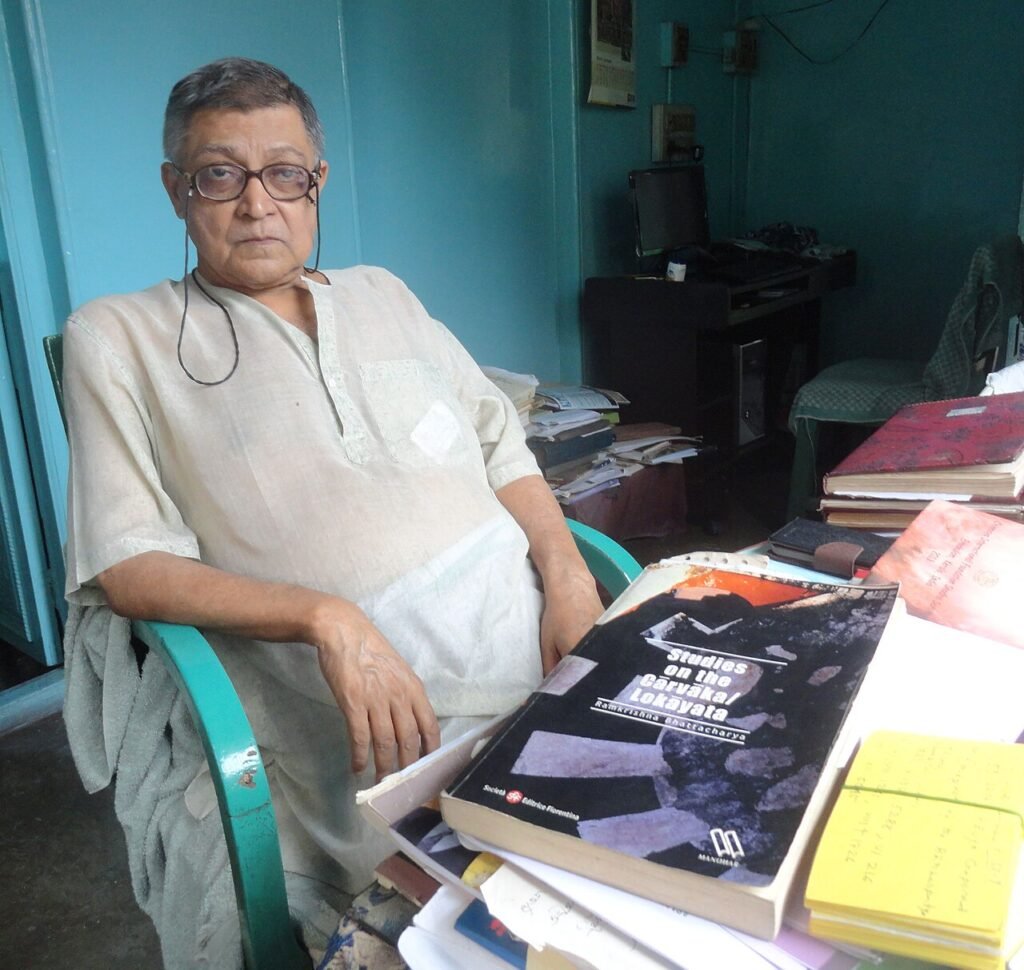
Prof Ramkrishna Bhattacharya taught English at University of Calcutta, Kolkata and was an Emeritus Fellow of University Grants Commission. He is now Fellow of Pavlov Institute, Kolkata.
Leave a Reply