The Practice: God’s Blue Autograph
To prove that he is a true devotee of the god, a man takes a bath, lights a sacred fire in a yajña kuṇḍa (fire pit) in front of him and chants mantras. The name of the god then appears on his body.
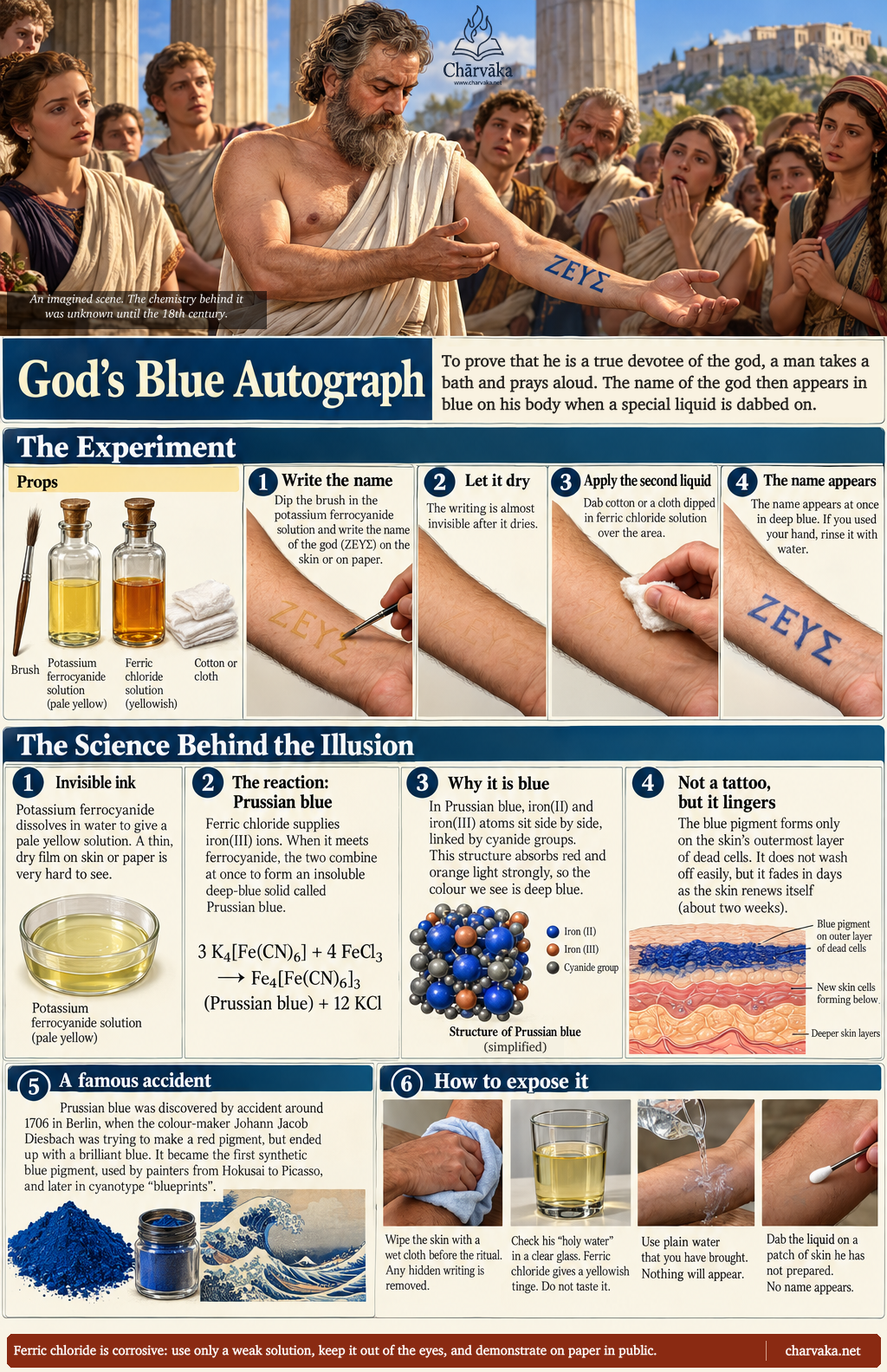
Premanand describes two ways of producing this effect. In the first, the name appears when ash from the fire pit is smeared on and dusted off (see “God’s Autograph: his name in the ash“). In the second, described here, the name appears in blue when a liquid is dabbed on the skin. In a ritual, that liquid can easily be passed off as holy water.
The Experiment
Effect
Magic tattooing: the name of a god, Zeus for a change, appears in blue on the hand, or on paper.
Props
An artist’s brush; a solution of potassium ferrocyanide in water; and a weak solution of ferric chloride (iron(III) chloride) in water, in separate, labelled bottles; cotton or a piece of cloth.
Method
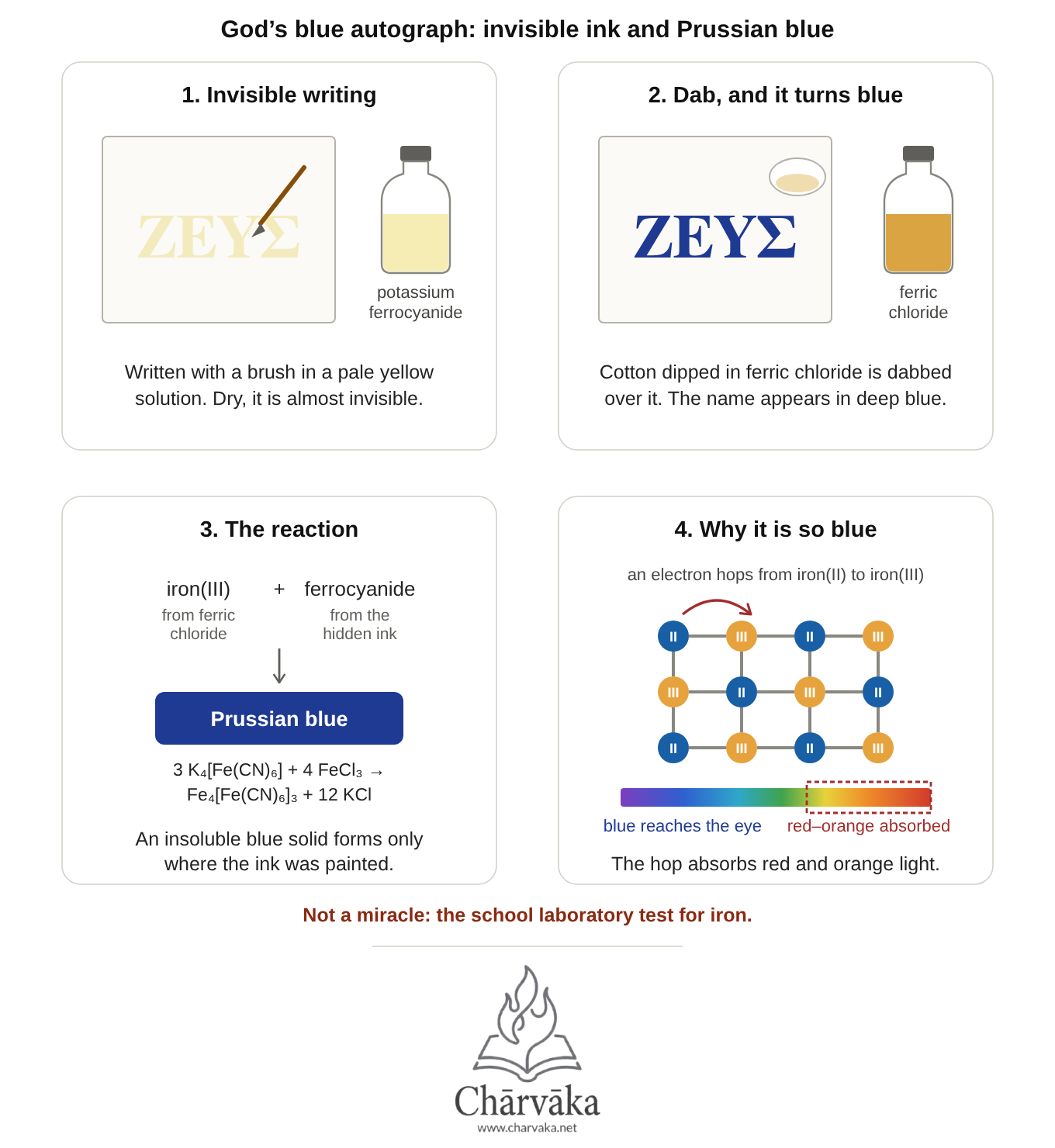
- Dip the brush in the potassium ferrocyanide solution and write the name of the god, here ΖΕΥΣ (Zeus), on your hand or on a sheet of paper.
- Let it dry. The writing is almost invisible.
- Dip cotton or a piece of cloth in the ferric chloride solution and dab it over the area you have written on.
- The name appears at once in deep blue. If you used your hand, rinse it with water.
The Science Behind the Illusion
1. Invisible ink
Potassium ferrocyanide dissolves in water to give a pale yellow solution. A thin, dry film of it on skin or paper is very hard to see. Despite the word “cyanide” in its name, it is not the poison: its cyanide groups are locked tightly to an iron atom. It is a permitted food additive (E536), used to keep table salt free-flowing, and Europe’s food safety authority found it of no safety concern at permitted levels (FSSAI; EFSA). It becomes dangerous only if it is heated strongly or mixed with strong acids.
2. The reaction: Prussian blue
Ferric chloride supplies iron in its iron(III) form. When it meets the ferrocyanide, which contains iron in its iron(II) form, the two combine at once into an insoluble deep-blue solid called Prussian blue:
3 K4[Fe(CN)6] + 4 FeCl3 → Fe4[Fe(CN)6]3 (Prussian blue) + 12 KCl
Because the blue solid forms only where the ferrocyanide was painted, the hidden name appears exactly as it was written. This is the standard school laboratory test for iron(III) ions: add a drop of potassium ferrocyanide solution, and a deep blue colour shows that iron(III) is present.
3. Why it is so intensely blue
In Prussian blue, iron(II) and iron(III) atoms sit side by side, linked by cyanide groups. Light of the right energy can make an electron jump from an iron(II) atom to its iron(III) neighbour. That jump absorbs red and orange light strongly, so the light that reaches our eyes is deep blue (Li and colleagues, 2023). Even a very thin layer gives a strong colour, which is why faint writing becomes bold.
4. Not a tattoo, but it lingers
A real tattoo is made by needles placing ink in the deeper layer of the skin, where it stays for life. Here the Prussian blue forms only on and in the skin’s outermost layer of dead cells. It does not wash off easily, because it is insoluble, but it fades in days as those cells are shed. The outermost layer renews itself in about two weeks (BioNumbers, Harvard Medical School).
5. A famous accident
Prussian blue was itself discovered by accident. Around 1706 in Berlin, the colour-maker Johann Jacob Diesbach was trying to make a red pigment, but the potash he borrowed from the alchemist Johann Konrad Dippel was contaminated with material from animal blood. The result was a brilliant blue. It became the first synthetic blue pigment, used by painters from Hokusai to Picasso, and later in cyanotype “blueprints” (Swiss National Museum). Today, in capsule form, it is an approved medicine for some kinds of radioactive and thallium poisoning (US Food and Drug Administration).
6. How to expose it
- Before the ritual, wipe his skin with a wet cloth. Potassium ferrocyanide dissolves in water, so any hidden writing is wiped away.
- Ask him to use plain water that you have brought. Nothing will appear.
- Look at his “holy water” in a clear glass against something white. Ferric chloride gives it a yellowish tinge. Do not taste it.
- Dab his “holy water” on a patch of skin he has not prepared. No name appears there.
Source & Attribution
This article is based on Science Versus Miracles by B. Premanand (1930–2009). While the core demonstration and methodology derive from Premanand’s field exposures, the analytical framework was updated in 2026 by Charvaka Desk, with the assistance of AI tools, to include scientific commentary across physics, chemistry, biology, physiology, psychology, and the mechanics of illusion. All revisions have been reviewed and fact-checked by our editors. The revision draws on the following sources:
- B. Premanand, Science Versus Miracles (Indian CSICOP, 1994)
- EFSA Panel on Food Additives, “Re-evaluation of sodium ferrocyanide (E 535), potassium ferrocyanide (E 536) and calcium ferrocyanide (E 538) as food additives“, EFSA Journal (2018)
- Food Safety and Standards Authority of India, “Mythbuster: Salt” (2020)
- “Ferric Chloride 10% Aqueous Solution: Safety Data Sheet“, ProSciTech
- M. Li and colleagues, “Identification of the Chromophores in Prussian Blue“, arXiv (2023)
- “Turnover time of cells in the epidermis“, BioNumbers, Harvard Medical School
- “The Swiss alchemist who invented a new shade of blue“, Swiss National Museum blog (2026)
- US Food and Drug Administration, “FDA approves first new drug application for treatment of radiation contamination due to cesium or thallium“
We follow the evidence, including when it shows we were wrong. If you find an error, tell us in the discussion below, or write to us privately. We will review it and correct the article, with a note of the change.
Leave a Reply