Very much like the Presocratic philosophical works, the basic texts of the Cārvāka system are lost. Only a few fragments — passages of varying length — have come down to us. Even then all of them are not genuine, as they seem to offer contrary points of view. Earlier scholars from H. T. Colebrooke down to D. R. Shastri and Mamoru Namai collected some fragments and presented them in ways they deemed fit.1 A closer analysis reveals that all the fragments are not of the same nature: some are aphorisms proper and a few are merely popular verses purportedly airing the Cārvāka view on life and death. More interestingly, there are a number of passages that appear to be more or less verbatim quotations from more than one commentary on the lost Cārvākasūtra.
So far the names of five commentators are known: Aviddhakarṇa, Udbhaṭabhaṭṭa (Bhaṭṭodbhaṭa), Kambalāśvatara, Purandara and Bhāvivikta. Six more fragments seem to have been extracted from some anonymous commentary or commentaries. In my paper I propose to discuss the difference in the attitude of the commentators to some of the Cārvāka aphorisms.
The Cārvāka apparently developed along the line of the other philosophical systems of India. The commentary and sub-commentary tradition is not always consistent in every respect. The commentators and sub-commentators sometimes manipulated the aphorisms to suggest what they would like them to mean. It is therefore necessary to take note of the Cārvāka/Lokāyatika philosophers known to us.
The names of two Cārvāka philosophers are given in Śāntarakṣita’s Tattvasaṃgraha and Kamalaśīla’s Pañjikā: Aviddhakarṇa, Kambalāśvatara, and Purandara. Purandara’s vṛtti (gloss), apparently on the collection of the sūtras, is mentioned in a Prakrit work, Pupphadanta (Puṣpadanta)’s Mahāpurāṇa and two Sanskrit works, Anantavīrya’s Siddhi-viniścaya-ṭīkā and Vādirājasūri’s Nyāya-viniścaya-vivaraṇa. It should be noted that Śāntarakṣita and Kamalaśīla were Buddhists while Pupphadanta and the other two were Jains.
The name of Aviddhakarṇa is also found in the Nyāya-viniścaya-vivaraṇa, Siddhi-viniścaya-ṭīkā and Pramāṇavārttika-svopajña-vṛtti-ṭīkā by Karṇakagomin. The name of his commentary is also given by Kamalaśīla: Tattvaṭīkā. All that can be said about these three commentators is that they must have flourished in or before the eighth century.
Cakradhara in his Granthibhaṅga commentary on Jayanta Bhaṭṭa’s Nyāyamañjarī mentions the fourth name, Bhāvivikta, whom he describes as a cirantana-cārvāka, an ancient (=traditional) Cārvāka. He may have written his commentary even before Kambalāśvatara and Purandara. Unfortunately no extract from his work has been quoted by Cakradhara.
The fifth and so far the last commentator we know of is Udbhaṭabhaṭṭa, also mentioned as Bhaṭṭodbhaṭa. This Udbhaṭa might be identical with the rhetorician from Kashmir. Kalhaṇa in his Rājatarangiṇī mentions a minister bearing the same name. As regards Kambalāśvatara and Purandara, all that can be said is that they belonged to the eighth century or before. As to Udbhaṭa, if all the Udbhaṭas were the same, we may fix the time at the ninth century. His name occurs in Syādvāda-ratnākara and Granthibhaṅga. Vādidevasūri respectfully refers to him as ‘a venerable old twice-born’ (jarad-dvijanmā-mahānubhāvaḥ). Considerably long extracts from Udbhaṭa’s commentary are quoted as the exponent’s view (pūrvapakṣa) by Cakradhara and Vādidevasūri. Cakradhara sets all speculation at rest by clearly stating that suśikṣita, “well educated” and cārvākadhūrta, “cunning Cārvāka” in Jayanta’s work mean Udbhaṭa (and his followers).
From Kamalaśīla we know that there were at least two commentaries (if not more) on the Cārvākasūtra in or before the eighth century. The commentators explained one sūtra (tebhyaś caitanyam) in two different ways. Cakradhara mentions Bhāvivikta as one among many of the traditional Cārvākas. So the number of commentators may have been more than five that we have so far been able to ascertain.
The fragments of the commentaries mostly refer to five aphorisms, namely, athātas tattvaṃ vyākhyāsyāmaḥ, “we shall now explain the principle”; pṛthivy āpas tejo vāyur iti tattvāni, “earth, water, fire and air are the principles, nothing else”; tebhyaś caitanyam, “consciousness (arises or is manifested) out of these”; pratyakṣam (ekam) eva pramāṇam, “perception indeed is the (only) means of right knowledge”; and pramāṇasyāgauṇatvād anumānād arthaniścayo durlabhaḥ, “since the means of right knowledge is to be non-secondary, it is difficult to ascertain an object by means of inference”.
The sūtra, kāyād (or śarīrād) eva, “From the body itself,” is more cryptic than the similar aphorism, tebhyaś caitanyam. Even before Kamalaśīla, there were two schools of commentators: one supplying the adhyāhāra, upajāyate, “is born”, the other opting for abhivyajyate, “is manifested”.2 Other writers while controverting the Cārvākas preferred either of the two, some mention both.
How many instruments of cognition did the Cārvākas accept as valid? Being materialists, they had to uphold perception. But does it mean that they excluded every other instrument of cognition as invalid? Kamalaśīla has quoted a sentence apparently taken from Purandara’s Vṛtti which runs as follows: “The Cārvākas, too, admit of such an inference as is well known in the world, but that which is called inference [by some] transgressing the worldly way is prohibited [by the Cārvākas].” It would seem that the Cārvākas accepted perception as the only valid means of knowledge because it was direct, unmediated and hence non-secondary, as the proper instrument of cognition should be. Inference on the other hand is dependent on perception, and so is regarded as secondary. The distinction made by the Cārvākas between utpannapratīti (inferential cognition acquired by oneself) and utpādyapratīti (inferential cognition to be acquired on somebody else’s advice), mentioned by Jayanta Bhaṭṭa, is the lasting contribution of the Cārvākas to the study of Logic, especially in relation to the nature of inference.
Absolutely nothing is known about Kambalāśvatara and Purandara. The names of Aviddhakarṇa and Bhāvivikta are also found in Nyāya literature. But at the present state of our knowledge we cannot say, as Eli Franco writes, whether they were “Cārvākas who converted to Nyāya or Naiyāyikas who converted to the Lokāyata.”3 Franco is also of the opinion that “the possibility of their having introduced Vaiśeṣika categories into the Cārvāka school is certainly not unimaginable.” Yet it is to be noted that Cakradhara mentions him as belonging to the traditional line of the Cārvākas. It was Udbhaṭa, as both Cakradhara and Vādidevasūri say, who went for strange innovations.
Of all the commentators, Udbhaṭa deserves more notice than others. While the other commentators seem to have followed the literal meaning of the aphorisms (so far as can be gathered from the available fragments, admittedly inadequate to form any definite opinion), Udbhaṭa was indeed a ‘revisionist’ among the materialists. Let me quote a few of his remarks as reproduced by Vādidevasūri:
While explicating the two aphorisms in the Lokāyatasūtras, “We shall now explain the principle” and “Earth, water, fire and air (are the principles)”, he (sc. Udbhaṭa) described it in another way, forsaking the conventional interpretation. In the first aphorism, the term, tattva, tells the impossibility of laying down any fixed number and essential characteristics of the sources of knowledge and objects of knowledge. The second aphorism, too, is explained by him as referring to the objects of knowledge. The word, iti in the (aphorism), “The earth, water, fire and air iti”, indicates also the possibility of similar objects of knowledge other than the earth, etc. Such is his view.
The word, iti, does not denote the end, (but) it is illustrative. There are other principles such as consciousness, sound, pleasure, pain, desire, aversion, efforts, impression and others. There are also prior non-existence of the earth, etc., posterior non-existence, and mutual difference which are quite apparent and distinct (from the principles, viz., earth, etc.).
This goes against the very grain of the Cārvāka approach.
Like Aviddhakarṇa, Udbhaṭa too was an accomplished logician. He could and did use the technical terms of Nyāya to justify the orthodox Cārvāka position. However, he succeeded more in obfuscating than expounding the significance of the aphorisms. Here is an example (the least opaque of the fragments related to logic):
The one who framed the definition [of anumāna as pramāṇa] aimed at brevity of expression, but not only because of this does inference become secondary. And if they were to define the characteristics of probans [sādhya, i.e., inferable property, such as ‘fire’] as attributes of the thing which is a part of the probandum [hetu, reason, such as ‘smoke’], there would be no secondary significance even in the definition.
It is probable that Jayanta Bhaṭṭa had Udbhaṭa in mind when he said, “The Cārvākas, the well-learned ones, say that it is really impossible to specifically state the number of the instruments of cognition.” Given Udbhaṭa’s refusal to delimit the number of the objects of cognition (see above), it is only one step further to deny any definite number of the instruments of cognition.
In fact, in one instance, Udbhaṭa seems to verge on pure idealism. He says, “[T]here is an unseen property of the elements, the particular nature of the elements that constitute the body, which brings about the experience of diverse pleasures and pains.”
Udbhaṭa’s penchant for novelty is most apparent in his interpretation of the word bhūtebhyaḥ. He does not take it in the ablative case denoted by the fifth declension (a view followed by the earlier Cārvākas like Bhāvivikta and others), but suggests that it is a case of tādarthye caturthī. The aphorism would then mean: “Consciousness is for (the sake of) the elements; consciousness is independent and aids the physical elements which constitute the body.” The separation of consciousness from the body is closer to idealism than materialism.
Although the available extracts from the commentaries are pitifully few, we may still venture to suggest that all the commentators of the Cārvākasūtra flourished long after the redaction of the sūtra work. Whether Purandara was the first redactor as also the first commentator cannot be ascertained. But the difference in opinion regarding the adhyāhāra in relation to an aphorism basic to the Cārvāka doctrine (tebhyaś caitanyam) shows that there was a school of commentators which believed in the immanence of consciousness in the body itself. Apparently it did not treat consciousness as an epiphenomenon as suggested by the sūtra, jalabudbudavaj jīvāḥ, “souls are like water bubbles.” But the way in which Udbhaṭa offers his interpretation of the well-known aphorisms exhibits a marked break from the tradition. It may even be argued that he was only manipulating the Cārvāka aphorisms to propound a philosophy of his own.
What, however, unites Purandara, Aviddhakarṇa and Udbhaṭa is their staunch defence of the primacy of perception. No other philosophical system except Cārvāka/Lokāyata seeks to classify the pramāṇas into two categories, primary (agauṇa) and secondary (gauṇa), that is, any other instrument of cognition except perception is a pramāṇa only in the metaphorical sense. Those who believe in the validity of more than one instrument of cognition treat all of them on a par: inference or word is as valid as perception. The Cārvākas alone treat perception as basic to acquiring knowledge and inference is to be admitted when and only when it is based on and preceded by perception. This is how anumāna is defined in the Nyāyasūtra, 1.1.5.
Notes & References
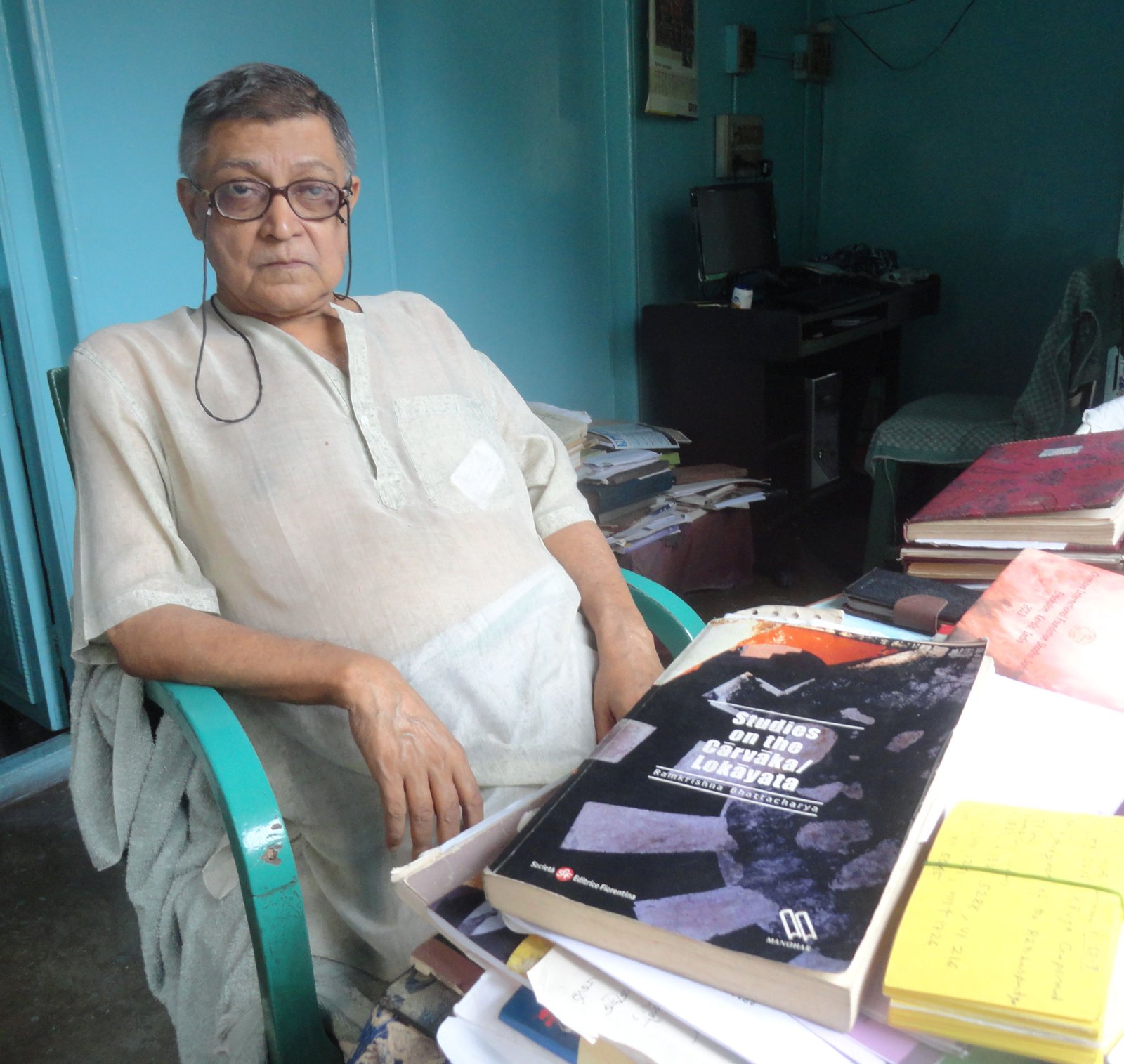
- 1 For an account of critical surveys in the field of Cārvāka studies, see Ramkrishna Bhattacharya, “Cārvāka Fragments: A New Collection”, Journal of Indian Philosophy (Dordrecht), 30: 6, December 2002, pp. 597-640, included, with revisions and corrections, in my Studies on the Cārvāka/Lokāyata, Firenze: Società Editrice Fiorentina, 2009. All the fragments referred to in this paper are to be found in the aforesaid article with full reference to the sources. Interested readers are requested to consult the same for further information.
- 2 See Kamalaśīla, Tattvasaṃgraha-pañjikā on Tattvasaṃgraha, verses 1857-58.
- 3 Eli Franco, Dharmakīrti on Compassion and Rebirth, Wien: Arbeitskreis für Tibetische und Buddhistische Studien, 1997, p. 142.
Bibliography
- Bhattacharya, Ramkrishna (2002). “Cārvāka Fragments: A New Collection”, Journal of Indian Philosophy (Dordrecht), 30: 6, pp. 597-640.
- Bhattacharya, Ramkrishna (2009). Studies on the Cārvāka/Lokāyata, Firenze: Società Editrice Fiorentina.
- Franco, Eli (1997). Dharmakīrti on Compassion and Rebirth, Wien: Arbeitskreis für Tibetische und Buddhistische Studien.
- Kamalaśīla. Tattvasaṃgraha-pañjikā on Tattvasaṃgraha.
Leave a Reply