reference to opposition to Modi’s possible projection as the Prime-ministerial
candidate of NDA, in the next parliamentary elections said that NDA’s Prime
Ministerial candidate should be one with secular credentials. His aide went on
to say that Vajpayee had the intention of sacking in the wake of Gujarat
carnage and the NDA lost 2004 Parliamentary elections due to the Gujarat carnage and role of Modi in the same (June 19,
2012). In response Lalu Yadav questioned Nitish as to how he, Nitish, continued
to be part of NDA after Gujarat happened? The
BJP spokesmen talked at various levels. One of them said that ideologically
Vajpayee, Advani and Modi are all the same. Another one said that Hindutva is
truly secular and liberal so why Modi cannot be the PM candidate. RSS Supremo
Bhagwat buttressed the point by saying as to why the nation cannot have a
Hindutvawadi prime minister?
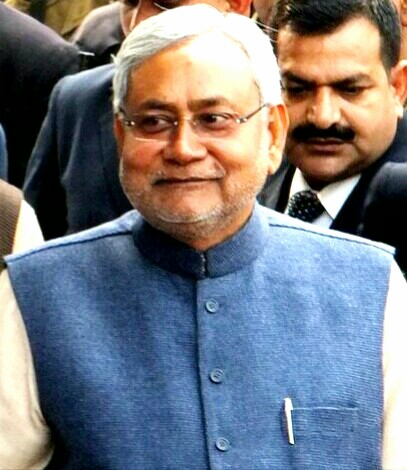 |
| Nitish Kumar |
With this the ever continuing
debate about secularism and the nature of Hindutva is in the social space once
again. One concedes that Kumar is no secular angel. When BJP came to become the
largest single party in Lok Sabha in 1996, no one dared to ally with it that
time as it’s communal face was starkly obvious due to its role in Babri
demolition and consequent violence, which was too fresh in people’s memory. By
1998 in a similar situation many parities including Kumar’s JD (U) could not
resist the temptation of power and struck some minimum common program to share
power with the BJP. Though his JD (U) had a common minimum understanding with
BJP, right under Kumar’s nose BJP during NDA regime communalized the polity to
no end. Saffronization of text books was done and introduction of courses like
Paurihitya and Hindu Rituals in the Universities being just few examples of the
Hindutva agenda, were starkly visible. When the carnage broke out in 2002,
Kumar was the minister for railways and in that capacity he ignored the
investigation of Godhra train burning, which was mandatory as per the rules.
Due to this Modi’s concoction that train burning was a preplanned act by
Muslims went unchallenged for a long time. Kumar could have called Modi’s bluff
that the train burning was a planned act by Muslims.
What did he tell Vajpayee at that time one does not know, but as a secular
person, his threat of pulling out from the Government would have set the house
in order to a great extent. Even today, right under his nose his ally; the BJP
of Bihar, is communalizing the polity. Communalism is not just communal
violence. Communal violence is just the superficially visible part of the
process of communalization, which aims to abolish secular space and liberal
values.
spoke-persons are partly true also. The claim that Vajpayee, Advani, and Modi
(one can add even people like Praveen Togadia, Promod Mutallik, Vinay Katiyar
and the likes) are similar, is true to a great extent. They are all
ideologically committed swaymsevaks, (RSS trained Cadres) working for the
agenda of Hindu Rashta, the goal of RSS politics. There are dissimilarities
amongst them also; there is a division of labor amongst them also. Since BJP is
not hoping for coming to majority on its own strength, it has to keep a liberal
façade. Precisely for this reason Vajpayee was the prime Minister, while prime
mover of the chariot of communalism through Ram Temple
campaign, Advani, was forced to play the second fiddle. When Vajpayee withdrew
from the scene, Advani decided for the image change over and he suddenly
realized the secular worth of Jinnah. It is another matter that he overplayed
the game and their patriarch, RSS, decided to clip his wings and demote him.
All the top brass of BJP, VHP, Bajrang Dal, Vanvasi Kalyan Ashram and many
other RSS outfits are primarily the RSS swayamasevaks, which is too well known
by now.
 When the previous avatar of BJP,
Jan Sangh, merged in Janata Party in the wake of lifting of emergency, the
other components of Janata party, socialists in particular, demanded that the
Jan Sangh members should give up their membership-affiliation with RSS. For Jan
Sanghis breaking link with RSS was unthinkable and they decided to pull out
from Janata Party and then they regrouped as Bharatiya Janata Party, as it is
known at present. Vajpayee, in his famous address to NRI Indians in Staten
Island, US, asserted that he is Swayamsevak first and anything else, PM, later.
same ideological wavelength but playing different roles at any point of time.
They are communal to the core, with the agenda to work for religion based
nationalism. To say that Hindutva is secular and liberal is like
putting the reality on its head. Hindutva is not Hinduism. Hinduism is an
umbrella of various religious streams, which flowered and existed in this part
of the world. Hindutva as a concept and political ideology started emerging
during colonial period and was later popularized by Savarkar. He defined it as
‘Whole of Hinduness’, a combination of Aryan race, culture and language. In
particular Hindutva is based on the Brahmanical stream of Hinduism, subtly
promoting caste and gender hierarchy, reviving the feudal hierarchical system
in the modern idioms.
together on the principles of Liberty,
Equality and Fraternity, the upholders of Hindutva, coming from the sections of
Rajas, Jamindars and section of upper caste Hindus kept aloof from the struggle
against British. They came together as Hindu Mahasabha and later founded and
supported RSS. Their politics was parallel and opposite of the
politics of Muslim League, which was arguing on the similar line for an Islamic
state, Pakistan.
Muslim League also had base amongst the landed aristocracy, Nawabas, Jagirdars
and later joined by educated elite. Hindutva stream, Hindu Mahasabha-RSS
projected the glorious Hindu past and asserted we are a Hindu Nation from times
immemorial. Muslim League identified with the rule of Muslim kings and traced
their lineage to the first invasion of Muslim King in this part of the world.
The National movement under Gandhi was for throwing away the yoke of colonial
rule and for social change of caste and gender relations. It articulated that
we are a Nation in the making.
 |
| MS Golwalkar |
Here one can see the
instrumentalist use of religion by a section of society, elite, who wanted to
preserve their privileges in the changing social dynamics. The sharpest
articulation of Hindutva politics came from M.S. Golwalkar, who in his ‘We or
our Nationhood Defined’, eulogized fascism and asked for a second class
citizenship for Muslims and Christians. Today the RSS cadres unable to swallow
the blunt formulation of their politics by Golwalkar deny the existence of this
book. The dilemma of RSS and its progeny is to keep the democratic face till
they come to a majority when they can unleash their full scale agenda.
Currently also their trained swayamsevaks are infiltrating in different wings
of the state, media and education apart from forming the organizations like BJP
etc. So who is secular in BJP? They claim that they believe in justice for all
and appeasement of none. This is a very cleverly worded sentence to hide their
intention of continuing the discrimination of those suffering in the present
scheme of things.
difference between Hinduism and Hindutva? One has to take recourse to the
example of the ‘father of the nation’ to avoid the heavy academic debates.
Gandhi was a Hindu but not a follower of Hindutva. Godse and the RSS tribe are
the practitioners of ‘Hindutva politics’. For this politics a Hindu like Gandhi
is unacceptable ideologically as he could reach the zenith of secular ethos
while being the best of the Hindus! We do realize that while the statement by
Nitish Kumar is a symbol of shadow boxing it also presents one of the aspects
of the political reality being witnessed by the nation.
Leave a Reply