North-South Divide
The story of Agastya, a North Indian sage, crossing the Vindhya hills and visiting South India (never to return), is well known. It has given rise to a proverb, Agstya-yātrā, in Bangla and perhaps in other North Indian languages. Like all legends, it is undated. Thus, it has been interpreted as an allegory of the ingress of the North into the South, or, as a recent historian has said, “evidence of Aryan speakers’ movement towards the south” (Noboru Karashima, “Beginnings of South Indian history,” in: Noboru Karashima (ed.), A Concise History of South India, New Delhi: Oxford University Press, 2014, p. 26). From about the third century BCE, religions born in North India spread to the South. Interestingly enough, two heterodox religions, Buddhism and Jainism, were the first to reach the Deccan and further south; the Brahmanical (Vedist) religion arrived later. There are sufficient archaeological findings to support this. The most conspicuous of the North Indian religions was Buddhism, although traditionally Jain migration is said to have started as early as the time of King Chandragupta Maurya (fourth century BCE).
The reflection of both Buddhism and Jainism is found in old Tamil literature. There are several long narrative poems that seek to establish the superiority of either Buddhism or Jainism. The Brahmanical religion did not take root in the South before the first century BCE. Consequently, in the Common Era, we find specimens of works belonging to these three religions written not in Sanskrit, but in Tamil.
Historians of Tamil literature—or of Indian literature as a whole (one such ambitious work is Sisir Kumar Das’s A History of Indian Literature 500–1399, New Delhi: Sahitya Akademi, 2005)—seldom, if ever, mention that the polemics in the Maṇimēkalai (The Jewel Belt), the Nīlakēci (The Blue-Haired), and similar works contain strong denunciations of several philosophical systems that traveled from the North to the South. Tolerance is now projected as the hallmark of Indian culture. Contrary to this notion, there seems to have been no love lost between the northern philosophical systems and Jainism or Buddhism in the South. Apparently, Buddhism and Jainism were both imported in their northern garb. Nevertheless, in the course of time, South India produced eminent Buddhist logicians, such as Diṅnāga (c. 480–540 CE). The Jains, in turn, produced theologians and philosophers like Kundakunda (first century BCE), who earned all-India fame in the Common Era.
Tamil Literature: Its Antiquity and Variety
It should be kept in mind that “Tamil can claim one of the longest unbroken literary traditions of any of the world’s living languages” (Kamil Veith Zvelebil, Tamil Literature, A History of Indian Literature, Volume X Fascicule 1, Wiesbaden: Otto Harrassowitz, 1974, p. 2). Nota Bene (Note Well): “the world’s living languages,” not just India’s.
Jean Filliozat, in his essay “The Jaina narrative literature in South India and its counterparts” (Indologica Taurinensia, Vol. XI, 1983, pp. 97–107), provides an account of the rich narrative tradition in Tamil. What is noteworthy is that, besides entertaining their audience with interesting stories, these narratives are highly tendentious: they indulge in undisguised propaganda in favor of their respective religions and philosophical systems. No counterpart to these narratives is found in the North. Historians of Tamil literature have called them “epics,” although they do not conform to Sanskrit criteria laid down in books of poetics and rhetoric, nor are they judged well by European standards. As Zvelebil explained:
“To express this terminologically, we may say that Tamil epic texts are not itihāsas, i.e., large narrative poems (large in character, in events, in setting, in effect) of the traditional heroic past, but rather longer or shorter mahākāvyas… They are very different from each other and, strictly speaking, some of them should hardly be called epics in the narrower and more technical sense at all. But they are not as radically different from the accepted concept of the epic as, say, Dante’s Divine Comedy, which has also been called an epic.” (Zvelebil, 1974, p. 16).
Philosophical Debates in the Epics
The Maṇimēkalai [Ilanko Ādigāl and Sattanar, Maṇimēkalai, trans. Prema Nandakumar, Thanjavur: Tamil University, 1989] (c. 550 CE) is what in Tamil tradition is called an epic. So is the Nīlakēci (c. 950 CE). The first is the story of the wanderings of a Buddhist female ascetic named Maṇimēkalai. It is said to reflect “almost exactly the ideas of Diṅnāga, the founder of Buddhist logic” (Zvelebil, p. 141). Among other things, the epic Maṇimēkalai contains the earliest known list of ṣaṭ-tarkī, six systems of philosophy based on argument: Lokāyata, Buddhism, Sāṃkhya, Nyāya, Vaiśeṣika, and Mīmāṃsā (27.78–80). Instead of the āstika/nāstika division of philosophical systems (which is based on the Brahmanical criterion of adhering or not adhering to the Veda), here is a secular division of systems founded, on the one hand, on argument, and on the other (presumably), on faith.
Maṇimēkalai, the heroine, inquires into the basic tenets of all philosophical systems—Sāṃkhya, Mīmāṃsā, etc.—and finds all of them wanting in substance. In the debates, Buddhism ultimately proves victorious over all Veda-abiding systems, as well as Jainism and materialism (with its two schools, Bhūtavāda and Lokāyata; 27.272–73). The Maṇimēkalai, therefore, besides its other merits, is the earliest work of doxography (a collection of views of ancient philosophical schools, now lost). The earliest known doxographical work in Sanskrit is the Ṣaḍ-darśana-samuccaya by the Jain savant Haribhadra, which was composed in the eighth century CE, long after the Maṇimēkalai. The Nīlakēci is also a doxographical work of some importance, as it records several doctrinal aspects of Southern Buddhism probably not found anywhere else. Its inclusion of the Ājīvikas is also significant. No other heterodox view current in the Buddha’s lifetime is mentioned; all seem to have become extinct in the Common Era.
With the passage of time, religious and philosophical systems that originated in the North traveled to the South. As mentioned, Jainism likely arrived first with Chandragupta Maurya (fourth century BCE), followed closely by Buddhism (third century BCE); Brahmanism, with its emphasis on varṇāśrama-dharma, was late to arrive (first century BCE). The Ācārakkōvai “belongs to the Brahmanical school and is a digest of ideas from the Dharmaśāstra” (Y. Subbarayalu, “Sangam and Post-Sangam Literature,” in: Noboru Karashima (ed.), A Concise History of South India, New Delhi: Oxford University Press, 2014, p. 46). There is also a Jain work called Silappatikāram, also spelled Cilappatikāram (The Lay of the Anklet, c. 450 CE), by Ilangovadigal, who is believed to have been a Chera prince. “Unlike the Silappatikāram [a Jain kāvya], the Maṇimēkalai [a Buddhist kāvya] is quite outspoken in religious propagation and underlines the fact that there were lots of polemical disputes and discussions developing among adherents of rival religions” (ibid., pp. 46–47).
The Jains, however, were not to be outdone: the author of the Nīlakēci (Neelakesi, edited, translated into English, and published by A. Chakravarti, Kumbhakonam, 1936), although Jain and hence tolerant by conviction, spares no religion or philosophical system. In the final section of the work (Section IV, Chapters 1–10, pp. 136–336), Nīlakēci, the Jain nun, addresses no fewer than ten doctrines:
-
Dharma Urai (Tarumavurai, exposition of the [Jaina] dharma)
-
Kuṇḍalakēci-vāda (the doctrine of Kuṇṭalakēci, i.e., the Buddhist doctrine preached by a female Buddhist ascetic)
-
Arka-candra-vāda (another Buddhist doctrine)
-
Mokkala-vāda (the doctrine of Mokkalaṉ, Pali Moggallāna, Sanskrit Maudgalyāyana, referring to the Buddhist doctrine of momentariness, kṣaṇikavāda)
-
Buddha-vāda
-
Ājīvika-vāda (doctrine of the Ājīvikas, an extinct heterodox sect)
-
Sāṃkhya-vāda
-
Vaiśeṣika-vāda
-
Veda-vāda (Mīmāṃsā)
-
Bhūta-vāda (Pūtavātam, materialism)
Referring to (and apparently agreeing with) the view of Chakravarti, Filliozat writes:
“It has been observed by the editor, A. Chakravarti, who contributes a detailed introduction to the work, that the major non-Jaina schools of philosophy—Śaṅkara, the Śaiva and Vaiṣṇava Saints, Nāyaṉmār and Āḻvār—are not mentioned in the work. Chakravarti thinks that this is because they did not yet exist as opponents of the Jaina doctrine, so that the polemical work Nīlakēci must belong to the period before their emergence. This may place the composition of the Nīlakēci in the 5th or 6th centuries.” (Filliozat, p. 105).
Modern scholars, however, prefer to date the work much later (tenth century CE; see Zvelebil, p. 139).
Materialist Schools Expounded in the Epics
What is most noteworthy is the mention of bhūtavāda in both epics. The Maṇimēkalai refers to another materialist school called Lokāyata (27.272–73). Curiously enough, the Nīlakēci does not mention Lokāyata at all; it speaks of bhūtavāda alone.
(One caveat: Appaswami Chakravarti Nayanar, in his translation of the Nīlakēci 4.10, often uses expressions like “the Lôkâyata teacher” [p. 322] or “the Chârvâka teacher” [p. 335 thrice, p. 336 twice]. However, the text—checked and confirmed by A. Mahalingam—invariably refers to Pūtavātam and Pūtavāti. Similarly, a quotation from Shakespeare’s Hamlet is inserted [p. 336], which is obviously not in the original. Barring these, Chakravarti’s translation, I am assured, is fairly faithful to the original.)
The doctrinal aspect of materialism (of the pre-Cārvāka kind) is more or less the same in both epics: unlike the Cārvākas, earlier materialists in India relied on only one instrument of cognition—namely, perception—whereas the Cārvākas admitted the validity of inference to a certain extent (insofar as it was based on and/or verifiable by perception). There are other differences between the pre-Cārvākas and the Cārvākas that can be discerned from later evidence (for details, see R. Bhattacharya, “Development of Materialism in India: the Pre-Cārvākas and the Cārvākas,” Esercizi Filosofici 8, 2013, pp. 1–12. [2013a]. ISSN 1970-0164. Link: http://www2.units.it/eserfilo/art813/bhattacharya813.pdf).
The Maṇimēkalai contains the earliest known description of Lokāyata as a philosophical system rather than a mere śāstra of disputation. In Pali and Sanskrit Buddhist traditions, disputatio is the only meaning of Lokāyata. The Maṇimēkalai refers to no book of disputation, but specifically mentions Lokāyata as a distinct school of materialism, separate from bhūtavāda.
Predominance of Women
One final note: Tamil epics feature heroines rather than heroes. There are no scenes of bloody battles, only battles of ideals—both religious and philosophical. The heroines, whether Buddhist or Jain, are self-confident, vocal, and always prepared to take part in debates. They travel throughout the Tamil land disguised as men. Social historians have detected:
“…indications of matrifocal and matripedestal traditions in the sources, indicating different cultural practices within the Tamil macroregion. The post-Sangam literature (c. fourth–sixth centuries CE), marked by didactic works and epics, points to influences from outside the region in the form of Jainism and Buddhism… However, the new ideas presented by the Sramanic traditions were eclipsed in the early medieval period with the growth of the Brahmanical religion in the region.” (R. Mahalakshmi, “Women in premodern South Indian society,” in: Karashima (ed.), p. 115).
[“Matrifocal societies are those that are centered on the mother as the pivotal figure in the social organization, while matripedestal refers to the idolization and worship of the mother.” Ibid., p. 115 n39.]
Appendix A
The bhūtavādī in the Maṇimēkalai is made to declare the basic doctrine of his system in the following terms (as translated by Prema Nandakumar):
When aathi (?) flowers, sugar, and the rest
Are mixed, wine is made.
Life too appears
By the mixing of elements, and vanishes
When they separate like sounds from a drum.
Conscious elements produce life within,
And unconscious ones produce the body,
Each appearing through their elements.
This is the truth.
Words different from this
And other facts are from Materialists [Lokāyatas].
Sense perception is valid.
Inference is false.
This birth and its effects conclude
Now.
Talk of another birth is falsity. (27.265–76, p. 154)
The words of the bhūtavādī have been paraphrased by a late medieval commentator in the following way:
“When certain flowers and jaggery are boiled together, liquor is born, which produces intoxication. Just as when elements combine, consciousness arises. Consciousness dissolves with the dissolution of the elements composing it, like the disintegration of sound. Elements combine to produce living Bhūtas, and from them, other living Bhūtas are born. Life and consciousness are synonymous. From non-living Bhūtas consisting of two or more elements arise non-living Bhūtas of the same type. Lokāyata is a variant of this system that agrees in fundamentals with it. Observation is the method by which knowledge is obtained. Inferential thinking is an illusion. This worldly life is real. Its effects are experienced in this life only. The theory that we enjoy the fruits of our actions in our next birth or in another world is false.” (Quoted and translated by N. Vanamamalai)
Appendix B
There are at least two recent translations of the Maṇimēkalai in English—one in prose and the other in verse:
-
Maṇimēkalai (The Dancer with the Magic Bowl), trans. Alain Daniélou with the collaboration of T.V. Gopala Iyer, New Delhi: Penguin Books, 1993.
-
Maṇimēkalai, trans. Prema Nandakumar, Thanjavur: Tamil University, 1989.
There is also an abridged version of the epic:
-
Lakshmi Holmström, Manimekalai/Silappattikaram, Hyderabad: Orient Longman, 1996.
No edition or translation of the Nīlakēci other than the ones by A. Chakravarti is available. The 1936 edition has been reprinted several times. Both the text and translation are available online.
The following articles are of interest:
-
Miyamoto Jō, “Lōkāyata in Tamil,” Journal of Indian and Buddhist Studies, Vol. 55, No. 3, March 2007, pp. 1131–1135.
-
G. Suryanarayana Sastri, “The Manimekalai Account of the Sankhya,” Journal of Indian History 8 (1929), pp. 322–327.
-
G. Suryanarayana Sastri, “Buddhist Logic in Manimekalai,” Journal of Indian History 9 (1930), part iii.
-
N. Vanamamalai, “Materialist Thought in Early Tamil Literature,” Social Scientist, Vol. 2, No. 4 (November 1973), pp. 25–41 (also available on JSTOR).
Other sources have been mentioned in the text within parentheses.
Acknowledgements
Chayan Samaddar, Prabir Gangopadhyay, Sunish Kumar Deb. The usual disclaimers apply.
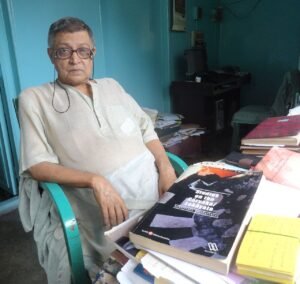
Prof Ramkrishna Bhattacharya taught English at Unversity of Calcutta, Kolkota and was an Emeritus Fellow of University Grants Commission. He is now Fellow of Pavlov Institute, Pavlov Institute, 98, Mahatma Gandhi Road, Kolkata – 700007
Leave a Reply