The cow is now the most important politico-religious icon in India. The self-proclaimed custodians of Hinduism and their political representatives in power are desperate to impose a ban on cow slaughter and beef consumption. As a result, there have been incidents of violence not only in relatively unknown towns like Dadri but also on the floors of State Legislative Assemblies. Moreover, efforts are underway to elevate the cow to the status of a national animal. For right-wing Hindu nationalists, the cow has become the new fulcrum of the communal agenda—much like the Ram Janmabhoomi movement was in the 1990s.
Of course, the debate surrounding the cow has existed for ages. Hindu traditionalists have long considered the cow holy and beef-eating a sin. On the other hand, efforts have been made on the basis of scriptural evidence to show that the animal was not always sacred and that beef-eating was once a regular practice among ancient Hindus. Even reformers like Raja Rammohun Roy and Swami Vivekananda argued that beef consumption and Hinduism were not historically incompatible. Nevertheless, the issue has continued to plague Hindu society, becoming a major bone of contention between liberals and conservatives since the nineteenth century.
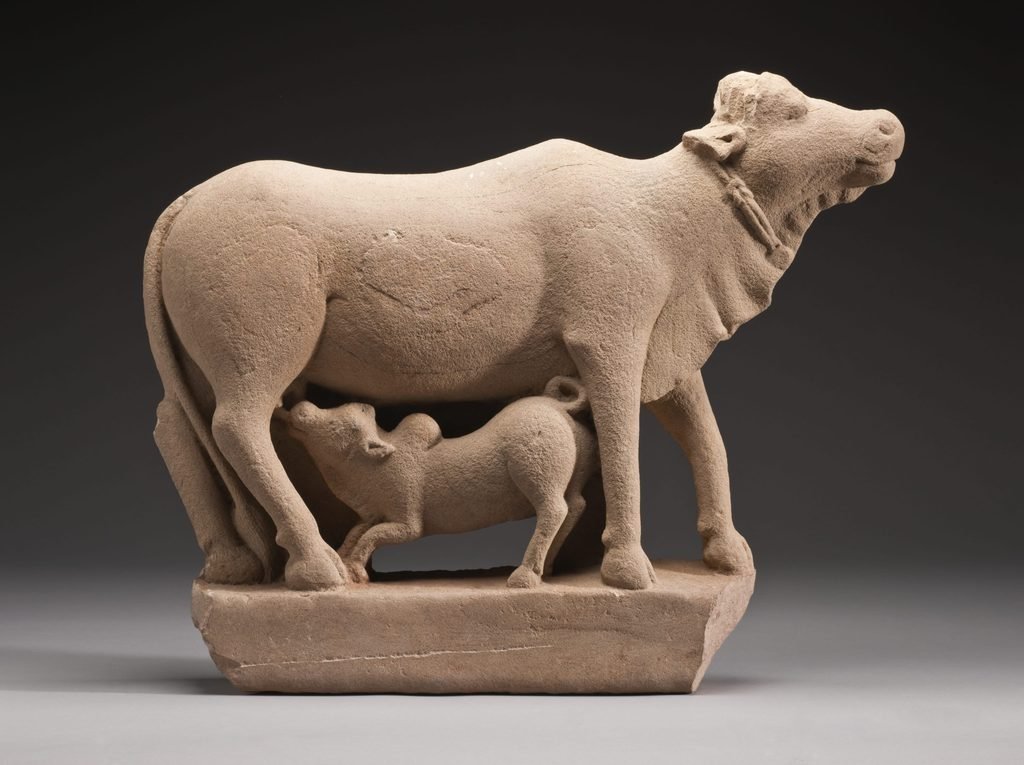
Modern scholars have approached the issue from a different angle. Rather than limiting themselves to citing literary and historical data to uncover the past, they provide logical explanations for why beef consumption eventually became unacceptable to Hindus. Yet despite these scholarly efforts, little has changed regarding the issue of the “holy cow.” The principal driver behind this persistence is political vested interest that seeks to maintain social and political dominance. Indeed, this politics of identity—which can properly be called communalism—has been at work ever since Brahmins first discouraged the consumption of beef.
The early Aryans who migrated to India were a semi-nomadic people with a predominantly pastoral economy. Cattle represented the primary form of wealth, over which inter-tribal wars were fought. Naturally, cattle—being their most valued possession—were sacrificed to propitiate supernatural powers. The Rigveda abounds in references to animal flesh, including that of the cow, being offered to various deities. This practice continued through the later Vedic period.
Furthermore, the slaughter of cattle and consumption of beef on occasions such as birth ceremonies, upanayana (initiation rites), marriages, śrāddha (ancestral rites), and the reception of guests (Pāṇini uses the term goghna for a guest) were standard in ancient times. Highly revered priests and sages, most notably Yājñavalkya, expressed a preference for beef. Brahmanical lawgivers like Manu, Bṛhaspati, and Parāśara classified cow-killing and beef consumption as a minor offense (upapātaka) rather than a major sin (mahāpātaka). In addition, medical treatises by Caraka (1st–2nd century CE) and Suśruta (3rd–4th century CE) explicitly prescribed the meat of cattle and other animals to treat various ailments. Epics like the Mahābhārata and the Rāmāyaṇa also bear testimony to the widespread consumption of beef among Brahmins.
However, the dietary preferences of the later Vedic people gradually shifted. The rising importance of agriculture—particularly with the widespread adoption of iron technology—necessitated the preservation of cattle for ploughing and draft labor. Consequently, recommendations against animal sacrifice were introduced into later scriptures.
Simultaneously, the emerging social hierarchy based on the varṇa system created a class-divided society in which Brahmins and Kṣatriyas benefited at the expense of Vaiśyas and Śūdras. Furthermore, ongoing deforestation and the subjugation of indigenous tribes formed the economic foundation of early kingdoms, inevitably sparking social opposition.
Jainism and Buddhism advocated alternative ideologies that harkened back to tribal collectives where equality prevailed and private property was absent. Hence, these movements emphasized asceticism and non-injury (ahiṃsā) to all living beings. This new economic reality—centered on plough agriculture and animal husbandry, which generated unprecedented surplus—combined with the growing popularity of anti-sacrificial doctrines, forced the Brahmanical order to re-evaluate its strategy.
To re-establish supremacy over Buddhism (which had secured royal patronage) and to regain lost authority in both royal courts and among the masses, Brahmins adopted image worship and built temples to counter Buddhist stupas and icons. Moreover, to gain an ideological edge over Buddhism, Brahmanism began discouraging yajña (fire sacrifices) and animal slaughter, promoting vegetarianism instead. Advocating the sanctity of the cow and its products (pañcagavya) was a central element of this strategy.
Despite Brahmanical prohibitions, the slaughter of cows and the consumption of beef persisted until roughly the twelfth century. Buddhism, being more pragmatic than Jainism, accommodated local dietary practices in the regions to which it spread. Meanwhile, oppressed groups within Hindu society (Dalits) continued to consume the meat of dead cattle, suffering the worst consequences of a class-divided social order.
The imperative to establish a unified “Hindu identity” gained momentum with the advent and expansion of Islamic rule in the medieval period. However, it was primarily under British colonial rule that this identity consolidated as a formal socio-political force. Many Brahmanical dictates were revived as part of the Hindu revivalist movement, generating a sharp divide between conservatives and liberals.
Educated on the foundations of Western liberalism and guided by rationalism, the intelligentsia of Bengal were among the first to revolt against the orthodoxy passing for Hinduism. Their initial reaction—sometimes manifested as conversion to Christianity—eventually gave way to internal social and religious reform movements that laid the groundwork for a secular nationalist ideology.
However, Hindu cultural symbols were initially deployed to arouse nationalist sentiment, which alienated many Muslims. This division played directly into the hands of British imperialists eager to implement divide-and-rule policies. Amid the urgent demands of the anti-colonial struggle, many patriots failed to foresee the long-term political consequences of this strategy. The divisive forces of communal politics—both Hindu and Muslim—remained a permanent blight on the subcontinent, culminating in Partition and persisting beyond it.
Why is there a renewed push to re-assert “Hindu identity” today? What purpose does it serve for the ruling party and its affiliates? Having secured power through electoral arithmetic by winning a little over thirty percent of the total vote, Hindutva forces seek to consolidate their position and bring the broader Hindu population under their sway. To achieve this, they unabashedly rely on communal mobilization.
Capitalizing on popular ignorance, the cow has become the primary icon for political consolidation. The Bharatiya Janata Party (BJP)—and its predecessor, the Jana Sangh—has consistently relied on communal ideology, a strategy reinforced by its electoral successes since 1992.
The fundamental questions remain: Should Hindutva forces be given free rein to alter the secular core of the Constitution and transform India into a Hindu Rashtra? Will progressive forces—who have long fought against bigotry and obscurantism to defend India’s pluralist foundation—be cowed into silence? Every fascist era eventually comes to an end, and history ultimately favors progressive values.
Works Cited
- Chattopadhyaya, Debiprasad. Religion and Society. Delhi: Aakar, 2013.
- Jha, D. N. The Myth of the Holy Cow. New Delhi: Navayana, 2015.
- Jha, D. N. Early India: A Concise History (From the Beginning to the Twelfth Century). New Delhi: Manohar, 2014.
- Kosambi, Dharmananda. Bhagaban Buddha (in Bengali). New Delhi: Sahitya Akademi, 2001.
- Sharma, R. S. Material Culture and Social Formations in Ancient India (in Bengali). Translated by Gautam Niyogi. Hyderabad: Orient Longman, 1998.
This essay was first published in Frontier (Vol. 48, No. 21, Nov 29 – Dec 5, 2015) and is reproduced here with the permission of the author.
Leave a Reply