Do not attempt. This trick works only by sealing a live animal inside a coconut and exposing it to smoke. We describe it to expose it, not so that anyone will repeat it. India’s Prevention of Cruelty to Animals Act, 1960 defines an animal as “any living creature other than a human being” (Section 2(a)).
The Practice: The Spirit in the Coconut
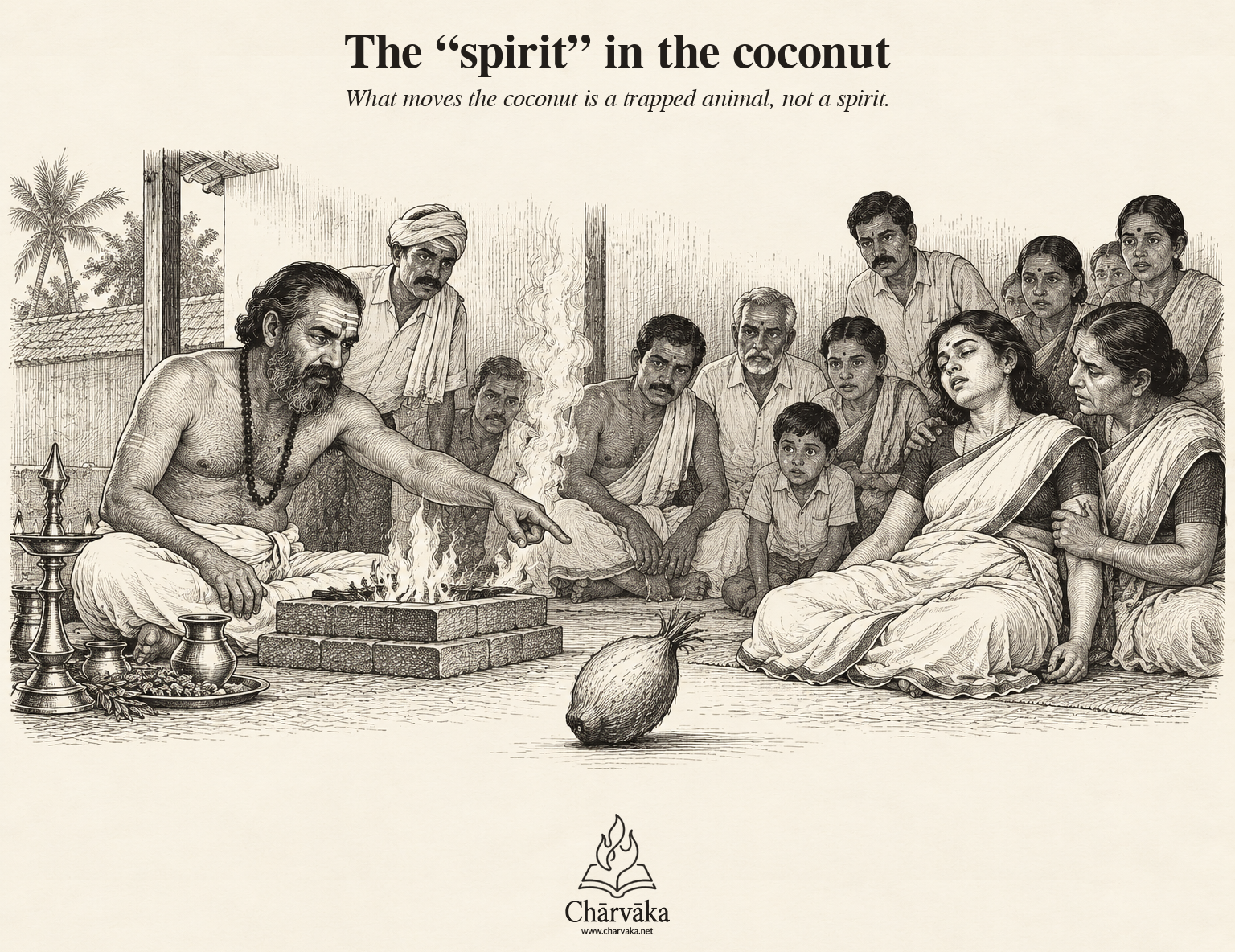
A person is said to be possessed by a spirit. The tantrik performs a havan, a ritual fire, and recites incantations. He then declares that the spirit has been taken out of the possessed person’s body and imprisoned inside a coconut. When the coconut is placed on the floor, it begins to move about, as if the spirit were struggling to get out.
The Experiment
Effect
Spirit within a coconut.
Props
A live mouse or a frog; one coconut with the fibre removed completely except at the top; and an instant glue (Premanand names the brand Quick Fix).
Method
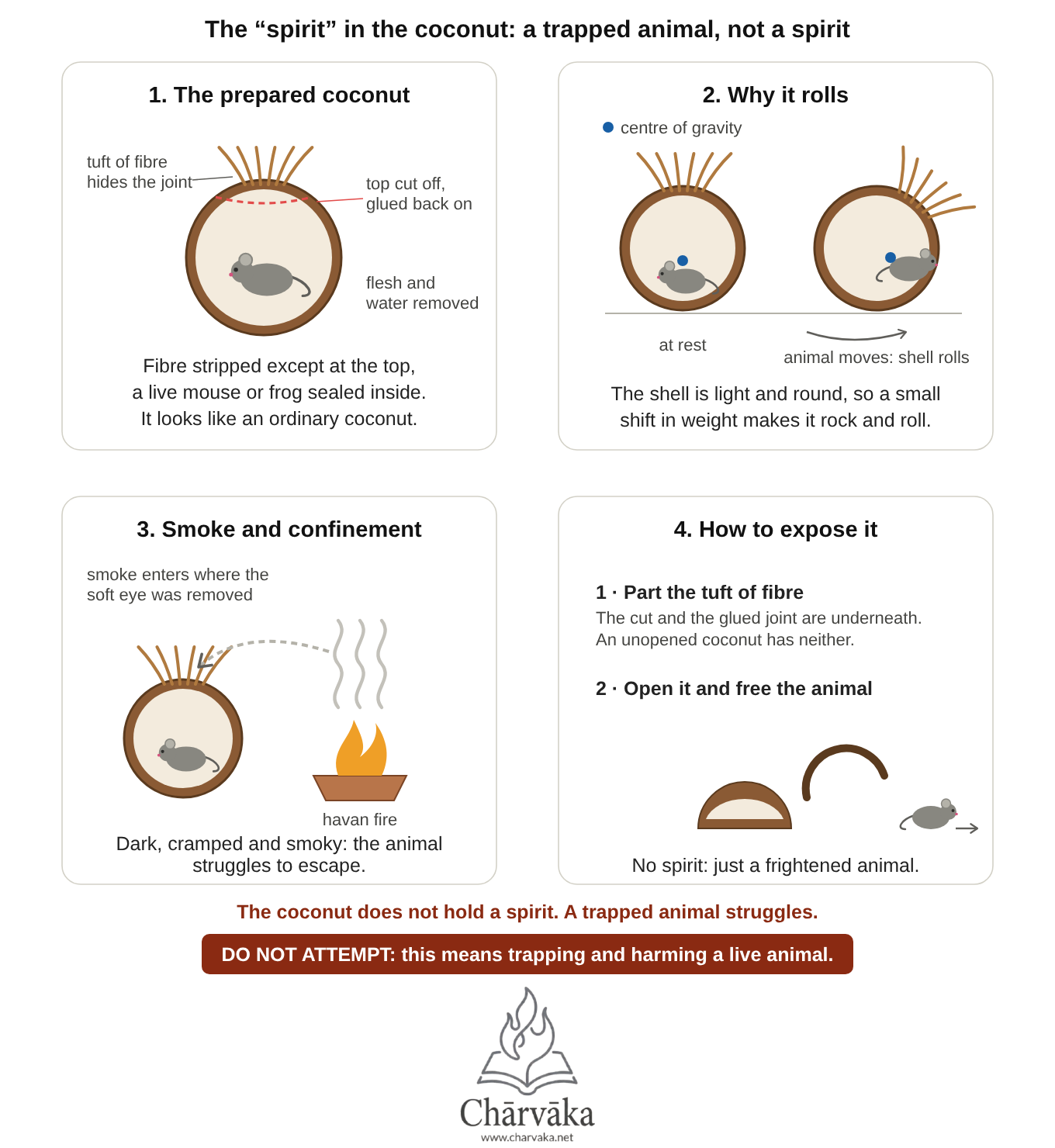
As Premanand recorded it (do not attempt): the top of the coconut is cut off, and the flesh and the soft eye are removed. The mouse or frog is put inside, and the top is glued back on. The joint is hidden by the tuft of fibre left at the top. After the havan and incantations, the tantrik acts as if the spirit has been removed from the possessed person’s body and imprisoned in the coconut, and places the coconut on the floor. The smoke from the fire makes the animal uneasy. It struggles to escape, and the coconut moves about.
The Science Behind the Illusion
1. Why the coconut moves so easily
With its fibre stripped away, a coconut is a hard, nearly round shell. With the flesh and water removed, it is also light. A round object comes to rest with its centre of gravity as low as possible. When the animal inside shifts its weight, climbs or pushes against the wall, the centre of gravity moves, and the shell rocks or rolls to a new resting position. In a light, empty shell, the weight of a small animal is enough to make it lurch and roll across the floor.
The tuft of fibre left at the top does two jobs. It hides the glued joint, and it makes the coconut look like the ordinary ones used in worship, which are often sold with a tuft at the top.
2. Why the animal struggles
The animal is shut in a small, dark space, with heat and smoke from the havan close by. A coconut has three “eyes”, but only one is functional: it stays soft, because that is where the seedling would push out (Biology Insights). Removing it leaves a small opening at the top, hidden by the fibre, through which some air, and the smoke, can reach the animal. As Premanand notes, the smoke makes it uneasy, and it struggles to escape. The cavity holds very little air, so an animal left inside for long can suffocate.
3. Why the audience sees a spirit
The coconut is placed on the floor only after it has been declared to hold the spirit, so every movement is read as the spirit trying to break out. The possessed person often becomes calm at the end of the ritual, which seems to confirm that the spirit has gone.
4. What is happening to the “possessed” person
Possession is a recognised medical condition, not a supernatural one. The World Health Organization’s International Classification of Diseases (ICD-11) describes possession trance disorder as a marked change in consciousness in which a person’s usual sense of identity is replaced by an outside, “possessing” identity, and their words and movements feel controlled by it. It counts as a disorder when the state is involuntary and unwanted, and not part of an accepted collective cultural or religious practice (Pietkiewicz and colleagues, 2022). Psychiatrists class it among the dissociative disorders, in which memory, identity and awareness, which normally work together, temporarily come apart. Possession states are common in India, where they are seen most often in young women, especially in rural areas and poorer families, and are linked with psychological stress, family conflict and earlier trauma (Chaturvedi, Desai and Shaligram, 2010; Ram and Mathew, 2025). An episode can also bring a person attention and respect that they otherwise lack, which helps explain why it may recur. Because the state is shaped by belief and expectation, it often ends when a ritual signals that the spirit has gone, and the cure seems complete. But the stress behind it remains. Psychiatrists recommend treating it with culturally sensitive psychological and medical care, not exorcism.
5. How to expose it
Part the tuft of fibre at the top of the coconut. Underneath, you will find the cut and the glued joint; a coconut that has never been opened has neither. Open the coconut along the joint and let the animal go at once.
Source & Attribution
This article is based on Science Versus Miracles by B. Premanand (1930–2009). While the core demonstration and methodology derive from Premanand’s field exposures, the analytical framework was updated in 2026 by Charvaka Desk, with the assistance of AI tools, to include scientific commentary across physics, chemistry, biology, physiology, psychology, and the mechanics of illusion. All revisions have been reviewed and fact-checked by our editors. The revision draws on the following sources:
- B. Premanand, Science Versus Miracles (Indian CSICOP, 1994)
- S. K. Chaturvedi, G. Desai and D. Shaligram, “Dissociative Disorders in a Psychiatric Institute in India: A Selected Review and Patterns Over a Decade“, International Journal of Social Psychiatry 56, no. 5 (2010): 533–539
- “Why Do Coconuts Have 3 Holes?“, Biology Insights
- “The Prevention of Cruelty to Animals Act, 1960“, full text, IIT Kanpur Animal Welfare Committee
We follow the evidence, including when it shows we were wrong. If you find an error, tell us in the discussion below, or write to us privately. We will review it and correct the article, with a note of the change.
Leave a Reply