Hemacandra and the Misunderstanding of Cārvāka Inference
Hemacandra, the Jain savant (twelfth century C.E.) also criticizes the nāstika, or heterodox view in his Anya-yoga-vyavaccheda-dvātriṁśikā (AYVD) solely on the ground that it does not admit inference as a valid instrument of cognition (verse 20). Malliṣeṇa (thirteenth century), in his Syādvādamañjarī (SVM), commentary on the AYVD, identifies this nāstika with the Cārvāka. Rightly so, for the two words are synonymous (see above). Malliṣeṇa then explains the point as follows: the Cārvākas accept only perception as the sole instrument of cognition; hence they do not accept anything else, not even inference, as a means of valid knowledge.27
We have already seen that this is a common charge brought against the Cārvākas by many of their opponents, both Vedists (Brahminical, such as Jayanta) and non-Vedists (the Jain, Hemacandra in this instance. See also KAMALAŚĪLA, II: 520, but see also II: 528, quoted below). In fact, the point that the Cārvākas accepted nothing but perception as pramāṇa is so widely — almost universally — believed by so many authorities, both ancient and modern, that it may appear to be an exercise in futility to question the veracity of this oft-repeated objection. Yet the fact is that long before Hemacandra wrote this, Purandara, a Cārvāka philosopher (fl. eighth century C.E.) whose name is connected with both the base text of the Cārvāka/Lokāyata system of philosophy as well as with a short commentary (vṛtti) on it,28 had clearly stated: “The Cārvākas, too, admit of such an inference as is well-known in the world, but that which is called inference [by some], transgressing the worldly way, is prohibited [by them]”.29
Purandara was not alone in asserting this view. Aviddhakarṇa (not later than the eighth century), another commentator on the Cārvākasūtra, also declared:
It is true that inference is admitted by us as a source of knowledge, because it is found to be so in general practice; (but what we only point out is that) the definition of an inferential mark is illogical (BHATTACHARYA 2009: comm. 3.81, 88).
And last but not least, Udbhaṭa, the last known commentator on the Cārvākasūtra, who in other respects was rather atypical in his interpretation of certain Cārvāka aphorisms (see above), states the Cārvāka position vis-à-vis inference more elaborately:
Failure of concomitance is not seen even in the case of probanses well-established in the world; so also it is not noticed in the case of the probanses established in the scripture; so, on the basis of the quality characterized by ‘non-perception of failure of concomitance’ being common to them, the probanses established in the scriptures are admitted as being gamaka. It is because of this that inference is secondary. Now the knowledge of non-failure of concomitance in respect of worldly probanses is instrumental in bringing about the knowledge of the probandum. But that is not there in the concept of probanses established by the scriptures. So it is not proper that non-perceptible things should be known with the help of these. Hence it is said that the ascertainment of things is difficult to attain by dint of inference (BHATTACHARYA 2009: comm. 12.81–82, 88).
The position of the Cārvākas is perfectly clear. They do not admit inference as an independent instrument of cognition on a par with perception, but at the same time they do admit the limited validity of inference insofar as it is confined to the material world, which is perceivable and verifiable by sense experience. It is in this sense that Udbhaṭa in response to some opponent makes a distinction between “incapable reasons” and “capable reasons” (BHATTACHARYA 2009: comm. 14.82, 89). Jayanta certainly knew all this. Hence, he makes “better educated ones” declare this in clear terms (as quoted above).
Given the incredible mobility of mss from Kashmir to Kerala and the custom of getting such mss speedily copied in various local scripts from Śāradā to Nāgarī to Malayalam, it is inconceivable that Hemacandra (respectfully called the “omniscient one of the Kali era,” kalikālasarvajña by the Jains) did not know any of them. Ratnaprabhā (fourteenth century), another Jain scholar, echoes the view of the three Cārvākasūtra commentators mentioned above:
The Cārvākas, however, contend that they admit inferences which are of practical utility, such as the inference of fire from smoke, and deny only those which deal with such supernatural matters as the heaven, the unseen power (apūrva) which generates in a next birth fruits of acts done in a present life, etc. etc. (VĀDIDEVASŪRI 1967: 540).
Guṇaratna (fifteenth century), yet another Jain commentator, also repeats all this30 as do both anonymous author of the Avacūrṇi to the SDSam (1969: 508) and another digest-writer of a small, anonymous and undated work called the Sarvamatasaṁgraha (BHATTACHARYA 2009: 58).
Hemacandra and Malliṣeṇa do not shift their position from the base text to the commentary (as Jayanta does) in their criticism of the Cārvākas. They err in completely ignoring the commentaries and thereby, like many others before and after them, misrepresent the Cārvāka view of inference. In fact, as has been shown time again by other scholars before, partial acceptance of inference distinguished the Cārvākas (among other things) from the earlier materialists, some of whom might have held one-pramāṇa position as alleged by their opponents.31 Very much like Jayanta, he too conveniently avoids mentioning the view of the “better educated Cārvākas” in this regard.
One last word. Why did Jayanta and Hemacandra, two stalwarts in the field of Indian philosophy, make such injudicious choices between the base text and the commentary? It will be insulting them to say that they did not know or understand the actual position of the Cārvākas in regard to inference. Yet to say that these savants deliberately distorted their opponent’s view will be equally ungenerous. Then why?
The only explanation I may venture to offer is that their desire to trounce their opponent blurred their vision and made them recourse to the shortest and easiest way. By damning the Cārvākas as ‘wretched’ (varāka) and undeserving of any serious discussion (NM I: 299),32 both chose to portray them as simpletons, which they were not. Jigīṣā (desire to conquer) is the greatest enemy of objectivity, as a learned friend of mine is fond of saying.
Notes & References
- 27 For a detailed study of SVM, chapter 20, see BHATTACHARYA 2009: 167–168.
- 28 See BHATTACHARYA 2009: 67.
- 29 As quoted by KAMALAŚĪLA in TSP II: 528 (on TS, Ch. 18, verse 1481, comm. 18 [in:] BHATTACHARYA 2009: 82, 90).
- 30 TRD, on SDSam verse 83, 306.13–15; C/L, 273.
- 31 Whether all pre-Cārvāka materialists too held such a one-pramāṇa position is open to further enquiry. A passage in the MBH mentions three pramāṇa-s, namely, perception confirmed in the world (lokataḥ siddhaṁ pratyakṣam), doctrines having the Veda to support them, and the practice of eminent persons, śiṣṭa-s (13.147.9). Dandekar has noticed that inference is absent in the list but suggests that presumably inference is understood to have been included in perception (critical edition, Anuśāsanaparvan, notes, 1119). This would suggest that inference was required to be confined to this world only and not to be derived from the Veda, etc. to prove the existence of supernatural objects. Cf. Nyāyasūtra 1.5: tat (sc. pratyakṣa) pūrvakam. See also MBH 12.211.26–27 where reasoned-out truth (kṛtānta) is called nothing but perception. See BHATTACHARYA 2010a: 426.
- 32 Cf. HEMACANDRA 1926 (Yogaśāstra 2.38, f. 96b). Śīlāṅka (19) also uses this insulting word to denigrate nāstika-s who speak of five elements (on SKS 1.1.1.21).
Bibliography
- AYVD — Hemacandra. Anya-yoga-vyavaccheda-dvātriṁśikā with Malliṣeṇa. Ānandaśaṅkara Bāpubhāī DHRUVA (ed.) (1933): Syādvādamañjarī. Poona: Bhandarkar Oriental Research Institute. See also THOMAS 1968.
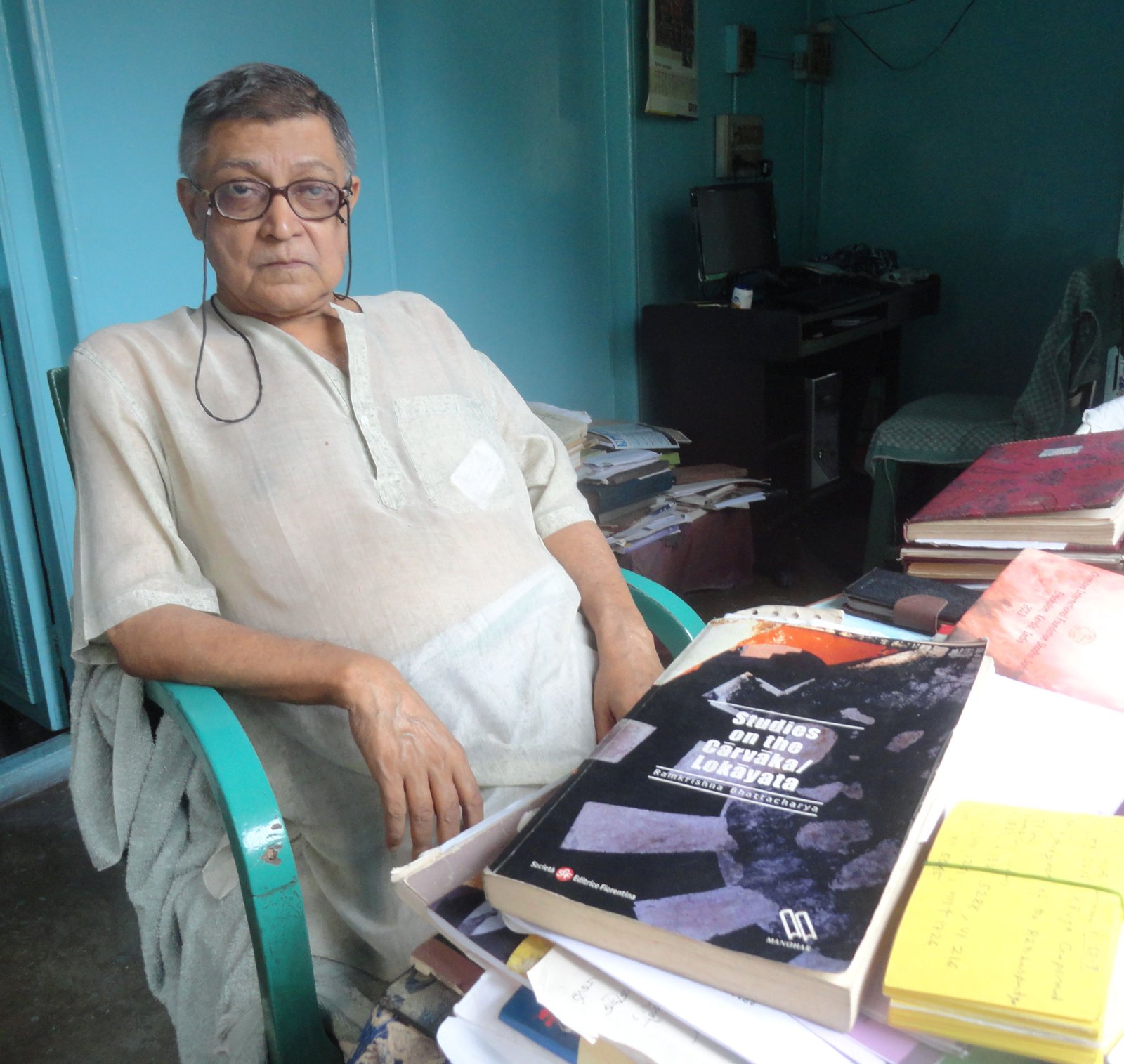
- BHATTACHARYA, Ramakrishna (2009): Studies on the Cārvāka/Lokāyata. Firenze: Società Editrice Fiorentina (also published in 2011, London: Anthem Press).
- BHATTACHARYA, Ramakrishna (2010a): Commentators on the Cārvākasūtra: A Critical Survey. Journal of Indian Philosophy 38, 4, 419–430.
- C/L — CHATTOPADHYAYA, Debiprasad, GANGOPADHYAYA, Mrinal Kanti (1990): Cārvāka/Lokāyata. New Delhi: Indian Council of Philosophical Research.
- HEMACANDRA (1926): Yogaśāstram. Bhavanagara: Srijainadharma Pracharasabha.
- KAMALAŚĪLA. See TS.
- MALLIṢEṆA (2005): Syādvādamañjarī with Anya-yoga-vyavaccheda-dvātriṁśikā of Hemacandra. Ānandaśaṅkara Bāpubhāī DHRUVA, Push Raj JAIN (eds). Delhi: Akshaya Prakashan (reimp.). See also THOMAS 1968.
- MBH — The Mahābhārata (1933–1966): Vishnu S. SUKTANKAR et al. (eds). Poona: Bhandarkar Oriental Research Institute.
- NM — JAYANTABHAṬṬA (1982–1984): Nyāyamañjarī. Gaurinatha SASTRI (ed.). Varanasi: Sampūrṇānanda Saṁskṛta Viśvavidyālaya (three vols).
- SKS — Sūtrakṛtāṅgasūtra: Prathama śrutaskandha. Series “Jināgama granthamālā”, Bewar: Sri Agama Prakashan Samiti, 1982.
- THOMAS, Frederick William (1968): The Flower-spray of the Quodammodo Doctrine. Trans. of Hemacandra AYVD and Malliṣeṇa SVM. Delhi: Motilal Banarsidass.
- TRD — GUṆARATNA (1916): Tarkarahasyadīpikā with HARIBHADRA’s Ṣaḍdarśanasamuccaya. Luigi SUALI (ed.). Calcutta: The Asiatic Society.
- TS — ŚĀNTARAKṢITA (1981): Tattvasaṁgraha (with Pañjikā by Kamalaśīla). Dwarikadas SASTRI (ed.). Varanasi: Bauddha Bharati (first edition 1968).
- TSP — See TS.
- VĀDIDEVASŪRI (1988): Syādvādaratnākara. Delhi: Bharatiya Book Corporation.
Leave a Reply